หน้าแรก
» ANDROID
»
Galaxy S27 Ultra Charging Speeds: What Would It Take for Samsung to Catch Up?
Galaxy S27 Ultra Charging Speeds: What Would It Take for Samsung to Catch Up?
Short answer: Samsung is much closer to the front of the flagship charging pack than it was a year ago, but the Galaxy S27 Ultra would need more than a bigger wattage number to prove it has fully caught up. As of September 14, 2026, Samsung has not announced Galaxy S27 Ultra charging specifications. The latest official Ultra baseline is the Galaxy S26 Ultra: up to 60W wired charging, up to 75% in around 30 minutes, and up to 25W wireless charging.
That is a meaningful jump from the Galaxy S25 Ultra, which Samsung rated for up to 65% in around 30 minutes using a 45W adapter. But “catching up” should be judged by the result you get at the outlet: useful battery recovered in a short stop, charging consistency when the phone is warm, wireless convenience, and how easily third-party USB-C chargers can deliver the advertised speed.
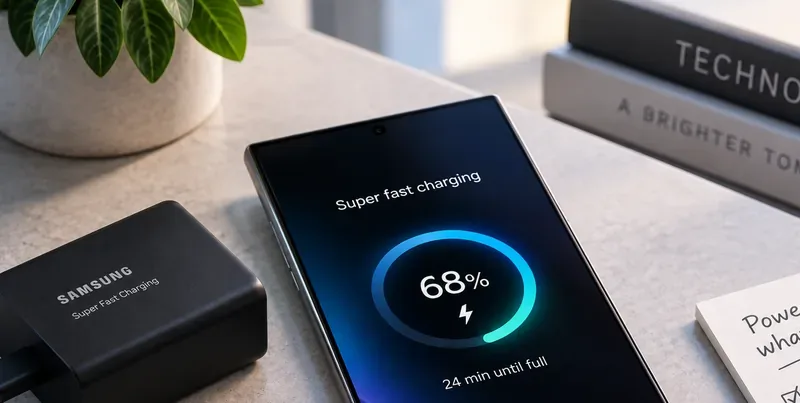
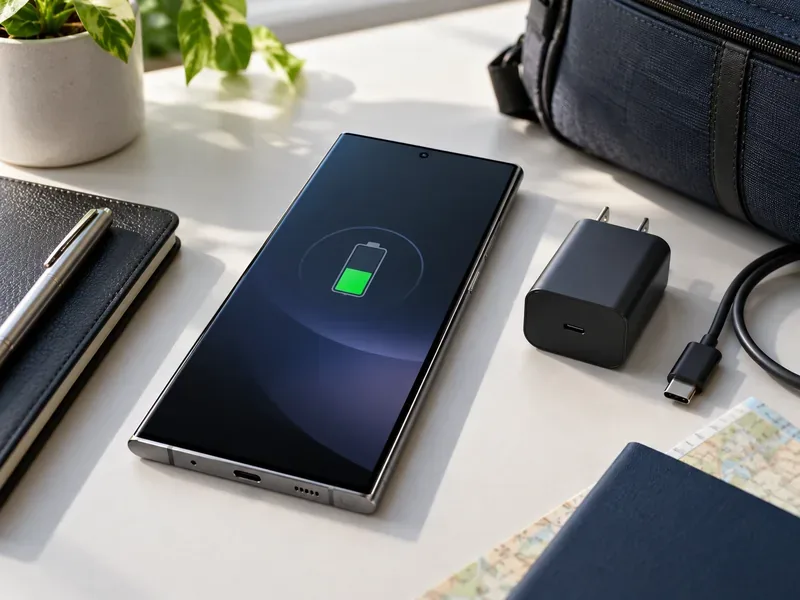
A premium phone charging over USB-C illustrates the real question behind higher wattage: how quickly a useful amount of battery returns during a short charging session. The device shown is not presented as Galaxy S27 Ultra hardware.
The result to look for: a useful top-up, not the biggest wattage
If Samsung announces the Galaxy S27 Ultra with 60W, 65W, 80W, or another headline number, the first question should be: how much charge does the phone actually gain in 20 or 30 minutes? Peak wattage is only one part of the charging curve. Phones usually accept their highest power when the battery is relatively low, then reduce power as the battery fills or temperature rises.
A good outcome for a premium phone is simple: a short coffee break or airport stop should add enough energy to remove battery anxiety for several hours. Samsung already claims the Galaxy S26 Ultra can reach up to 75% in around 30 minutes from empty with the required 60W charger. That is the number any S27 Ultra charging upgrade should clearly beat or achieve under easier, more broadly compatible conditions.
Sign that Samsung has genuinely improved: the company publishes a noticeably better 30-minute percentage, a shorter time to a practical threshold such as 80%, or maintains similar speed with a larger battery.
Sign that the upgrade is mostly marketing: the maximum wattage rises but Samsung’s own 30-minute charge figure barely changes.
Samsung already made its biggest recent charging move with the S26 Ultra
The Galaxy S26 Ultra marked Samsung’s first major Ultra charging increase in several generations. Samsung’s official U.S. product page lists Super Fast Charging 3.0 up to 60W and says the phone can reach up to 75% in around 30 minutes. It also supports Super Fast Wireless Charging up to 25W. Samsung notes that the 60W adapter is sold separately and that actual speed depends on battery level and other conditions. See the official Galaxy S26 Ultra product page and Samsung’s Galaxy S26 launch specifications.
For context, Samsung listed the Galaxy S25 Ultra at up to 65% in around 30 minutes with a 45W adapter. Its battery capacity was the same 5,000mAh typical capacity Samsung lists for the S26 Ultra. That makes the S26 improvement easier to interpret: Samsung increased both the peak input and the amount of charge recovered in the same published 30-minute window. The official Galaxy S25 series announcement provides the earlier figure.
Samsung Ultra generation
Official wired charging claim
Official wireless figure
What changed
Galaxy S25 Ultra
45W adapter; up to 65% in around 30 minutes
Fast Wireless Charging 2.0
Long-standing 45W wired ceiling
Galaxy S26 Ultra
Up to 60W; up to 75% in around 30 minutes
Up to 25W
Higher peak power and a better 30-minute result
Galaxy S27 Ultra
Not announced
Not announced
Any exact figure today is unconfirmed
Is 60W already enough to “catch up”?
It depends on which competitor you mean. Against mainstream U.S. flagships that emphasize battery management and standard USB-C charging rather than extreme wattage, Samsung is now competitive. Against Android flagships built around aggressive fast charging, it still trails on paper.
Google rates the Pixel 10 Pro XL for up to 70% in about 30 minutes with a 45W USB-C PPS charger or higher, plus Qi2 wireless charging up to 25W. Samsung’s S26 Ultra claim of 75% in around 30 minutes is therefore in the same practical range and slightly higher by the manufacturers’ own published percentages, though the phones have different battery capacities and test conditions. Check Google’s official Pixel 10 Pro specifications.
Apple takes another approach. Apple says the iPhone 17 Pro and 17 Pro Max can reach up to 50% in 20 minutes with a 40W-or-higher adapter. That result cannot be converted directly into a Samsung-equivalent wattage because Apple does not present charging the same way and battery sizes differ, but it shows why time-to-percentage matters more than peak watts. See the official iPhone 17 Pro specifications.