Home
» INTERNET
»
How Often Should I Clean My Retainer? A Practical Care Schedule
How Often Should I Clean My Retainer? A Practical Care Schedule
For most removable retainers, the practical baseline is simple: rinse the retainer whenever you take it out, clean it thoroughly at least once a day, and use a retainer-safe deep-cleaning method about once a week if your orthodontist or the product instructions allow it. The American Association of Orthodontists (AAO) currently recommends daily attention and describes weekly soaking as a useful way to limit buildup. Fixed retainers need daily brushing plus careful cleaning around and under the wire rather than a removable-appliance soak.
The goal is not to make a retainer look “brand new” at any cost. A good result is a retainer that is free of visible debris and slippery film, does not develop a persistent odor, still feels smooth enough to wear comfortably, and—most importantly—still fits exactly as prescribed. Cleaning that scratches, warps, cracks, or changes the fit is not a successful cleaning method.
Rinse promptly with cool or lukewarm water before saliva and plaque dry on the surface.
No loose food particles or fresh film left to dry in place.
At least once daily
Gently clean all surfaces with a dedicated soft toothbrush and a retainer-safe cleanser, such as mild liquid dish soap when permitted.
The surface feels clean rather than slick, with no obvious residue in grooves.
About once weekly
Use a retainer-cleaning tablet or solution according to its label and your orthodontist's advice.
Less persistent odor and buildup without whitening, roughening, distortion, or damage.
Any time problems persist
Stop escalating home treatments and ask your orthodontist if odor, deposits, staining, cracks, or fit problems remain.
The appliance remains structurally intact and continues to fit correctly.
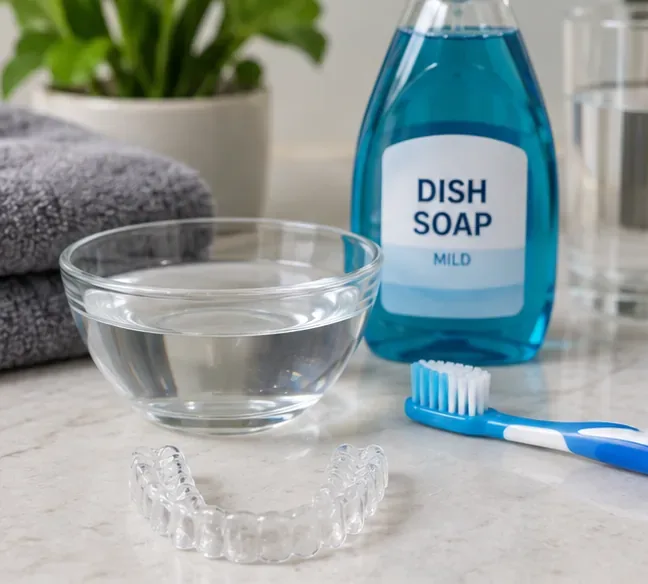
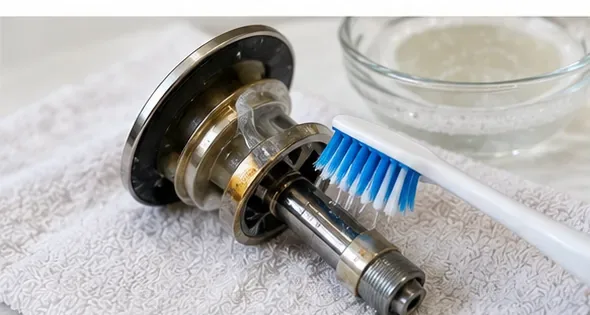
A simple daily setup for a removable retainer: a dedicated soft toothbrush, water, and a mild cleanser that your retainer instructions allow.
The AAO's 2025 cleaning guide goes a step further and says retainers should ideally receive attention whenever they come out of the mouth. Its general retainer page describes daily gentle brushing and suggests a retainer-cleaning soak at least weekly. Those statements are compatible in practice: quick rinsing is useful after each removal, while one careful cleaning each day is the minimum routine to build around.
What should you do every time the retainer comes out?
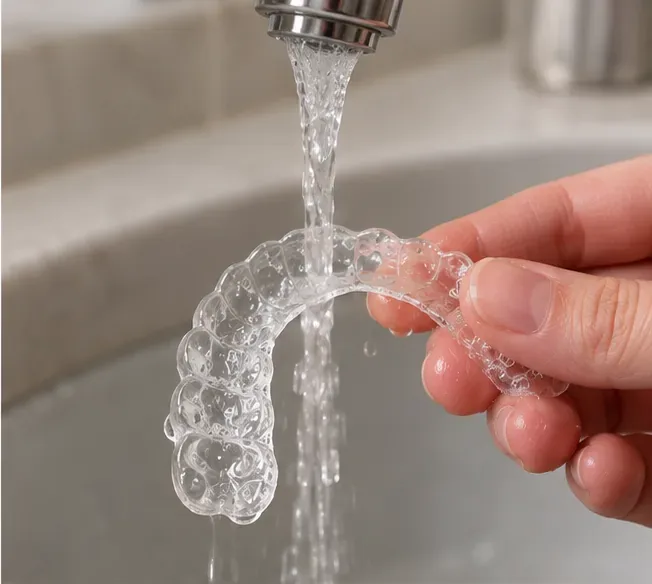
Rinse it before saliva, plaque, and food residue dry onto the appliance. Use cool or lukewarm water—not hot water. This is a small step, but it makes the later daily cleaning easier because dried deposits are harder to remove.
Rinse a removable retainer promptly after taking it out so fresh debris does not dry onto the plastic.
Common misunderstanding: “If I rinse it, I have cleaned it.”
A rinse can remove loose debris, but it is not the same as physically cleaning the surfaces. AAO guidance still calls for daily brushing because plaque can cling to the appliance. Action: treat rinsing as the quick maintenance step and daily brushing as the actual cleaning step.
What should a daily cleaning look like?
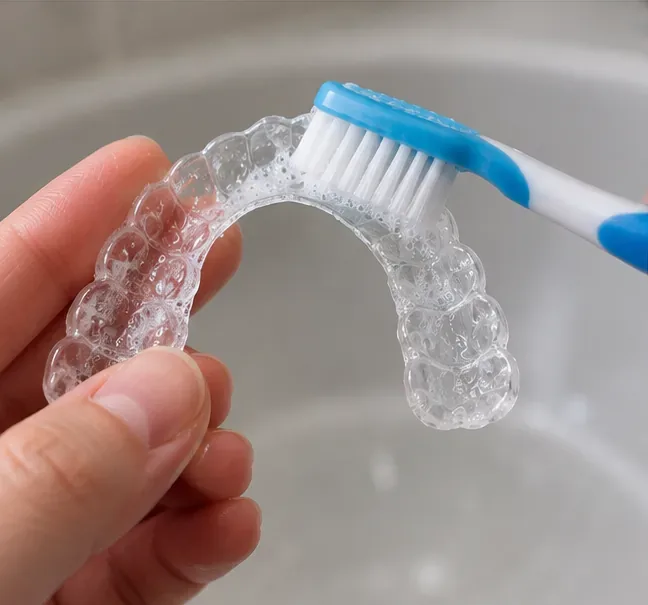
Use a separate soft-bristled toothbrush so you are not transferring toothpaste or gritty residue from your regular toothbrush. Gently clean the inside and outside surfaces, including grooves where plaque can collect. The latest AAO cleaning guide recommends mild dish soap for daily cleaning, while some hospital instructions similarly recommend liquid soap and water.
Use light pressure. You are trying to lift film, not polish the appliance. A clear plastic retainer can be scratched by abrasive products, and scratches can make it look cloudier and may make deposits harder to remove.
Daily cleaning should be gentle: cover the full surface with a soft brush rather than scrubbing aggressively.
Common misunderstanding: “Toothpaste is automatically the safest cleaner.”
That depends on the retainer and the toothpaste. AAO guidance warns that many toothpastes contain abrasive ingredients that can scratch retainer material. However, manufacturer instructions can differ; for example, Invisalign's current Vivera retainer guidance allows a regular or denture toothbrush with non-abrasive toothpaste. Action: do not assume that the product you use on your teeth is automatically appropriate for your appliance. Follow the instructions for your specific retainer; if they are unclear, mild soap and water are the more conservative cross-brand choice.
Do you need a weekly deep clean?
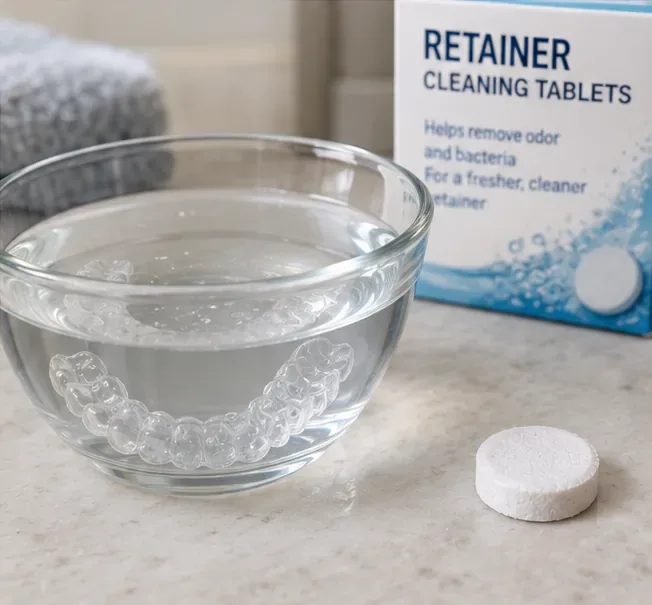
For many removable retainers, a weekly soak in a retainer-cleaning product is a reasonable supplement to daily brushing. The AAO specifically describes weekly retainer-cleaning tablets or solutions as a way to address bacteria and debris. Follow the product's contact time instead of leaving the retainer soaking indefinitely.
A periodic retainer-cleaning soak can supplement daily brushing when the product is compatible with your appliance.
Deep cleaning is not a substitute for daily care. If you wait a week between cleanings, plaque and minerals can build up enough that a tablet has to work against deposits that could have been prevented. Action: use the weekly soak as maintenance, not as a rescue routine.
How do you know your retainer is actually clean enough?
Judge the result by several signs rather than by transparency alone. A clear retainer can become somewhat cloudy from age, surface wear, or mineral deposits even when it has just been cleaned. Conversely, a retainer can look clear but still have an odor or a thin film.
Surface: it should not feel slimy or greasy after rinsing.
Debris: there should be no visible food particles or soft plaque trapped in grooves.
Odor: a strong smell that returns immediately after cleaning suggests the routine is not removing the source.
Comfort: the retainer should not feel rough because of hardened deposits or damaged edges.
Fit: it should seat the same way it did before cleaning. Cleaning should never change its shape.
If those quality checks are met, more aggressive cleaning is usually unnecessary. “Cleaner” is not better if the extra treatment damages the material.
When should you change your cleaning method?
If odor or film returns quickly
Make sure you are cleaning daily rather than relying only on rinsing. Add the manufacturer-approved weekly soak if you have not been using one. Also clean and dry the storage case regularly so a freshly cleaned retainer is not going straight back into a dirty container.
If you see hard white or yellow deposits
Hardened buildup may not respond to ordinary brushing. Scraping with sharp tools can gouge the retainer. Action: ask your orthodontist whether the appliance should be professionally cleaned or replaced rather than escalating to stronger household chemicals.
If the retainer develops cracks, rough edges, warping, or a changed fit
Stop treating this as a cleaning problem. The AAO advises contacting an orthodontist when a retainer is cracked, warped, broken, or no longer fitting correctly. A retainer's main job is positional control; a spotless appliance that no longer fits is not doing that job safely.
What should you avoid?
Hot or boiling water: heat can warp plastic retainers. Use cool or lukewarm water instead.
Bleach, alcohol-based mouthwash, and harsh chemicals: the AAO warns that these can damage retainer materials or leave irritating residues. A home cleaning routine should not depend on disinfectants intended for countertops or laundry.
Abrasive scrubbing: whitening or gritty toothpastes and aggressive brushing can scratch plastic. If your manufacturer explicitly allows a non-abrasive toothpaste, follow that instruction; otherwise, use a gentler option.
Dishwashers and uncontrolled heat: a dishwasher may expose a removable retainer to temperatures high enough to deform it. Hand-cleaning gives you much better control.
What about a fixed or permanent retainer?
A fixed retainer is bonded behind the teeth, so the “rinse daily, soak weekly” schedule does not apply. Instead, clean it as part of your oral hygiene every day. Brush carefully around the wire and use floss threaders, interdental brushes, or another method recommended by your dentist or orthodontist to clean between the teeth and under the wire.
The quality target is healthy gum tissue and a wire area that is free of trapped plaque and food. Bleeding, swelling, persistent bad breath, visible tartar around the wire, or a loose/broken bond are reasons to arrange professional dental or orthodontic care rather than trying stronger home cleaners.
When is home cleaning no longer enough?
Home cleaning cannot repair a cracked appliance, reverse heat warping, restore a worn fit, or reliably remove every hardened deposit. Persistent odor or discoloration despite a sound routine may also indicate aging material or microscopic surface damage. The AAO recommends professional evaluation for ongoing odor, discoloration, damage, irritation, or fit changes.
There is no universal replacement interval that applies to every retainer. Clear retainers, Hawley retainers, and fixed wires age differently, and wear varies with grinding, handling, cleaning products, and how many hours the appliance is worn. Action: use condition and fit—not an arbitrary calendar date—as the reason to ask whether replacement is needed.
A simple schedule you can actually maintain
For a typical removable retainer, the routine can be summarized this way: rinse it each time it comes out, brush it gently every day, deep-clean it about weekly when your product instructions permit, and check the appliance regularly for odor, deposits, cracks, roughness, and fit changes. That schedule is frequent enough to prevent most avoidable buildup without pushing you toward harsh cleaning methods that may shorten the appliance's useful life.
If your orthodontist gave you instructions that differ from this general schedule, follow those instructions. Retainer material, design, and treatment plan matter, and the best cleaning routine is the one that keeps the appliance hygienic without changing how it fits your teeth.