Home
» INTERNET
»
Medicare Open Enrollment 2026: How to Check Your 2027 Drug List and Costs
Medicare Open Enrollment 2026: How to Check Your 2027 Drug List and Costs
Medicare’s 2027 handbook says people can start comparing next year’s Medicare health and drug plans on October 1, 2026. The annual Open Enrollment Period runs October 15 through December 7. It is the window to join, switch, or drop Medicare Advantage or Part D coverage for 2027; changes made in that window generally take effect January 1, 2027, if the plan receives the request by December 7. If you look before October 1 and only see 2026 options, return to the comparison tool on or after that date. The comparison date appears in the 2027 Medicare & You handbook; see Medicare’s Open Enrollment page for the enrollment rules.
Fictional example for illustration only: Ruth has Original Medicare and a separate Part D drug plan. She takes three ongoing prescriptions and usually fills them at one neighborhood pharmacy. She is not a real beneficiary, and this example is not a test of Medicare’s website. It shows how to make a comparison personal: check each exact drug, the pharmacy, and the full-year costs instead of relying on a plan’s headline premium.
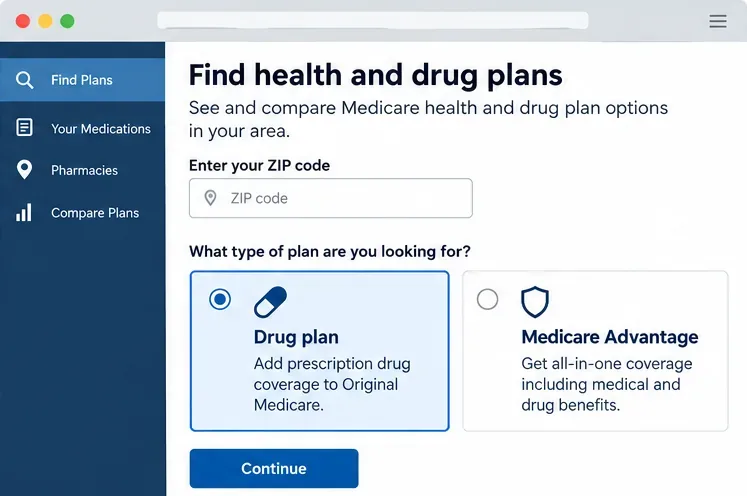
Start at Medicare Plan Finder. Medicare says the tool can estimate monthly and yearly plan costs after you enter your prescriptions. The four screen illustrations below are schematic guides to that workflow, not authentic Medicare.gov screenshots; the site’s actual layout may differ.
Schematic screen: enter your ZIP code and choose the coverage type that matches your situation before comparing 2027 options.
Before you compare: make a usable medication list
Ruth first gathers the current prescription labels or a medication list from her pharmacy. For every medicine, she writes down the exact name (including brand or generic if specified), strength, dosage form, and how often she takes it. She also notes the usual quantity per fill, such as a 30-day or 90-day supply, and whether she expects the prescription to continue in 2027. Those details matter because a plan’s coverage and price can depend on the specific product, strength, quantity, and pharmacy.
If a label is unclear, Ruth asks her pharmacist or prescriber to confirm it rather than guessing. She does not enter over-the-counter products as though they were Part D prescriptions, and she does not change a dose or stop a medicine to make a plan look cheaper. Medicare drug coverage generally applies to eligible outpatient prescriptions; some drugs are covered under Part B in particular circumstances. When the coverage part is unclear, ask the prescriber or plan.
How to check the 2027 drug list and costs
1. Open the 2027 comparison and select your coverage route
On or after October 1, enter the ZIP code where you live so the tool can show plans available in your area. Ruth selects a stand-alone drug plan because she has Original Medicare. Someone comparing Medicare Advantage should compare the full health plan and its drug coverage together; a drug-only premium does not show the whole medical-plan picture. If you have employer, union, retiree, VA, or other drug coverage, check with that benefits administrator before making a change.
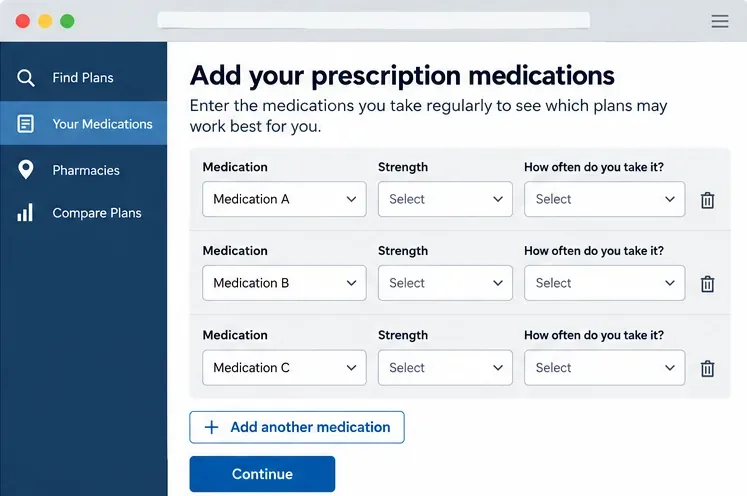
Schematic screen: add each current prescription and confirm its strength and frequency; the medication names shown are placeholders.
2. Add every prescription accurately
Ruth adds each medicine one at a time and confirms the strength and frequency. If the search shows several forms or strengths with similar names, she chooses the one that matches the label and confirms the selection before continuing. She includes medicines she expects to use next year, not only those refilled this week. Missing a drug can make the comparison estimate misleading.
A plan’s covered-drug list is called its formulary, and each plan has its own, as described in Medicare’s Part D formulary guidance. A drug appearing on the list does not settle every coverage question: the plan may place it on a cost-sharing tier or apply prior authorization, step therapy, or quantity limits. Review the plan’s drug details and its official 2027 documents for each prescription. If a medication is not listed or a rule appears difficult, ask the plan and prescriber about the coverage rule or an exception before treating the plan as workable. Medicare lists these requirements in its drug plan rules.
3. Add the pharmacy you actually use
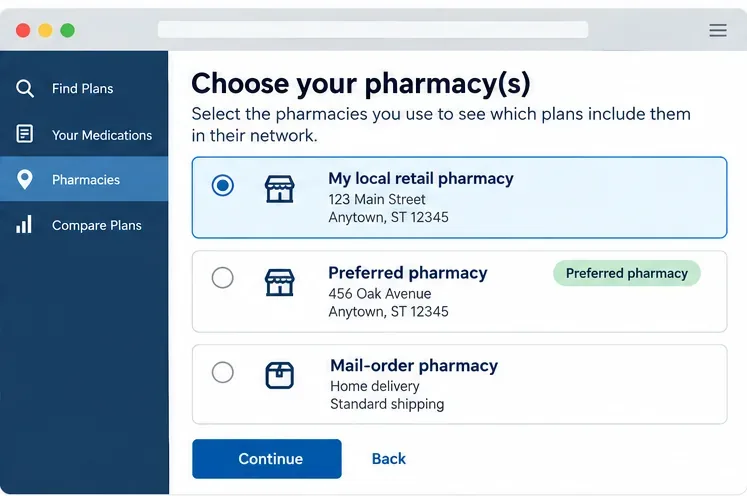
Ruth selects her regular pharmacy and, if relevant, a second pharmacy she could realistically use. She may compare a nearby retail location with mail order, but she should verify that the selected location is in the plan’s network. A preferred in-network pharmacy can have lower cost sharing than a standard network pharmacy; “preferred” is plan-specific, so a pharmacy that is preferred in one plan may not be preferred in another. Check Medicare’s pharmacy guidance and each plan’s network details.
Schematic screen: include the pharmacy you actually use, then compare it with other in-network or mail-order options.
4. Compare covered status and estimated yearly cost
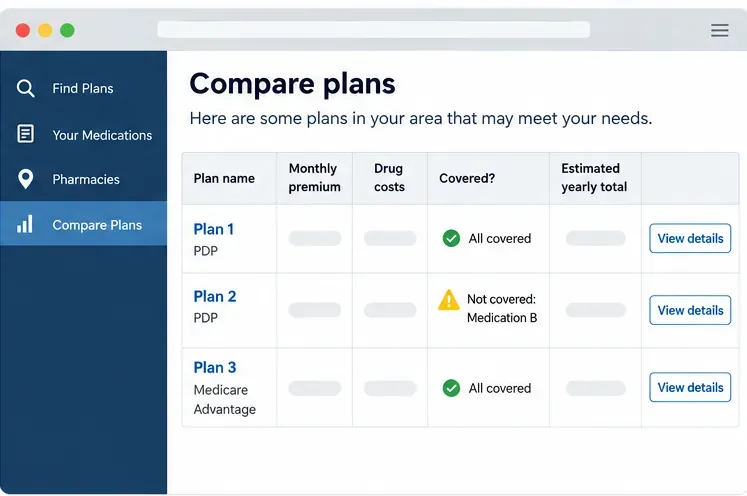
Ruth reviews the plan results drug by drug. She checks whether every prescription is covered, each listed tier or restriction, the cost at her selected pharmacy, the monthly premium, any deductible, and the estimated total for the year. Medicare’s Plan Finder can estimate monthly and yearly costs based on the drugs and pharmacies entered, but an estimate is not a promise of the exact amount she will pay. Prices can depend on when a deductible is met, coverage rules, pharmacy choice, and actual fills.
In 2027, a Medicare drug plan may set its own deductible, but it cannot exceed $700; some plans have no deductible. For covered Part D drugs, Medicare’s 2027 out-of-pocket threshold is $2,400, after which catastrophic coverage applies for the rest of the year. These limits do not mean that every prescription is covered or that every person’s total annual spending is capped at $2,400: monthly plan premiums are separate, and the cap applies to covered Part D drug out-of-pocket costs. Compare plan-specific estimates rather than using the national limits as a price quote. Medicare lists the 2027 deductible maximum and Part D out-of-pocket threshold on its drug coverage cost page.
Schematic screen: compare drug coverage and estimated yearly cost across plans; no amounts or plan results are represented.
Which costs belong in the comparison?
Item to check
Why it matters
Ruth’s practical check
Monthly premium
Paid for coverage whether or not she fills a covered prescription; a low premium alone does not prove the plan is cheapest overall.
Add the annual premium to her comparison notes.
Deductible
She may pay covered-drug costs up to the plan deductible before the plan begins paying under its benefit.
Check the 2027 deductible and whether it applies to all or only some tiers.
Drug cost sharing
Copayments or coinsurance can vary by drug tier and pharmacy.
Compare each of her three drugs at her selected pharmacy.
Coverage rules
Prior authorization, step therapy, or quantity limits can affect access and timing.
Read the rule and ask the plan or prescriber what it means for her prescription.
Pharmacy network
Preferred, standard, out-of-network, and mail-order prices may differ.
Confirm the exact location and compare only pharmacies she can use.
A useful shortlist is a plan that covers all medicines she expects to take, has acceptable rules for them, includes a convenient pharmacy, and has a reasonable estimated annual cost—not simply the lowest monthly premium. If two plans are close, compare their official Evidence of Coverage documents and call both plans with the exact drug, strength, quantity, and pharmacy to confirm details.
Check the notices from your current plan
Ruth also reads her plan’s Annual Notice of Change (ANOC) and Evidence of Coverage. Medicare says plans send the ANOC each fall, usually in September; it describes changes to coverage and costs that take effect in January. The Evidence of Coverage explains the plan’s benefits and member costs. If either document has not arrived, contact the current plan. Compare its 2027 changes with the new Plan Finder results rather than assuming the 2026 drug list or price will continue. Medicare explains what the Annual Notice of Change contains and what to do if it is missing.
Common assumptions worth checking
“My medicine was covered this year, so it will be covered next year.” Formularies and plan terms can change. Action: check the 2027 list and notice for every drug before December 7.
“The lowest premium is the lowest-cost choice.” Premium is only one part of drug spending; deductible, drug cost sharing, and pharmacy can alter the annual estimate. Action: compare the total estimate using your complete list and actual pharmacy.
“If the tool says a drug is covered, I can fill it without restrictions.” Coverage can still involve prior authorization, step therapy, or quantity limits. Action: open the plan’s drug details and confirm any requirement with the plan before enrollment.
“Open Enrollment means I have to switch.” Medicare describes it as an opportunity to make a change. If you review the options and your current coverage still works for you, you can keep it; check the ANOC so you know what will change.
Use the final week to confirm, not rush
Ruth saves her shortlist and calls the plan with any uncovered drug, restriction, or surprising price. She can also get free, personalized counseling through her State Health Insurance Assistance Program (SHIP), which Medicare identifies as a source of health insurance counseling, or call 1-800-MEDICARE at 1-800-633-4227. After choosing, she submits the enrollment request by December 7 and saves the confirmation. She keeps taking medicines as prescribed unless her clinician advises otherwise.
One optional budgeting feature is the Medicare Prescription Payment Plan, which spreads covered Part D out-of-pocket costs across the calendar year. It can help manage cash flow but does not reduce the total drug cost. Ruth treats it as a payment option, not a reason to skip the plan and formulary comparison.
The practical rule: use the 2027 Medicare Plan Finder with your exact prescriptions and pharmacies, then confirm the formulary, restrictions, and costs in the plan’s official documents. The comparison can narrow the choices, but a plan’s own written terms and confirmation are the final check for your specific situation.