Home
» INTERNET
»
How to Clean a Baseball Glove Safely Without Ruining the Leather
How to Clean a Baseball Glove Safely Without Ruining the Leather
A baseball glove should not be treated like a washable fabric item. The safest cleaning method depends on the glove’s material and manufacturer, and that distinction matters more than any one “hack.” Current manufacturer guidance checked in September 2026 shows that Rawlings and Wilson do not give identical instructions for every glove: Rawlings tells owners of fielding gloves to use a dry cloth or soft sponge and/or its Glovolium treatment products, while Wilson says a damp cloth or rag can be used on its leather gloves and that the glove should then dry naturally.
The practical takeaway is simple: start with the least aggressive method that matches your glove. Remove loose dirt, use only the amount of moisture your manufacturer allows, condition leather sparingly if appropriate, and let the glove dry naturally. If you do not know the glove’s material or care instructions, do not guess with solvents, household degreasers, or heavy oil.
What Is Actually Verified, and What Depends on the Glove?
Question
Evidence status
Best action
Can every baseball glove be wiped with water?
Condition-dependent. Wilson recommends a damp rag for its leather gloves and water-only wiping for SuperSkin, while Rawlings lists a dry cloth or soft sponge for fielding gloves.
Check the maker and material before adding water.
Does every glove need conditioner?
No. Wilson specifically says SuperSkin does not require Mink Oil Glove Paste or Pro Stock Glove Conditioner.
Condition leather only when the manufacturer allows it and the leather is actually dry.
Is more conditioner better?
No. Wilson explicitly says not to overdo conditioner and recommends applying it to dry areas.
Use a thin amount, not a heavy coating.
Are solvents a good shortcut for stubborn grime?
No for Rawlings fielding gloves. Rawlings says not to use solvents or ammonia-based cleaners.
A very soft brush only if your glove maker permits it and you are using it gently on loose surface dirt
Clean water if your manufacturer allows damp wiping
A baseball-glove conditioner made for your glove’s material, if needed
A baseball for maintaining the pocket while the glove rests
Do this: Before cleaning, identify the brand and material. If the glove is a Wilson SuperSkin model, use the material-specific method below rather than treating it like full-grain leather.
How to Clean a Leather Baseball Glove
1. Remove loose dirt before adding moisture or conditioner
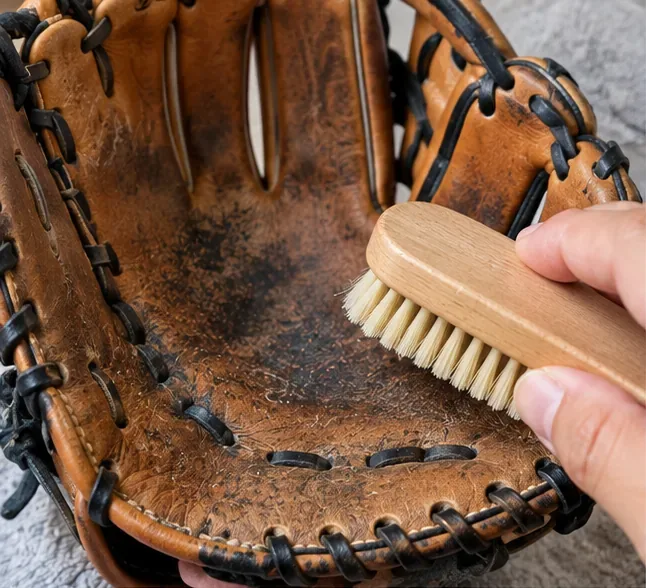
Start with the glove open and inspect the pocket, finger stalls, web, heel, and laces. Loose infield dirt and dust should come off before you rub anything into the leather. Rawlings’ current fielding-glove care guidance specifically names a dry cloth or soft sponge. A very soft brush can be useful for loose debris on some gloves, but that is not a universal manufacturer instruction, so use it only lightly and stop if it catches stitching or roughens the surface.
Do this: Wipe first with a dry soft cloth or sponge. If you use a soft brush, keep pressure light and follow with the cloth so grit is not left behind.
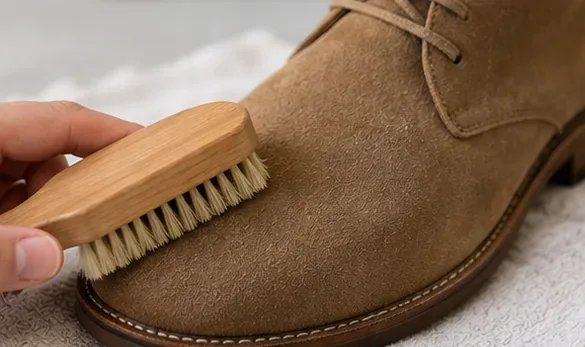
A soft brush lifts loose surface dirt from the glove pocket before any wet cleaning or conditioning. If your glove maker specifies cloth or sponge only, follow that instruction instead.
2. Clean the surface with the moisture level your manufacturer allows
This is where a common oversimplification causes problems: “just wash it with soap and water” is not a universal glove-care rule. Wilson’s published glove-care guidance says to clean its leather gloves with a damp cloth or rag and let them dry naturally. Rawlings, by contrast, lists a dry cloth or soft sponge and/or Glovolium treatment products for fielding gloves. Those instructions are different enough that the brand matters.
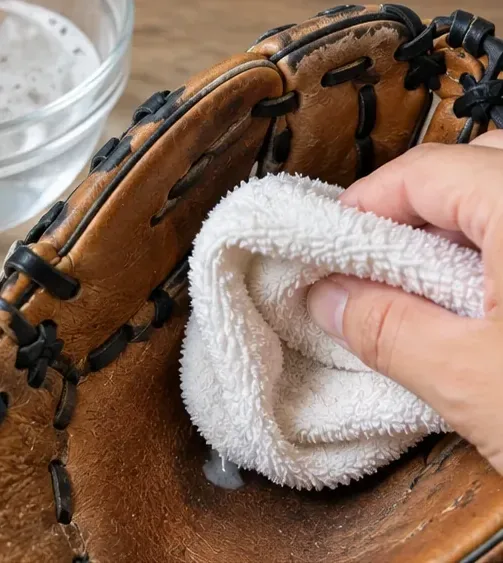
If your manufacturer approves damp wiping, wring the cloth well so it is damp rather than dripping. Wipe small sections, especially the palm and finger areas where sweat and dirt accumulate. Avoid saturating the padding, laces, or finger stalls.
Do this: Use only the amount of moisture your glove’s maker recommends. When the brand is unknown, default to a dry soft cloth first rather than soaking the glove.
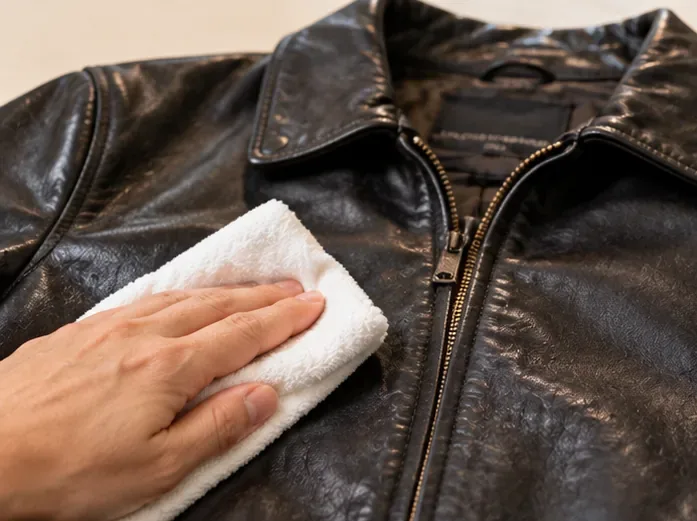
A soft cloth wipes the glove’s pocket in a controlled area. Keep moisture limited and avoid saturating the leather, padding, or laces.
3. Condition only when the glove material and condition call for it
Conditioner is maintenance, not a mandatory final step for every glove. Wilson recommends applying conditioner to dry areas and specifically warns not to overdo it. It also says to let the glove sit for 24 hours before using it again after conditioning. Rawlings sells glove-specific treatments intended to clean, soften, preserve, and protect leather ball gloves, but the exact product and amount still depend on the glove.
The reason to be restrained is practical: a glove needs to remain structured enough to catch and control the ball. Adding a thick layer of conditioner does not make cleaning more effective, and the manufacturer guidance does not support heavy application.
Do this: If the leather feels dry and your manufacturer permits conditioner, apply a small amount to the dry leather and spread it thinly. Do not pack product into seams, laces, or the pocket.
A small amount of glove-safe leather conditioner is worked into the leather. Conditioning should be light and material-appropriate, not a heavy coating.
4. Let the glove dry naturally and restore its shape
Wilson’s care guidance says to let a cleaned glove dry naturally. Rawlings recommends storing fielding gloves in a cool, dry area away from direct sunlight and keeping a ball in the pocket when the glove is not in use. Those instructions support a slow, low-heat finish rather than using a hair dryer, heater, hot car, or direct sun to speed things up.
Once surface moisture is gone, place a baseball in the pocket if that matches how you normally shape the glove. Do not force the glove flat. If you conditioned it, Wilson recommends allowing 24 hours before using it again.
Do this: Set the glove in a cool, dry, shaded place with airflow. Put a ball in the pocket and give it enough time to dry or rest before play.
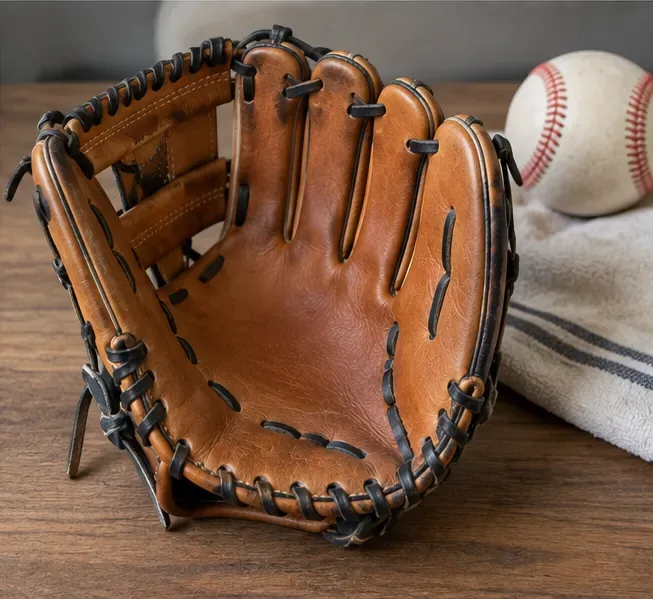
The cleaned glove rests in a dry indoor area after wiping and conditioning. Natural drying helps avoid the unnecessary heat of dryers, heaters, or direct sun.
Special Case: Wilson SuperSkin Is Not Full Leather
Not every premium baseball glove is made entirely from leather. Wilson describes SuperSkin as a synthetic microfiber material used on some A2K and A2000 gloves. Wilson’s own material-care guidance says a damp rag with water is all that is needed to maintain SuperSkin and that the material does not require Mink Oil Glove Paste or Pro Stock Glove Conditioner.
This is a useful example of why “condition every glove” is a bad universal rule. The leather portions of a mixed-material glove may have different needs from the SuperSkin shell.
Do this: If your glove has SuperSkin, wipe the SuperSkin portion with a water-dampened rag and skip leather conditioner on that synthetic material. Treat leather sections separately according to Wilson’s leather guidance.
Common Baseball Glove Cleaning Myths
Myth: “If the glove is dirty, soak it so the dirt comes out faster.”
Verified: Neither of the manufacturer instructions used here calls for soaking a fielding glove. Wilson calls for a damp cloth and natural drying; Rawlings calls for a dry cloth or soft sponge and/or glove-treatment products. A full water soak goes beyond those published cleaning directions.
Do this: Clean in small areas instead of immersing the glove.
Myth: “A thick coat of oil or conditioner protects better.”
Verified: Wilson says not to overdo conditioner and directs users to apply it to dry areas. That makes a heavy coat unnecessary under the manufacturer’s own guidance.
Do this: Use a light application only where the leather needs it, then allow the glove to rest.
Myth: “Every glove material should be cleaned the same way.”
Verified: Wilson’s SuperSkin guidance differs from its leather-glove care guidance. SuperSkin needs only a damp rag with water and does not need the same conditioners used on leather.
Do this: Identify the shell material before you choose a cleaner or conditioner.
Myth: “A hair dryer or direct sun is the best way to finish quickly.”
Condition-dependent, but the published guidance points the other way: Wilson says to dry the glove naturally, and Rawlings says to store fielding gloves in a cool, dry area away from direct sunlight. Those directions do not support aggressive heat drying.
Do this: Let the glove dry at room conditions in the shade rather than forcing the process with heat.
What If You Do Not Know the Glove’s Brand or Material?
This is the part that cannot be answered with a single verified formula. Leather type, finish, dyes, synthetic panels, padding, and prior conditioning can vary. There is no universal manufacturer-backed cleaner that is guaranteed to behave identically on every unknown glove.
Do this: Start with the lowest-risk reversible step: a dry, soft cloth. Look for a model name, tag, stamp, or product page. If you later identify the manufacturer, switch to its instructions before introducing water, oil, conditioner, or any specialty cleaner.
Quick Cleaning Checklist
Identify the glove brand and material.
Remove loose dirt with a dry soft cloth or sponge.
Use a damp cloth only when the manufacturer permits it.
Do not use solvents or ammonia-based cleaners on Rawlings fielding gloves.
Condition leather sparingly and only when appropriate.
Do not put leather conditioner on Wilson SuperSkin.
Let the glove dry naturally in a cool, shaded location.
Store it with a ball in the pocket if recommended for your glove.
The safest rule is not “never use water” or “always oil the glove.” It is to match the cleaning method to the glove you actually own. When the manufacturer is known, its instructions should win over a generic internet shortcut.