Home
» INTERNET
»
How to Clean a BUNN Coffee Maker With Vinegar: A Beginner’s Guide
How to Clean a BUNN Coffee Maker With Vinegar: A Beginner’s Guide
If your BUNN coffee maker is brewing more slowly than it used to, making extra rumbling sounds, or showing signs of mineral buildup, a vinegar cleaning may help. The key for a beginner is not to treat every BUNN brewer as if it uses the same cleaning recipe. BUNN’s home models have different tank designs, vinegar amounts, soak times, and control sequences.
This guide uses the current BUNN Speed Brew routine-cleaning procedure as the main step-by-step path because it applies to a large group of home brewers. BUNN’s current Speed Brew owner’s manual, revision 53883.0002 H 07 dated 4/25, covers GRX, BX, SBS, CSB1, CSB2, BTX, and CSB3T models. You can check the current BUNN Speed Brew owner’s manual and the BUNN Speed Brew support page before starting. If you have a Heat N’ Brew HB or My Café MCU, use the model-specific section below instead of copying the Speed Brew quantities.
First, Know What Vinegar Cleaning Is Doing
Minerals naturally present in water can collect inside a coffee maker over time. BUNN describes routine cleaning as a way to remove mineral deposits from the internal hot-water system. This process is often called descaling, meaning the removal of mineral scale from water-contact surfaces.
Descaling is different from ordinary washing. Washing the carafe and brew funnel removes coffee residue and oils you can see. Vinegar cleaning targets deposits inside the water path that you usually cannot reach with a sponge. A successful cleaning should leave the brewer flowing normally, with no lingering vinegar smell after rinsing. It cannot repair a damaged heater, leaking seal, broken switch, or other failed component.
What You Need Before You Start
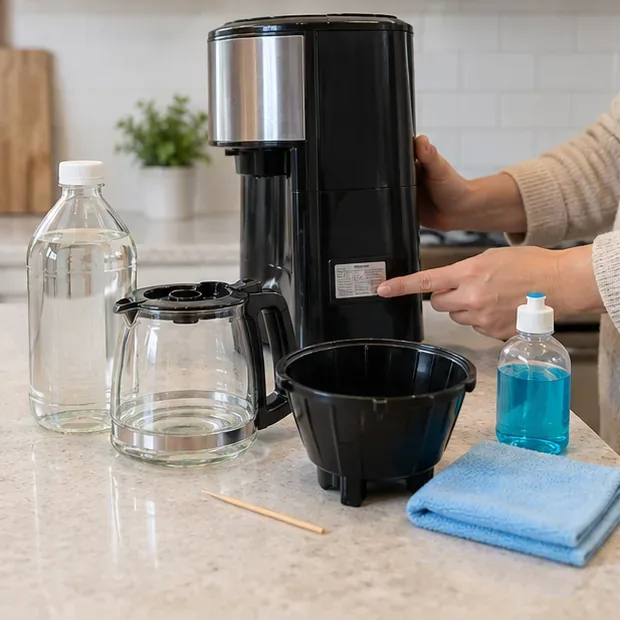
For a Speed Brew routine cleaning, BUNN specifies 1 quart, or 32 fluid ounces, of white vinegar, plus a toothpick and dish soap. You will also need the brewer’s carafe, fresh cold water for rinsing, and a soft cloth. Do not substitute harsh cleaners inside the water tank unless your exact BUNN manual specifically authorizes them.
Gather the brewer, carafe, brew funnel, white vinegar, toothpick, mild dish soap, and a soft cloth before starting.
32 fluid ounces of white vinegar for the Speed Brew procedure
Fresh cold water for at least three rinse cycles
The clean carafe and brew funnel
A toothpick for blocked sprayhead holes
Mild dish soap and a soft cloth
Important: check the model and date code on your brewer before following the quantities below. The current Speed Brew manual says the model and date code are on the bottom of the machine. Different BUNN product lines use different cleaning volumes.
How to Clean a BUNN Speed Brew Coffee Maker With Vinegar
Step 1: Put the empty funnel and carafe in place
Slide the empty brew funnel into its rails and place the empty carafe under the funnel. There should be no paper filter, coffee grounds, or brewed coffee in the machine. Starting with an empty system keeps the cleaning process focused on the water path and prevents vinegar from mixing with coffee residue.
Step 2: Pour in 32 ounces of white vinegar
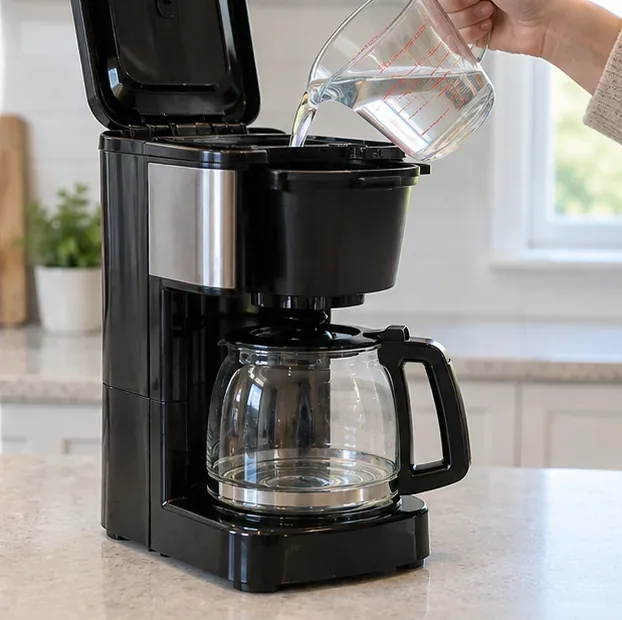
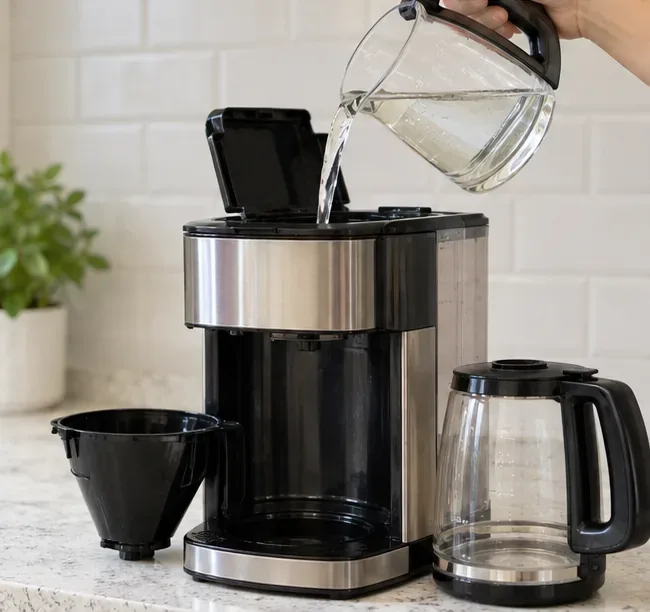
Open the brewer lid and pour 1 quart, or 32 fluid ounces, of white vinegar into the coffee maker. Close the lid. Liquid will begin moving through the system, so keep the carafe correctly positioned under the brew funnel. When liquid stops flowing, empty the carafe.
Pour the model-specified amount of white vinegar into the brewer with the empty carafe positioned below the funnel.
For this Speed Brew procedure, BUNN specifies straight white vinegar rather than a 50/50 mixture. Do not assume that instruction applies to every BUNN model; Heat N’ Brew uses a different standard mixture, described later.
Step 3: Let the vinegar stay in the hot-water system for at least two hours
The current Speed Brew manual says to leave the tank power switch in the ON position and allow the vinegar to sit in the coffee maker for at least two hours. This dwell time gives the cleaning process time to work on mineral deposits inside the internal tank.
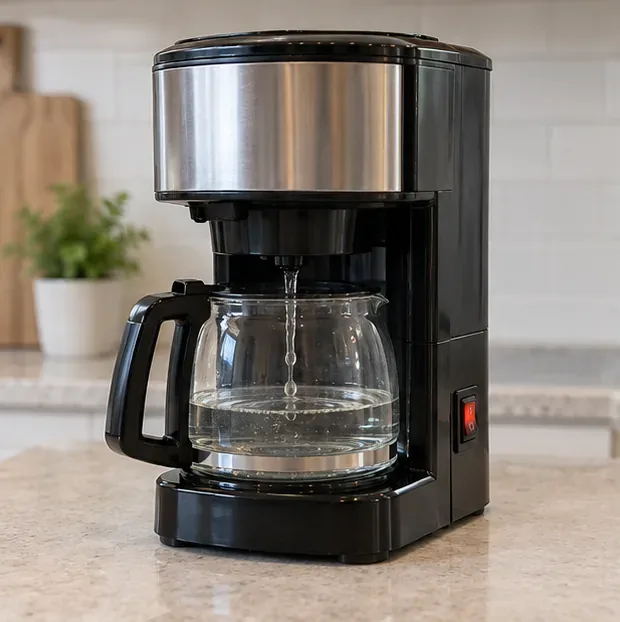
Let the vinegar move through the brewer, then follow the required soak time for your model.
This is one point where older online instructions may differ, so follow the manual for your actual model rather than mixing procedures from different generations. If your machine’s controls or tank arrangement do not match the Speed Brew family, stop and check its manual.
Step 4: Switch the tank power off, unplug the brewer, and let it cool
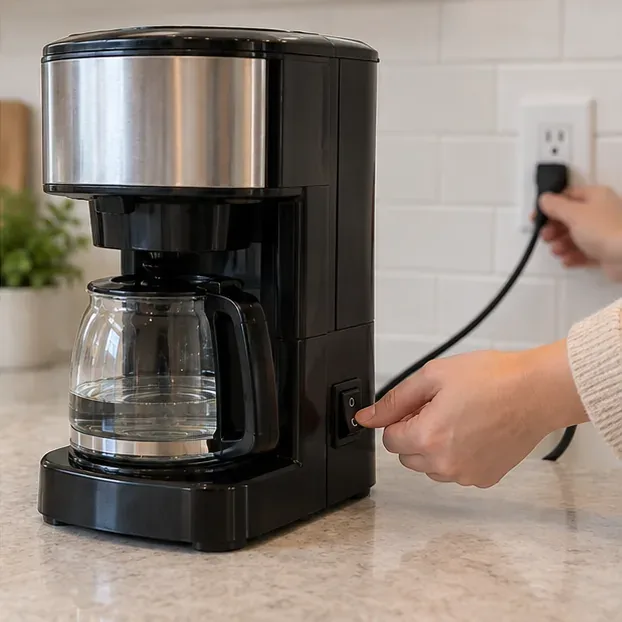
After the vinegar has been in the Speed Brew for at least two hours, flip the tank power switch to OFF and unplug the coffee maker. BUNN’s routine-cleaning sequence then calls for at least 30 minutes of cooling before the sprayhead is removed. The brewer contains hot water internally, so do not rush this part or tip the machine.
After the vinegar soak on a Speed Brew, switch the tank power off, unplug the brewer, and let it cool before removing parts.
If the machine or surrounding parts still feel unusually hot after the minimum cooling time, wait longer before handling removable parts. Cooling time can vary with room conditions and recent use.
Step 5: Remove the brew funnel and sprayhead
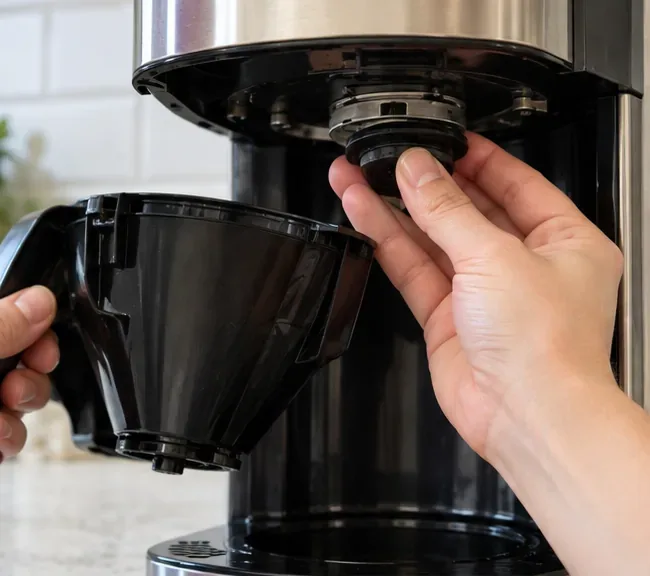
Once the brewer is unplugged and cool enough to handle, remove the brew funnel. Unscrew the sprayhead with your fingertips. The sprayhead is the small part above the funnel that distributes water over the coffee grounds during normal brewing.
Remove the brew funnel and sprayhead only after the brewer is switched off, unplugged, and cool enough to handle safely.
Do not force a stuck part with pliers or another aggressive tool. If the sprayhead will not loosen normally, consult BUNN support rather than damaging the fitting.
Step 6: Clean the sprayhead holes
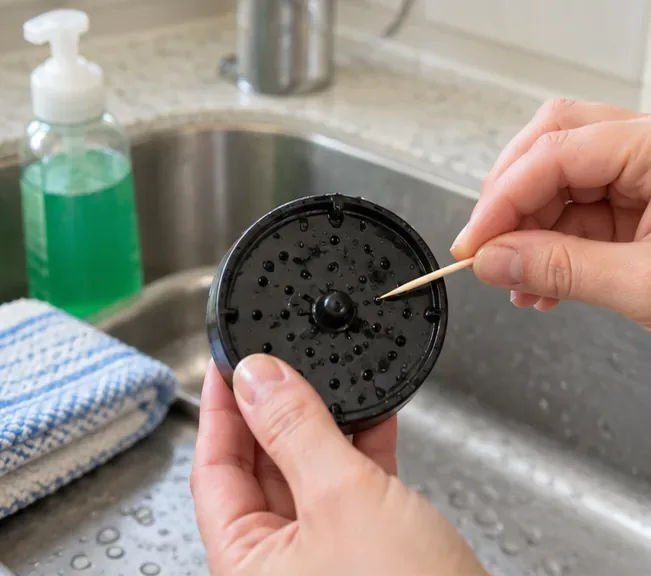
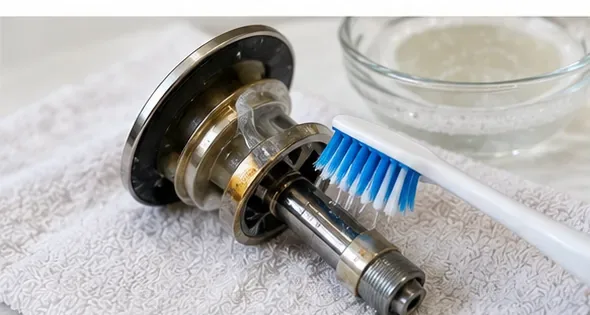
Inspect the sprayhead for white flakes or other mineral deposits. BUNN instructs owners to clear blocked holes with a toothpick, wash the sprayhead with a cloth and dish soap, and rinse it with water. This small step matters because a restricted spray pattern can contribute to slow or uneven water flow.
Clear mineral deposits from the sprayhead holes with a toothpick, then wash with mild dish soap and rinse thoroughly.
A toothpick is useful because it can clear a small opening without the scraping force of a metal pick. Avoid enlarging the spray holes; the goal is to remove deposits, not change the part.
Step 7: Flush the internal tank with fresh water
Reinsert the brew funnel. Pour one carafe of fresh water into the coffee maker, put the carafe under the funnel, and close the lid. The fresh water will begin flushing vinegar from the internal hot-water tank. Empty the carafe when the flow stops.
Flush the internal tank with fresh cold water, repeating the cycle until the vinegar odor is gone.
Repeat with fresh cold water three or more times. BUNN gives a practical finish test: keep rinsing until you no longer smell vinegar. Three cycles are therefore a minimum, not a guarantee that every brewer will be fully rinsed after exactly three passes.
Step 8: Reassemble, power on, and let the tank reheat
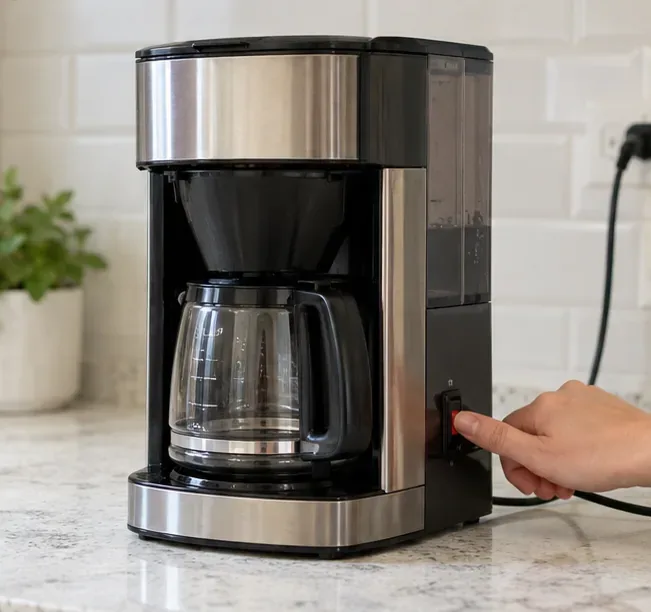
After the vinegar odor is gone, remove the funnel, reattach the sprayhead, replace the funnel, and put the carafe back in position. Plug in the coffee maker and switch the tank power ON. The Speed Brew manual says to allow about 15 minutes for the water in the tank to reach brewing temperature.
Reassemble the brewer, restore power, and allow the tank to return to brewing temperature before making coffee.
Before making coffee, verify that the sprayhead is installed, the funnel is seated normally, there is no vinegar odor, and water flow looks normal. If those checks are good, the brewer is ready for regular use.
How the Vinegar Method Changes by BUNN Model
A generic search for “how to clean a BUNN coffee maker with vinegar” can hide important model differences. Use this table as a quick orientation, then confirm the instructions for your exact brewer.
Model family
Official vinegar method
Rinsing
Speed Brew
32 oz white vinegar; allow it to sit in the brewer at least 2 hours before the cool-down and sprayhead-cleaning steps
Fresh cold water 3 or more times, until vinegar odor is gone
Heat N’ Brew HB
Standard maintenance uses equal parts water and white vinegar: 25 oz of each; let the solution sit a few minutes, then run the brew cycle
3 or more full-carafe water cycles
My Café MCU
14 oz white vinegar cycled through the brewer
3 or more 14 oz water cycles
The Heat N’ Brew manual also describes a stronger-clean option using 50 oz of white vinegar with a pause and a 30-minute soak. Do not apply that stronger procedure to another product line. See the official BUNN Heat N’ Brew support page for the HB model and the official BUNN My Café support page for the MCU.
How Often Should You Clean It?
For Speed Brew, BUNN recommends routine cleaning every three months, with more frequent cleaning when the mineral content of the water is higher. The same manual says the sprayhead and sprayhead tube may need more frequent attention in very hard water, particularly if brew time slows.
That makes brewing behavior a useful maintenance signal. If water begins moving more slowly, mineral flakes appear around the sprayhead, or the machine develops persistent rumbling associated with lime buildup, it may be time to clean sooner. On the other hand, cleaning far more often than the manual calls for is not automatically better.
Common Beginner Mistakes to Avoid
Using the wrong model’s vinegar quantity. Speed Brew, Heat N’ Brew, and My Café do not use the same standard cleaning volume.
Removing the sprayhead while the brewer is still hot. Follow the power-off, unplug, and cooling instructions before touching internal water-path parts.
Stopping after one water rinse. BUNN calls for at least three fresh-water cycles in the procedures above, and Speed Brew should be rinsed until the vinegar odor is gone.
Forcing clogged parts with metal tools. The Speed Brew manual specifies a toothpick for the sprayhead holes.
Assuming vinegar fixes every problem. Descaling helps with mineral deposits; it does not repair electrical faults, cracked parts, damaged seals, or persistent leaks.
Ignoring the sprayhead. Mineral buildup can restrict the small holes even when the rest of the brewer looks clean.
How to Tell Whether the Cleaning Worked
A reasonable post-cleaning check is simple: the brewer should have no obvious vinegar smell after the final rinse, the sprayhead holes should be clear, removable parts should be back in their normal positions, and the machine should return to its usual water flow after reheating. Make one plain-water cycle if you want an extra confirmation before brewing coffee.
If water still moves very slowly, the brewer leaks, the sprayhead cannot be installed correctly, or unusual behavior continues after proper cleaning, stop repeating vinegar cycles and use BUNN’s model-specific troubleshooting or service support. Repeated descaling is not a substitute for diagnosing a failed component.
Bottom Line
For a current BUNN Speed Brew, the beginner-friendly sequence is: set the empty funnel and carafe, add 32 oz of white vinegar, let the vinegar sit in the operating tank for at least two hours, switch off and unplug, cool the brewer, clean the sprayhead, flush with fresh water three or more times until the vinegar smell is gone, then reassemble and allow about 15 minutes to reheat. The most important first step, however, is confirming your model so you do not borrow the wrong vinegar ratio or timing from another BUNN brewer.