Home
» INTERNET
»
How to Clean a Coffee Maker Without Vinegar: Start Simple, Then Descale the Right Way
How to Clean a Coffee Maker Without Vinegar: Start Simple, Then Descale the Right Way
Your coffee maker may still look clean while the coffee tastes flat, the brew cycle takes longer, or the machine sounds different. Those symptoms can come from two very different kinds of buildup: coffee oils and organic residue on removable parts, or mineral scale inside the water path. If you want to clean a coffee maker without vinegar, the most useful first step is to decide which problem you actually have rather than replacing vinegar with another random pantry ingredient.
For coffee residue, warm water and mild dish soap may be enough for the carafe, basket, lid, and other washable parts. For mineral scale, plain water and dish soap do not do the same job. A manufacturer-approved descaler is usually the most predictable vinegar-free choice. That matters because official guidance varies by brand: Moccamaster recommends specific commercial descalers and says it does not recommend vinegar; Nespresso says its machines should be descaled with the Nespresso kit and warns that vinegar or other store-bought descalers may damage the machine; Keurig provides a dedicated descaling-solution method; and some Breville machines use a packaged descaler and a programmed descale mode. These manufacturer materials were checked on September 12, 2026.
Why does a coffee maker get dirty even when you rinse the carafe?
Brewing leaves several kinds of residue behind. Coffee oils can coat the basket, reusable filter, lid, and carafe. Fine grounds can lodge around the brew basket or shower area. Moisture left in a reservoir can encourage organic buildup. Minerals naturally present in water can accumulate inside the heating system and tubing as scale.
The last problem is easy to miss because the scale may be inside the brewer. Moccamaster explains that mineral buildup can slow water flow and affect brewing temperature and saturation time. Its current support also distinguishes a cleaner, which removes coffee oils and organic material, from a descaler, which removes limescale. Ninja similarly states in its DualBrew owner guidance that a water-only Clean cycle will not properly descale the brewer.
Which vinegar-free method should you try first?
Problem
Start with
What it can do
Main limitation
Oily carafe, basket, lid, or reusable filter
Warm water and mild dish soap
Removes coffee oils and everyday residue from washable parts
Does not remove internal mineral scale
Brown carafe stains
Manufacturer-approved deeper cleaning method
Targets stains without sending an unnecessary cleaner through the brewer
Material and dishwasher rules vary by model
Slow flow, descale light, or known hard-water scale
Manufacturer-approved descaling liquid or powder
Dissolves mineral buildup in the water path
Must be compatible with the specific machine
You want a citric-acid option
A pre-formulated citric-acid-based descaler approved by the manufacturer
Avoids vinegar odor while addressing scale
Pure citric acid mixed at an improvised concentration is not automatically safe
Odor or stains in a removable reservoir
Baking soda only where the manufacturer permits it
Can help with surface odor or residue in some designs
Not a universal mineral descaler
Cuisinart currently publishes a baking-soda method as a vinegar-free option, but it specifically says it recommends that method only when the water reservoir is removable. That is a useful example of why a technique should not be generalized to every coffee maker.
How to clean a coffee maker without vinegar, from easiest to more involved
1. Unplug the machine and wash the removable parts
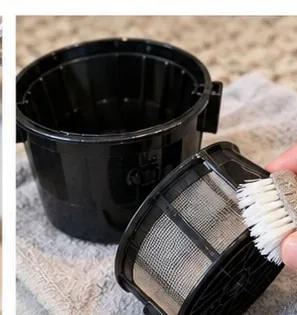
Start with the parts that actually touch coffee. Turn the machine off, unplug it, and allow hot surfaces to cool. Remove the carafe, brew basket, reusable filter, and lid if the manual identifies them as removable.
Wash approved parts with warm water and mild dish soap, then rinse thoroughly. Moccamaster's current U.S. manual says to hand-wash its carafe and brew basket with mild dishwashing detergent after each use. Mr. Coffee likewise tells owners of multiple drip models to wash the brew basket, carafe, and lid with hot water and mild liquid soap after the machine has cooled.
Start with the easiest problem: remove coffee oils and residue from washable parts using the cleaning method approved for your model.
Do not assume dishwasher safety. A plastic basket from one brewer may be top-rack safe while another manufacturer's thermal carafe may be hand-wash only. This easy cleaning step is worth doing before descaling because it can solve stale flavors caused by coffee oils without sending any chemical through the internal water path.
2. Decide whether the brewer actually needs descaling
Move to descaling when the evidence points to mineral buildup: the machine's descale indicator is on, brewing is noticeably slower, water output has weakened, or the model's maintenance schedule says descaling is due. Hard water can make scale build faster.
Do not expect descaling to fix every failure. A newly updated Moccamaster support article from September 2026 says that if the power light is on but no water moves through the heating system, descaling will not typically correct the issue and service may be needed. That is a useful stopping rule: no-flow hardware faults are different from gradual mineral restriction.
3. Choose an approved vinegar-free descaler
The safest option is the product named in the manual. Moccamaster recommends Urnex BioCaf Descaler or Dezcal in the U.S. and explains that these are formulated for coffee brewers. Its support says BioCaf is primarily citric-acid-based and Dezcal combines citric and sulfamic acids. Moccamaster also warns against pouring pure citric or sulfamic acid into the brewer because concentration determines both effectiveness and compatibility.
Nespresso takes an even narrower approach. Its U.S. VertuoLine descaling guide instructs owners to use the Nespresso Descaling Kit and warns that alternatives such as vinegar or store-bought descalers may cause damage. For a Nespresso machine, therefore, “vinegar-free” should not be interpreted as permission to improvise with lemon juice, baking soda, or bulk citric acid.
Keurig's official instructions provide a vinegar-free path using Keurig Descaling Solution. Breville's Grind Control tutorial calls for one packet of descaler with a specified amount of warm water. The common principle is not the acid name; it is following the formulation and procedure approved for the exact machine.
If the brewer actually needs descaling, add only a descaler and dilution that the manufacturer allows for that machine.
4. Remove water filters if the instructions require it, then set up the machine
Some coffee makers use charcoal or other replaceable water filters. Descaling instructions may tell you to remove them before adding descaler. Do that only when the model manual says so, and remember to reinstall or replace the filter after the process.
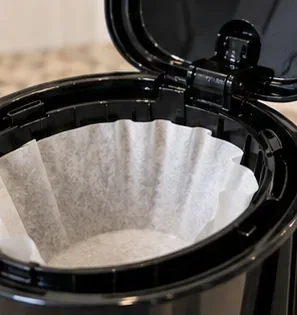
Empty old grounds. Put the empty carafe, mug, or waste container in the correct position. If the manufacturer tells you to leave the brew basket empty, do so. If the model uses a specific insert during cleaning, follow that procedure instead of assuming every drip machine should be configured identically.
Set up the brew basket and carafe exactly as the manual specifies before running a vinegar-free cleaning or descale cycle.
5. Run the documented Clean, Descale, or brew-cycle procedure
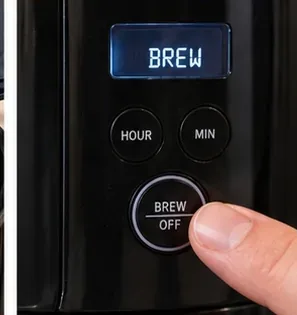
Machines with a dedicated Clean or Descale program may control pauses and flow automatically. Use that program rather than manually stopping and restarting the brewer. Ninja's DualBrew manual, for example, says its Clean cycle takes about 75 minutes and intentionally delivers solution in stages with pauses. Breville espresso machines can have separate descale stages for coffee, steam, and hot-water circuits.
This is why a generic instruction such as “run half the solution, wait 30 minutes, then finish” should not be treated as universal. Keurig has used timed standing periods in some official descaling procedures, but other machines use very different sequences. Follow the current manual for your model.
Use the brewer's Clean or Descale program when it has one; otherwise follow the documented cycle sequence for the exact model.
6. Let the prescribed cycle finish, then discard the spent solution
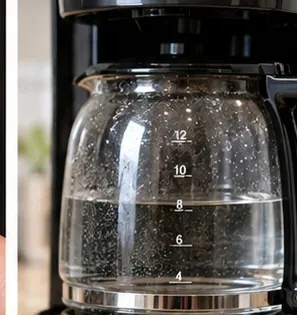
Allow the cleaning or descale program to finish unless the manufacturer specifically tells you to interrupt it. The liquid collected in the carafe may look clear, cloudy, or lightly discolored; appearance alone does not prove how much scale was removed.
Let the prescribed cycle finish and collect the spent solution in the carafe or container required by the instructions.
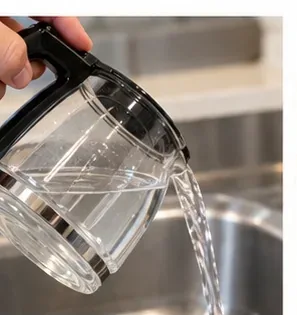
Discard the used solution. Do not reuse it unless the product instructions explicitly allow reuse. Rinse the carafe or waste container before moving to fresh-water flushing. If descaler spills on a countertop, wipe it promptly and follow the safety directions on its label.
Discard the used solution after the cycle and rinse the carafe before the fresh-water flush.
7. Flush the machine with fresh water
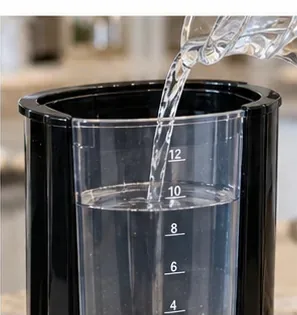
This step matters as much as descaling itself. Refill the reservoir with fresh water and run the number of rinse cycles specified by the manufacturer.
The required amount varies. A current Moccamaster manual says to brew two full reservoirs of water after descaling. Some Keurig instructions call for repeated fresh-water brews and can require many cycles for a particular brewer. Breville's BES840 manual instructs users to rinse and refill the water tank, then repeat the relevant descale-path operations with fresh water. Do not stop rinsing merely because the water in the carafe looks clear.
Flush the internal water path with fresh water for the number of cycles required by the manufacturer.
If you still smell or taste cleaner after completing the required rinse, continue flushing with fresh water before making coffee. A descaler should never become part of the next beverage.
8. Reassemble and run a practical result check
Return the filter basket, water filter, reservoir, lid, and other parts to their correct positions. Run any final water-only check required by the manual, then brew normally.
After rinsing, confirm normal flow, no cleaner odor or taste, and a brew cycle that behaves normally before returning to regular use.
A successful result is not “the machine looks shiny.” The useful signs are functional: water flows at its normal rate, the machine completes the cycle normally, the descale alert clears according to the instructions, the final rinse has no cleaner odor or taste, and coffee no longer has a stale flavor caused by dirty removable parts.
What if you only have baking soda?
Use it narrowly rather than treating it as a direct chemical substitute for vinegar. Cuisinart's current cleaning article says baking soda can be used as a vinegar-free method only when the water reservoir is removable, and it also recommends baking soda for deeper carafe stains. That makes baking soda useful for certain surfaces and certain approved machines.
What baking soda does not establish is a universal descaling rule. Mineral scale is a different maintenance problem, and brands that specify a descaling solution generally expect that chemistry. If your brewer has an internal boiler, pump, narrow tubing, capsule system, or programmed descale routine, use the product and process named by the manufacturer instead of running an unapproved baking-soda mixture through it.
Can you use plain citric acid powder instead?
Only when the manufacturer explicitly gives a recipe for your machine. A citric-acid-based commercial descaler and a spoonful of bulk citric acid are not automatically equivalent. Concentration, additional acids, buffering, contact time, and material compatibility can differ.
Moccamaster is unusually explicit on this point: it recommends specific citric-acid-based formulations but says it would never recommend putting pure citric or sulfamic acid directly into the brewer. That is a better model for decision-making than guessing a universal tablespoons-per-reservoir ratio.
When should you stop cleaning and troubleshoot something else?
Switch from cleaning to troubleshooting when the brewer still has one of these problems after correct cleaning and rinsing:
No water moves through the machine at all.
The machine leaks during or after a cycle.
A pump, grinder, valve, or heating system makes abnormal noises.
The descale warning cannot be cleared using the model's documented reset or completion procedure.
Flow remains severely restricted after a correctly completed descale.
The coffee still tastes wrong even though the machine is clean, which may point to beans, grind size, water quality, or brew ratio instead.
Moccamaster's support notes that coffee quality can also be affected by bean quality, grind size, water quality, coffee-to-water ratio, and lack of cleaning or descaling. Cleaning is therefore one variable to fix, not an explanation for every bad cup.
How often should you do this?
There is no honest universal schedule. Moccamaster recommends descaling every 100 cycles or at least every three months. Nespresso's U.S. VertuoLine guide says every three months or 300 capsules, whichever comes first. Cuisinart suggests descaling every one to three months depending on water hardness in its general guidance. Other machines use a sensor, usage counter, or clean light.
Use your manual's interval, then shorten it if hard water causes scale faster. Clean removable coffee-contact parts much more frequently than you descale the internal water path.
How to check your result before calling the job finished
Run the required final fresh-water rinse and smell the water after it cools. There should be no cleaner odor.
Taste only after the machine has been fully rinsed; there should be no chemical aftertaste.
Compare brew time with the machine's usual behavior rather than an arbitrary internet target.
Watch for steady water flow and normal completion of the cycle.
Confirm that the descale or clean indicator behaves as the manual says it should.
Inspect the countertop and base for leaks after reassembly.
If those checks pass, you have accomplished the goal without vinegar: coffee residue is gone from the washable parts, mineral scale has been treated with compatible chemistry when needed, and the internal system has been flushed clean.
The safest vinegar-free strategy is not to search for the strongest substitute. Start with ordinary washing where ordinary washing is enough. When the problem is mineral scale, move up to a descaler that the coffee maker manufacturer actually supports. Then rinse until the machine, the water, and the next cup all pass the same test: normal operation with no cleaner left behind.