Home
» INTERNET
»
How to Clean a Dry Erase Board Eraser Without Making It Worse
How to Clean a Dry Erase Board Eraser Without Making It Worse
A dry erase board eraser usually tells you it needs attention before it looks completely filthy: it starts leaving a gray haze, pushes colored residue from one part of the board to another, or takes several passes to clear fresh writing. The tempting fix is to soak the whole eraser in soapy water and scrub it hard. That can be the wrong move.
The reason is simple: “dry erase eraser” describes several different constructions. Some use washable microfiber or soft bristles. Others use traditional felt, replaceable felt layers, foam-and-felt combinations, or a plastic body with a removable pad. Current manufacturer guidance does not support one universal washing method for all of them. Quartet, for example, specifically recommends washing an eraser's microfiber cloth with water when residue builds up, while one of its soft-bristle erasers is explicitly described as hand washable. By contrast, Quartet's Premium Felt Whiteboard Eraser is designed around replaceable felt pads rather than a blanket “wash the whole eraser” instruction.
Best first action: identify what type of eraser you have before getting it wet. The cleaning sequence below starts with the safest decision and then branches based on whether the manufacturer actually describes the material as washable.
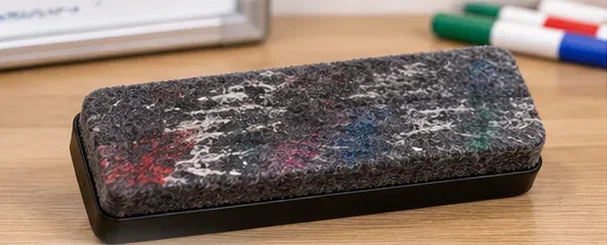
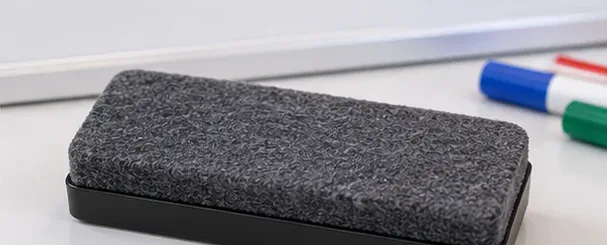
A dry erase eraser that is loaded with marker residue may begin smearing instead of lifting ink cleanly. Start by checking its material and construction.
What Is Actually Verified About Cleaning Dry Erase Erasers?
Manufacturer guidance checked for this article on September 12, 2026 supports three points that are useful across brands. First, residue buildup matters: Quartet warns that a dirty eraser can begin spreading residue on the board. Second, water cleaning is appropriate for some products, including washable microfiber or soft-bristle designs. Third, some felt products are intended to be refreshed by flipping or replacing the felt rather than by treating the entire eraser as washable.
Eraser type
What is verified
What to do
Microfiber cleaning surface or cloth
Quartet recommends washing microfiber with water and letting it dry before reuse; 3M also sells a washable dry erase microfiber cleaning cloth.
Rinse or wash with water as directed, then dry fully.
Soft-bristle eraser labeled washable
Quartet's washable soft-bristle model is described as hand washable and cleanable with water.
Hand wash with water, then air-dry.
Traditional or replaceable felt
Some Quartet felt models are designed with replaceable pads; a 3-in-1 model uses reversible felt plus a separate microfiber surface.
Check the product instructions. Flip or replace the pad if that is how the model is designed.
Unknown generic eraser
No universal manufacturer rule was found that says every felt or foam eraser can be soaked.
Use dry residue removal first and avoid soaking until washability is confirmed.
Action: look for a model number, care label, removable pad, reversible pad, or a product page before washing the entire eraser.
How to Clean a Dry Erase Board Eraser: The Safe 8-Step Method
1. Inspect the eraser before you clean it
Look at the working surface and the body. Is the cleaning material a removable cloth, a soft-bristle pad, stacked felt, a reversible felt insert, or a fixed block? Also check whether the plastic handle contains magnets, glued layers, or other parts that do not need to be soaked.
If you cannot identify the construction, treat washability as unknown. That is more accurate than assuming “felt can always be washed.”
Action: search the model number or manufacturer page. If it says “washable,” “hand washable,” or gives water-cleaning instructions, continue to the wet-cleaning steps. Otherwise, remove loose residue dry and consider replacing the pad when performance drops.
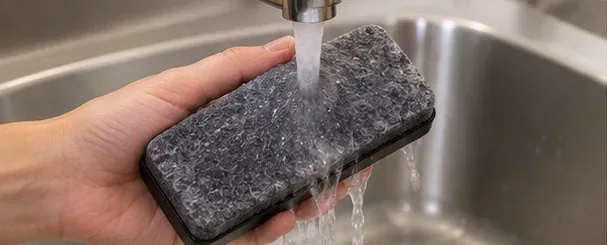
2. If the cleaning surface is verified washable, use plain water first
Plain water is the clearest manufacturer-backed starting point for washable microfiber and certain washable eraser surfaces.
For a washable microfiber surface, water is the conservative first choice. Quartet's board-maintenance guidance specifically says to wash the microfiber cloth with water to remove residue and let it dry before further use. Its washable soft-bristle eraser is also described as cleanable with water.
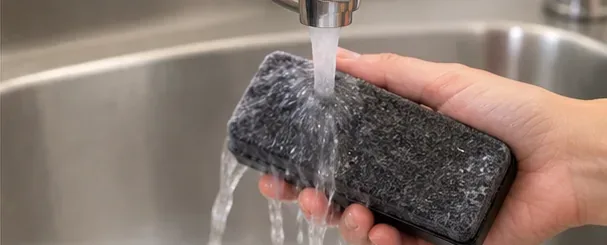
Action: hold only the washable cleaning surface under cool or lukewarm water if the construction allows it. Avoid unnecessarily submerging the handle or backing.
3. Do not assume a soap soak is required
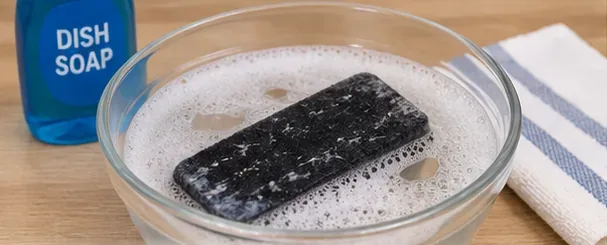
Soaking an eraser in soapy water is a common cleaning idea, but it should not be the default when the manufacturer only specifies water or when the eraser's construction is unknown.
Common misconception: “A deeper clean always means warm soapy water.” That is not what the official guidance reviewed here says. Quartet's maintenance instructions specify water for microfiber; they do not establish detergent soaking as a universal requirement for dry erase erasers.
Soap may be acceptable for a particular washable textile or pad if its maker says so, but that is product-specific. Adhesives, foam layers, rigid housings, and replaceable felt systems can be built differently.
Action: skip detergent unless your eraser's instructions permit it. If plain water restores the washable surface, there is no reason to add another cleaning chemical.
4. Avoid aggressive brushing on an unknown felt pad
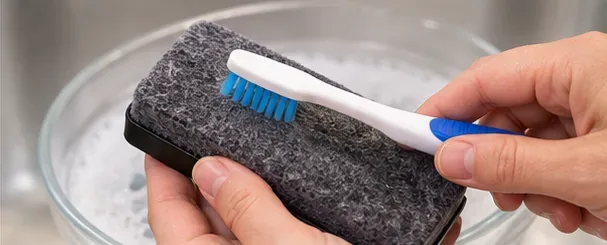
A brush can disturb fibers on some pads. Treat scrubbing as product-specific rather than a universal step for every felt eraser.
Another common assumption is that visible stains must be scrubbed until the pad looks new. Appearance is not the best success criterion. The practical goal is to stop the eraser from transferring residue back to the board.
For replaceable felt designs, the manufacturer may expect you to expose a fresh layer, flip a reversible pad, or install a refill instead of scrubbing worn felt. Quartet's Premium Felt Whiteboard Eraser, for example, is sold with multiple felt pads and instructions to replace the eraser pad to maintain clean erasing.
Action: if the felt is fixed and the care instructions do not call it washable, do not scrub it wet. If it is reversible or replaceable, use that feature.
5. Rinse a washable pad until loosened residue is gone
After washing a verified washable surface, rinse away loosened marker residue so it is not left in the cleaning fibers.
For a verified washable surface, keep rinsing until obvious loose residue has been carried away. There is no need to chase every permanent discoloration in the fibers. An eraser can remain visibly gray yet work properly if it no longer transfers loose ink dust to the board.
Action: finish with clean water, then stop washing once the pad is free of loose residue rather than continuing to abrade it for cosmetic reasons.
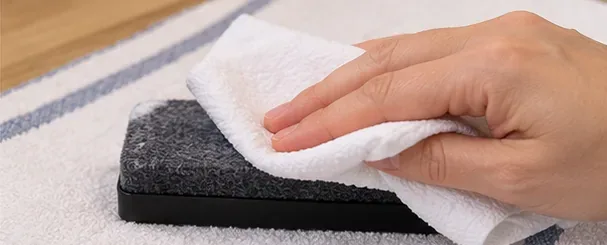
6. Blot or press out excess water without twisting the pad
Press a towel against a washable pad to remove surface moisture before air-drying it.
Manufacturer guidance emphasizes drying before reuse. A towel can shorten that process by removing surface water. With removable cloths or soft pads, pressing is gentler than wringing or twisting.
Action: blot the washable material with a clean towel. Keep the eraser's shape intact and avoid forcing water deeper into a rigid body.
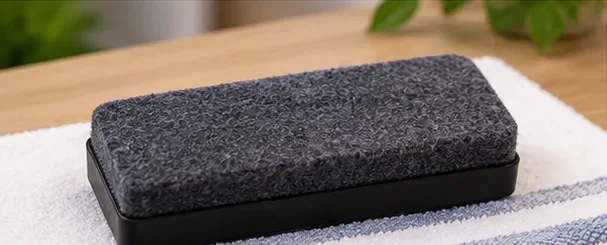
7. Air-dry completely before the next use
Let the cleaned eraser air-dry fully before returning it to the whiteboard tray.
Do not rush this part. Quartet's printable care guidance says to leave washed microfiber to dry overnight before the next use. Using a damp eraser can produce a different kind of smear and makes it harder to judge whether the cleaning actually worked.
Action: leave the eraser in a ventilated spot until the washable material is fully dry; overnight is a sensible benchmark when following Quartet's microfiber guidance.
8. Test performance, not just appearance
A cleaned eraser is ready for a performance check: it should remove fresh dry erase ink without depositing a noticeable gray film.
Once dry, make a small test mark with a normal dry erase marker on a clean part of the board, let the mark dry normally, and erase it. The result should be more important than whether the eraser pad looks factory-new.
If the eraser still leaves a gray trail, there are two possibilities: the eraser is still carrying residue, or the board itself needs cleaning. Quartet's board-care instructions recommend fully erasing the board, applying the appropriate board cleaner, and drying the surface thoroughly. Testing on a dirty board can make a clean eraser look ineffective.
Action: test once on a clean board. If smearing persists, use the eraser's designed refresh option—flip the felt, replace the felt layer, wash the removable microfiber again, or replace the eraser.
Common Cleaning Myths: What Is Verified, Conditional, or Still Unclear?
“You can wash every dry erase eraser in the sink.”
Status: not verified as a universal rule. Some products are explicitly washable; others use replaceable felt. The materials may look similar while the construction differs.
Action: confirm washability before soaking.
“Rubbing two erasers together fully cleans them.”
Status: limited at best. Rubbing or tapping may dislodge loose dry marker dust, but the manufacturer guidance reviewed for this article does not present eraser-on-eraser rubbing as a complete cleaning method. It also does not solve residue embedded in a washable microfiber surface.
Action: treat dry dust removal as a quick maintenance step, not proof that the eraser is fully clean.
“Dish soap is always better than water.”
Status: depends on the product. The clearest official instruction located for microfiber erasers specifies water. A product that explicitly allows detergent is a different case, but that permission should come from its care instructions rather than from a generic cleaning tip.
Action: start with the least aggressive verified method.
“If the eraser is still gray, it is still dirty.”
Status: not necessarily. Pigment can discolor a porous cleaning material even after loose residue has been removed. The more useful test is whether the eraser transfers residue or fails to clear fresh dry erase ink.
Action: judge by board performance, not color alone.
“A machine-washable dry erase cloth means the whole eraser can go in the washing machine.”
Status: false as a generalization. 3M's Post-it Dry Erase Cleaning Cloth is specifically described as machine washable, but that is a cloth product. That does not automatically apply to a rigid eraser body, glued felt block, magnetic eraser, or multi-material unit.
Action: machine-wash only a component or product whose manufacturer explicitly says it is machine washable.
When Should You Replace the Eraser Instead of Cleaning It?
Cleaning is worthwhile when the material is washable and structurally sound. Replacement makes more sense when the felt is flattened, peeling, permanently matted, separating from its backing, or still spreading residue after the verified cleaning method. For replaceable-pad designs, changing the pad is normal maintenance rather than a failure.
Quartet's maintenance guidance explicitly lists replacement as the next option when cleaning no longer improves performance, and its Premium Felt model is built around replaceable felt layers.
Keep using it: the pad is intact and removes fresh ink cleanly after drying.
Flip or replace a pad: the model is designed for reversible or refillable felt.
Replace the whole eraser: the body or cleaning surface is damaged, or residue continues to transfer after proper maintenance.
Quick Self-Check: Did the Cleaning Work?
Use this short check after the eraser is completely dry:
Clean a small section of the whiteboard so the test surface itself is not contaminated.
Draw two or three short lines with a functioning dry erase marker.
Let the ink dry as it normally would during use.
Erase with one or two normal passes.
Look from an angle for gray transfer, streaks, or colored smears.
If the mark clears and the eraser does not deposit a noticeable film, the maintenance worked. If smearing remains, do not keep escalating to stronger chemicals without guidance. Re-check whether the eraser is actually washable, clean the board separately, and use the manufacturer's flip/refill/replacement option where available.