Home
» INTERNET
»
How to Clean a GE Dishwasher Filter: A Step-by-Step Guide
How to Clean a GE Dishwasher Filter: A Step-by-Step Guide
You open your GE dishwasher after a cycle and find grit on glasses, food specks on plates, or a stale smell near the bottom of the tub. A dirty filter can be one cause, but the first thing to know is that not every GE dishwasher uses the same filtration system. GE says many newer models have removable Fine and Ultra Fine Filters that need routine maintenance, while older models and some current models use self-cleaning filtration with no removable filter for the owner to clean.
That means the safest starting point is model identification, not pulling on the first plastic part you see. GE’s current support guidance says to check the Owner’s Manual for your exact dishwasher before removing anything. You can use the GE dishwasher support center to find model-specific information, or follow GE’s dedicated Fine and Ultra Fine Filter cleaning instructions if your machine uses that removable-filter design.
Before you start: confirm that your GE dishwasher has a removable filter
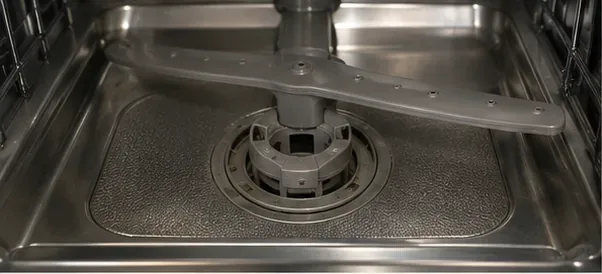
Look at the bottom of the tub after pulling out the lower rack. On removable-filter models, you will usually see a cylindrical Ultra Fine Filter seated in the center of a broader mesh Fine Filter. GE’s support article describes the Ultra Fine Filter as the part that twists counterclockwise for removal. The flat Fine Filter beneath it is held by retaining posts on models that use that configuration.
If you do not see this arrangement, do not pry at the sump cover or other fixed parts. Your dishwasher may use a different design or self-cleaning filtration. Stop and check the Owner’s Manual by model number.
A removable-filter dishwasher typically has a cylindrical Ultra Fine Filter in the center of the tub, surrounded by a broader Fine Filter. Confirm your model before removing parts.
What you need
Warm water
Mild dish soap
A nonabrasive sponge
A soft brush only if needed for the Fine Filter and stubborn deposits
A clean towel or protected counter for setting parts down
GE specifically warns that scouring pads or brushes can damage the Ultra Fine Filter. For that part, use warm soapy water and a sponge. GE allows a soft brush or sponge on the Fine Filter when stubborn soil or hard-water calcium deposits need extra help.
Step 1: Remove the lower rack and expose the filter area
Make sure the dishwasher is not running, then slide the lower rack out far enough to access the bottom of the tub. If it is easier on your model, remove the rack completely. This gives you room to turn the filter without bumping the spray arm or rack wheels.
Take a quick look around the filter area before touching anything. Large food scraps, labels, glass fragments, or other debris can interfere with draining and may be worth removing carefully first.
Step 2: Unlock the Ultra Fine Filter
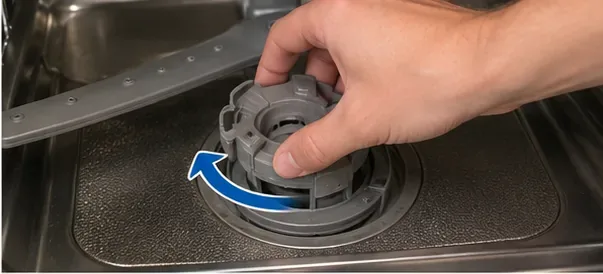
Grip the top of the cylindrical Ultra Fine Filter and rotate it counterclockwise. GE’s instructions specify counterclockwise for removal. Do not force it if it will not move. A filter that feels stuck may be loaded with residue, incorrectly seated, or simply designed differently on your model.
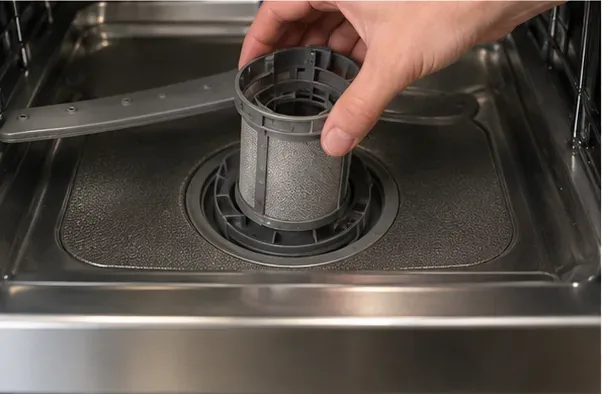
Turn the Ultra Fine Filter counterclockwise to unlock it. If it resists strongly, stop and verify the procedure for your model rather than forcing the plastic parts.
Step 3: Lift out the Ultra Fine Filter
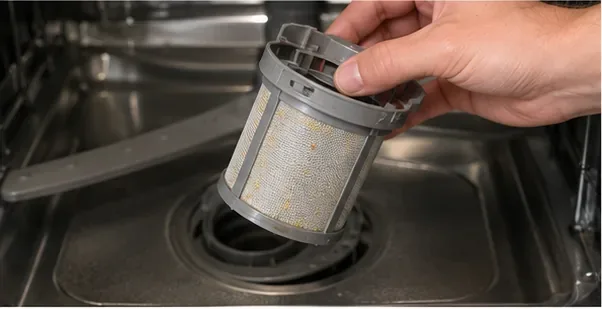
Once unlocked, lift the filter straight up. Inspect the mesh for grease, food particles, seeds, fibers, or mineral film. A visibly loaded mesh is a strong sign that cleaning is worthwhile, especially if wash performance has dropped or dishes have started feeling gritty.
Lift the unlocked Ultra Fine Filter out of the tub and inspect the mesh for food particles, grease, and mineral buildup.
Step 4: If your model has a removable Fine Filter, take it out carefully
GE’s removable-filter instructions say to remove the Ultra Fine Filter first. Then, on models with the removable mesh Fine Filter, turn each of the two retaining posts near the back of the dishwasher tub counterclockwise and remove the Fine Filter.
The exact hardware is model-specific, so this is the point where the Owner’s Manual matters most. If your dishwasher does not have the same retaining-post arrangement, do not improvise. Clean only the parts GE identifies as owner-removable for your model.
Step 5: Wash the Ultra Fine Filter with warm soapy water
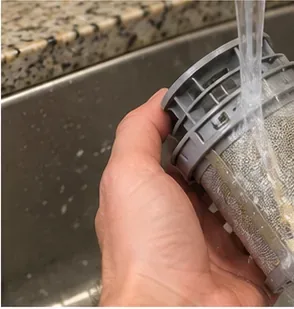
Rinse the cylindrical Ultra Fine Filter under warm water, then use mild dish soap and a sponge to loosen stuck-on residue. GE cautions against scouring pads and brushes on this filter because they can damage the filter material.
Work gently around the mesh and plastic frame. The goal is to clear the openings without bending, fraying, or scratching the filter.
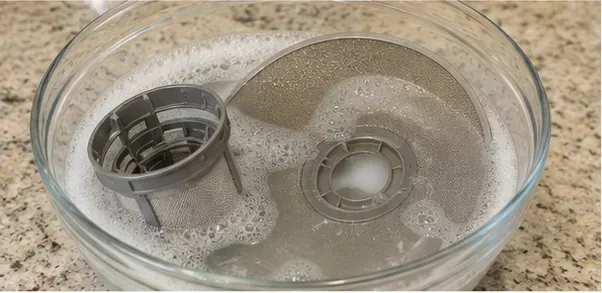
Rinse the Ultra Fine Filter with warm water and wash it with mild soap and a nonabrasive sponge. Avoid scouring pads and stiff brushes on this part.
Step 6: Clean the Fine Filter separately
Rinse the flat Fine Filter with warm soapy water. For ordinary food film, a sponge is usually enough. GE notes that a soft brush may be needed for stubborn soils or calcium deposits caused by hard water. Keep the pressure light so you do not scratch or distort the mesh surface.
If mineral scale is the main problem, cleaning the dishwasher interior may also be necessary. GE’s general dishwasher-cleaning guidance discusses mineral buildup separately from ordinary food soil, so do not assume the filter alone is responsible for white film throughout the machine.
Wash removable filter parts with warm soapy water. Use gentle cleaning rather than abrasive scrubbing, and reserve a soft brush for stubborn deposits on the Fine Filter.
Step 7: Inspect the parts before reinstalling them
After cleaning, look through the mesh under good light. You should no longer see obvious food trapped in the openings. Check the plastic frame for cracks, warping, broken tabs, or torn mesh. A damaged filter should not simply be put back into service as though nothing happened; use the model-specific parts information from GE to identify the correct replacement.
The parts do not need aggressive polishing. What matters is that the filter openings are clear, the frame is intact, and no large debris remains.
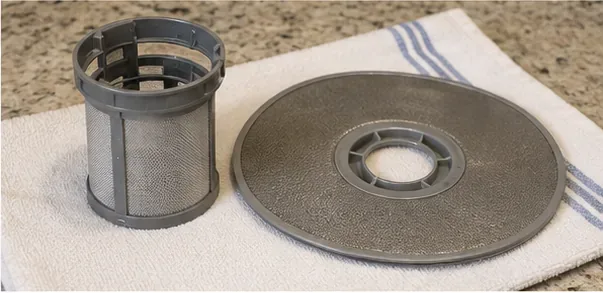
Inspect the cleaned filters before reinstalling them. The mesh should be clear of visible debris and the frames should be intact, without cracks or distortion.
Step 8: Reinstall the Fine Filter and lock the Ultra Fine Filter
If you removed the Fine Filter, place it back in position first. GE says to reinstall the retaining posts and twist them clockwise to lock the Fine Filter in place.
Then reinstall the Ultra Fine Filter. GE’s instructions note that an arrow embossed in the Fine Filter serves as a guide for aligning the Ultra Fine Filter. Seat the cylindrical filter correctly and rotate it clockwise until it locks.
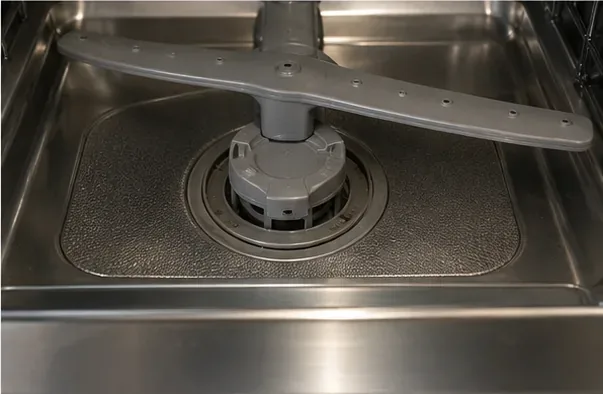
Lower the clean Ultra Fine Filter into its opening only after the Fine Filter is correctly positioned and secured.The finished assembly should sit flat and secure beneath the lower spray arm, with the Ultra Fine Filter locked in place.
How often should you clean a GE dishwasher filter?
GE’s support pages give slightly different maintenance language depending on context. The dedicated filter-cleaning article recommends inspecting and cleaning the Fine and Ultra Fine Filters periodically, about every other month or more often depending on usage. GE’s poor-wash troubleshooting guidance says removable Fine and Ultra-Fine Filters should be cleaned once a month for optimum wash performance.
A practical approach is to inspect the filter monthly, especially in a busy household, and clean it whenever debris is visible or performance starts slipping. If your dishwasher sees lighter use and the filter stays clean, an every-one-to-two-month cleaning interval is consistent with GE’s published guidance.
Signs that the filter needs attention sooner
Glasses or plates feel gritty after a full cycle.
Food particles remain on otherwise clean dishes.
You can see debris trapped in the filter mesh.
Wash performance has declined without another obvious cause.
There is heavy mineral residue on the Fine Filter in a hard-water area.
GE specifically lists decreased wash performance and gritty-feeling dishes as indications that the filters need cleaning. Its poor wash performance guidance also notes that excessive food can clog dishwasher filters.
What not to do
Do not assume every GE dishwasher has a user-removable filter
Some GE dishwashers use self-cleaning filtration. If the Owner’s Manual does not instruct you to remove a filter, do not disassemble fixed components.
Do not scrub the Ultra Fine Filter with a brush or scouring pad
GE explicitly warns that brushes and scouring pads can damage this filter. Use warm soapy water and a sponge instead.
Do not force the filter when removing or reinstalling it
If the part will not turn as described, stop and verify your exact model. Forcing the locking mechanism can damage tabs or leave the filter incorrectly seated.
Do not treat the filter as the only possible cause of poor cleaning
A clean filter cannot compensate for blocked spray-arm jets, poor rack loading, detergent problems, or other mechanical issues. GE’s troubleshooting guidance lists several possible causes of poor wash performance.
How to check your work
After reinstalling the filter, make three quick checks before loading the dishwasher normally:
Physical check: The Fine Filter should lie flat and any retaining posts should be locked. The Ultra Fine Filter should be seated and locked clockwise.
Clearance check: Confirm that the lower spray arm and rack move normally and do not contact the filter assembly.
Performance check: Run a normal or short cycle with a typical load and compare the result with the problem that prompted cleaning. Grit should be reduced if a dirty filter was the cause.
If dishes remain gritty after the filters are clean and properly installed, the next step is troubleshooting rather than repeated filter cleaning. Check spray-arm holes for blockage, review loading, and consult the model-specific GE support page. If the dishwasher still does not wash correctly, GE recommends service after basic troubleshooting fails.
Bottom line
Cleaning a GE dishwasher filter is usually straightforward when the machine has GE’s removable Fine and Ultra Fine Filter system: remove the lower rack, unlock and lift the Ultra Fine Filter, remove the Fine Filter if your model permits it, wash the parts gently, and reinstall them in the correct order.
The most important detail is model compatibility. GE has used both removable and self-cleaning filtration designs, so the Owner’s Manual always takes priority over a generic tutorial. Once you confirm that your filter is removable, regular inspection and gentle cleaning can help prevent food buildup and restore wash performance without damaging the filter itself.