Home
» INTERNET
»
How to Clean a Leather Jacket Safely: A Care-Label-First Guide
How to Clean a Leather Jacket Safely: A Care-Label-First Guide
Research note for September 2026: Current manufacturer guidance does not point to a new universal way to clean every leather jacket. It still varies by the leather finish and the exact garment. For example, Belstaff's current product-care guidance describes cautious spot cleaning for some leather, while a current AllSaints leather-jacket product page specifies specialist leather cleaning. The practical consequence is simple: your jacket's care label comes before any generic cleaning recipe.
If the label allows surface cleaning, you can often remove dust, light grime, and a small fresh mark from smooth finished leather at home. The safe approach is to use as little moisture and product as possible, test first, and let the jacket dry naturally. Suede, nubuck, waxed leather, shearling, vintage leather, and jackets labeled for professional leather cleaning need a different approach.
Before You Start: Check the Leather and the Care Label
Leather is not one uniform material. The surface may be smooth and coated, waxed or oiled, highly absorbent, or deliberately textured. Suede and nubuck have a raised nap, meaning the soft, fuzzy surface fibers that give them their characteristic look. Those finishes should not automatically be treated with the same cloth-and-cleaner method used on smooth leather.
In the United States, the Federal Trade Commission's Care Labeling Rule recognizes “Leather clean” as professional cleaning using special leather or suede methods. If your label uses that instruction, or says “specialist leather clean only,” do not turn a home-cleaning guide into permission to override it.
Jacket material or finish
Best starting point
Home wet cleaning?
Smooth finished leather
Care label, then gentle dusting and spot testing
Only if the label or maker permits it
Waxed or oiled leather
Brand-specific care or a leather specialist
Avoid generic cleaner or conditioner unless approved
Suede or nubuck
Suede brush and suede-specific care
Do not use a smooth-leather routine by default
Shearling, vintage, very soft aniline-style leather
Professional assessment
Usually not a good first DIY project
Faux or “vegan” leather
Its own care label and manufacturer instructions
Do not assume real-leather products are compatible
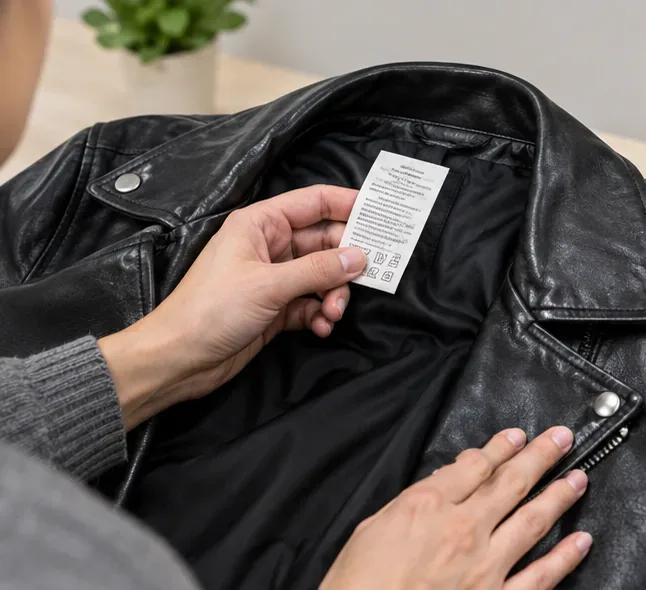
Step 1 begins with the inside care label. The exact jacket instructions take priority over a general leather-cleaning method.
What You Need for a Basic Smooth-Leather Surface Clean
Two or three clean, soft, lint-free cloths, preferably light colored so you can notice dye transfer
A very soft brush for loose surface dust, if the leather finish tolerates brushing
Cool or lukewarm water
A leather-specific cleaner approved for the finish, or a small amount of neutral soap only when the maker allows it
A sturdy padded or broad wooden hanger
Leather conditioner only if it is compatible with the finish and the manufacturer recommends conditioning
Do not start with rubbing alcohol, acetone, bleach, household disinfectant, abrasive powder, furniture polish, or a strong detergent. These products can remove color, alter the topcoat, leave residue, or dry the surface. Also skip a “more is better” approach with conditioner; excess product can darken leather, make it tacky, or change the finish.
How to Clean a Leather Jacket in 4 Careful Steps
Step 1: Read the Label and Identify Any Special Finish
Look inside the jacket for the care label and also check the maker's current product-care page if you know the model. Stop the DIY process if the garment says professional leather clean only, specialist clean only, or otherwise rules out home cleaning.
Look for signs that the jacket is suede, nubuck, waxed, oiled, heavily distressed, hand-finished, or unusually absorbent. Belstaff, for example, separates waxed leather from ordinary leather care and says waxed leather should not be treated with its generic conditioner. Its current care page recommends specialist attention for that finish.
Step 2: Remove Loose Dust Before Adding Moisture
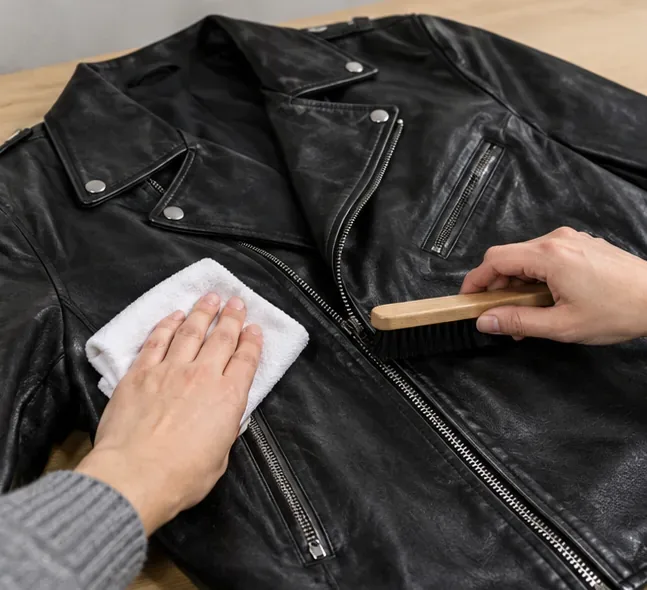
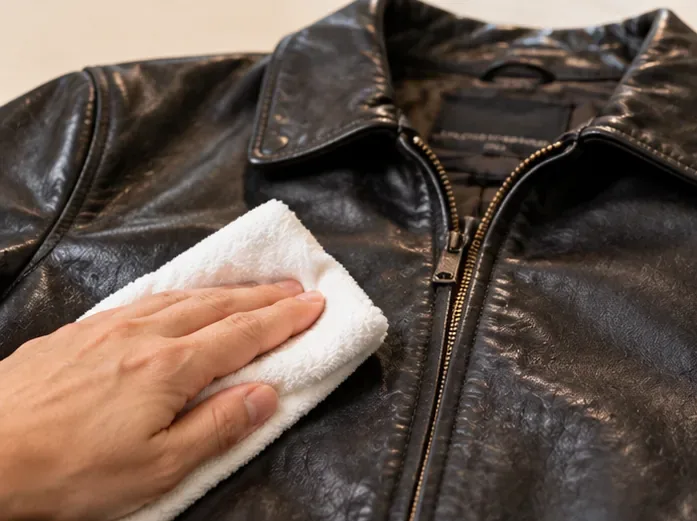
Zip the jacket, empty the pockets, and lay it flat on a clean surface or place it on a sturdy hanger. Wipe the surface gently with a dry, soft cloth. If a soft brush is suitable for the finish, use light strokes around seams, pocket edges, cuffs, and hardware where dust collects.
This dry step matters because adding water to loose dirt can turn dust into a smeared film. Do not scrub scuffs aggressively; a scuff may be a change in the finish rather than removable dirt.
Remove loose dust with light pressure before using any moisture. Focus on seams and hardware without scrubbing the leather surface.
Step 3: Patch-Test the Exact Cleaner and Method
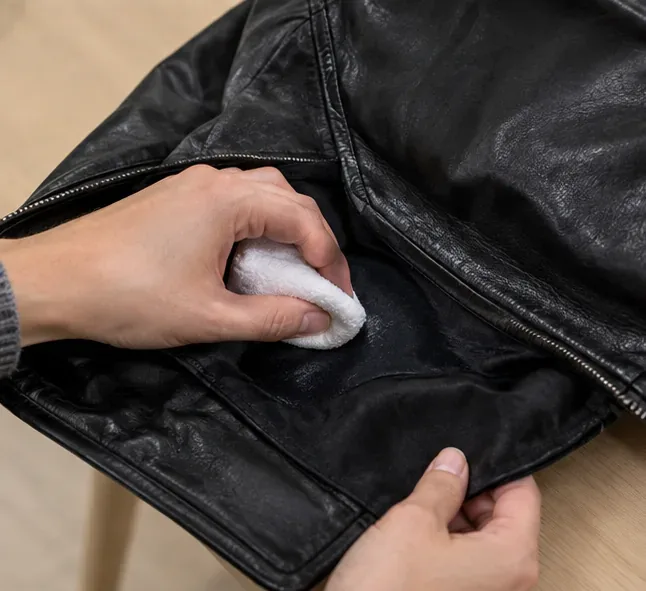
Before touching a visible panel, test your intended method on a hidden area, such as an inside hem, under a flap, or another inconspicuous spot. Use the same cleaner concentration, cloth, pressure, and drying method you plan to use elsewhere.
Wait until the test area is fully dry. Stop if you see permanent darkening, lightening, loss of sheen, tackiness, dye transfer, a roughened surface, or a sharp boundary around the test spot. Coach's current leather-care instructions for its own products also emphasize testing cleaner on an inconspicuous area first; that principle is useful even though a jacket maker's instructions should remain the primary authority for a jacket.
Patch-test in a hidden area and let it dry completely before deciding that a cleaner is safe for the visible leather.
Step 4: Clean with Minimal Moisture, Then Air-Dry
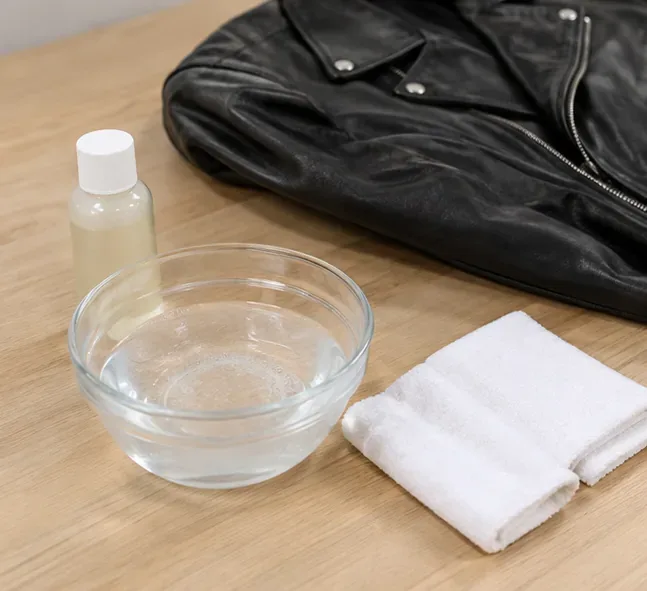
If the label and patch test both support home surface cleaning, dampen a clean cloth and wring it out thoroughly. The cloth should be damp, not dripping. For a maker-approved cleaner, follow its dilution and application instructions. Belstaff's current guidance for some leather uses neutral soap with cold water for spot cleaning; that is not permission to use soap on every leather jacket.
Work in a small area at a time with gentle passes. Do not pour water or cleaner directly on the leather. If you used a mild cleaning solution, use a second barely damp cloth to remove residue, then blot excess moisture with a dry cloth rather than rubbing hard.
Use a small amount of compatible cleaner and minimal water. A damp cloth should do the work; the jacket should never be soaked.
Hang the jacket on a padded or broad hanger in a well-ventilated place and let it dry naturally. Keep it away from radiators, hair dryers, fireplaces, tumble dryers, and direct sunlight. AllSaints' current leather-care guidance likewise advises natural drying rather than forced heat when leather gets wet.
Only after the jacket is fully dry should you consider conditioner. Many smooth leathers need little or no added product, and some finishes can be harmed or visibly changed by conditioning. AllSaints notes that most of its smooth leather jackets do not need a product, while Belstaff specifically excludes waxed leather from its generic conditioning advice. If conditioning is allowed, patch-test first and apply a very thin, even amount rather than saturating the surface.
How to Handle Common Leather-Jacket Stains
The safest stain response depends on both the stain and the finish. Quick action is useful, but aggressive chemistry is not. A fresh mark that can be lifted with a soft damp cloth is very different from ink, oil, dye transfer, or a stain that has penetrated absorbent leather.
Problem
Safer first response
When to stop DIY
Fresh light dirt or surface mark
Blot or gently wipe if the label permits a damp cloth
If the color or sheen changes
Water mark
Let the leather dry naturally first; follow the maker's method rather than adding heat
If a ring remains or the leather stiffens
Oil or grease
Blot excess without rubbing
If the stain has soaked in; professional cleaning is safer
Ink, marker, makeup, perfume, adhesive
Do not reach automatically for alcohol or solvent
Professional leather cleaner recommended
Mildew or persistent musty odor
Isolate the jacket from other garments and keep it dry
Widespread growth, deep odor, or valuable/vintage leather
What About Suede and Nubuck Jackets?
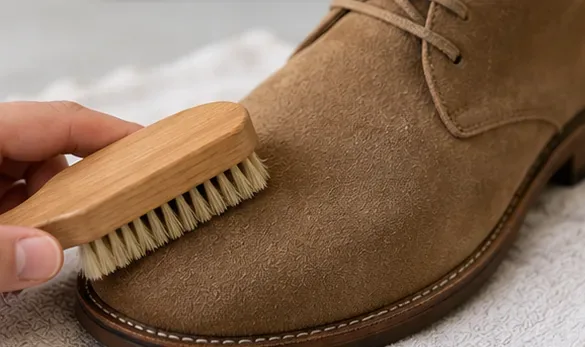
Suede and nubuck need their own care routine because the nap can flatten, discolor, or show water marks differently from smooth leather. Start with the garment label. For general suede technique, Dr. Martens' suede-care guidance uses a suede brush and warns against over-soaking, then recommends natural drying and brushing to restore the nap. That guidance is written for the brand's footwear, so use it as a material-care reference rather than as permission to treat a suede jacket against its label.
If a suede jacket has an oil stain, large water stain, dye transfer, or an unknown finish, a specialist cleaner is the safer route. Do not apply smooth-leather conditioner to suede unless the jacket manufacturer specifically says it is compatible.
Mistakes That Commonly Damage Leather Jackets
Machine washing or soaking without explicit permission: water exposure can change shape, color, finish, adhesives, lining, and interfacings.
Using a hair dryer or radiator: forced heat can harden, shrink, or distort leather.
Using alcohol, acetone, bleach, or strong household cleaner: solvents and oxidizers can strip finish or dye.
Scrubbing one spot hard: you can create a cleaner-looking patch that is actually finish loss.
Conditioning suede, waxed leather, or specialty finishes with a generic cream: the appearance can change permanently.
Skipping the patch test: even a product labeled for leather may not suit every finish.
Storing the jacket damp or in sealed plastic: trapped moisture and poor airflow can encourage odor or mildew.
How to Store a Leather Jacket After Cleaning
Make sure the jacket is completely dry before storage. Use a broad, supportive hanger so the shoulders are not pulled into points. Store it in a cool, dry, ventilated area away from direct sunlight. AllSaints recommends a breathable dust bag rather than a plastic cover for leather storage.
Avoid folding the jacket for long periods because deep creases can become difficult to relax. Leave enough space around it that other garments do not press sharply into the leather. If you applied any approved conditioner or protector, make sure the surface is fully dry before it touches pale fabric or upholstery.
When Professional Leather Cleaning Is the Better Choice
Choose a professional cleaner who specifically handles leather and suede when the care label requires it, when the jacket is suede or nubuck and heavily soiled, when the finish is waxed or unusual, or when the problem involves ink, oil, mold, large stains, strong odor, color loss, or vintage leather. Professional care is also the better option when the jacket is expensive enough that a small chance of permanent finish change is not worth the experiment.
A useful decision rule is this: home cleaning is best for routine surface maintenance on a compatible smooth leather, not for restoration. If the job has moved from “remove a little dirt” to “repair color, remove a penetrated stain, fix cracking, or reverse finish damage,” you are outside the scope of a basic cleaning routine.
Quick Self-Check After Cleaning
The jacket is fully dry and still hangs in its original shape.
There is no new dark patch, pale patch, sticky residue, or sharp water ring.
The leather still feels flexible rather than stiff or brittle.
No cleaner residue remains around seams, snaps, or zippers.
If conditioner was used, the finish looks even and not greasy or overly glossy.
The jacket is stored in a cool, ventilated place away from direct sun and heat.
Frequently Asked Questions
Can you wash a leather jacket in a washing machine?
Usually not. Follow the care label. Many leather-jacket makers explicitly prohibit washing, tumble drying, or ordinary dry cleaning, and some specify professional leather cleaning. Only machine-wash a leather garment if its exact label or manufacturer instructions clearly permit it.
Can you clean a leather jacket with dish soap?
Do not assume dish soap is safe. Some manufacturer guidance allows a neutral soap solution on certain leather, but a household dish detergent can contain degreasers, fragrance, dyes, or additives not intended for a jacket finish. Use the maker-approved product or method whenever possible, and patch-test it.
Should you condition a leather jacket after every cleaning?
No. Conditioning depends on the leather and finish. Some smooth leathers may benefit from occasional compatible conditioner, while waxed leather, suede, nubuck, and some finished fashion leathers need different care. Too much conditioner can alter color and feel.
How often should you clean a leather jacket?
Clean based on actual need rather than a rigid calendar. Regularly remove dust, deal with fresh surface marks promptly, and avoid unnecessary full-surface cleaning. A jacket worn daily in a city environment will need more maintenance than one worn occasionally and stored correctly.
Bottom Line
The safest way to clean a leather jacket is not to search for the strongest cleaner. It is to identify the finish, obey the garment label, remove dry dirt first, patch-test, use minimal moisture only when permitted, and dry the jacket naturally. That conservative process protects the color, topcoat, shape, and feel that make leather worth keeping in the first place.