Home
» INTERNET
»
How to Clean a Microwave Filter: Grease Filters vs. Charcoal Filters
How to Clean a Microwave Filter: Grease Filters vs. Charcoal Filters
The most important thing to know is that not every microwave filter should be washed. On most over-the-range microwaves, the metal grease filter underneath the unit is designed to be removed and cleaned. A charcoal filter, used when the microwave recirculates air back into the kitchen instead of venting outdoors, is usually not washable and should be replaced instead.
That distinction prevents the most common mistake: soaking a charcoal filter in soapy water and expecting it to work like new. Whirlpool, Maytag, Samsung, and GE all distinguish washable grease filters from replaceable charcoal filters in their current support guidance. For model-specific access, orientation, dishwasher compatibility, and reminder-reset steps, your owner's manual is the final authority.
First, identify which filter you have
Filter type
Where it usually is
What you do with it
Metal grease filter
On the underside of an over-the-range microwave, above the cooktop
Remove and clean regularly; replace if bent, broken, or damaged
Charcoal filter
Usually behind a top/front vent grille or behind/alongside the grease filter on recirculating models
Replace; do not wash unless the exact owner's manual explicitly says otherwise
Microwave vented directly outdoors
May still have a grease filter, but often does not use the charcoal filter in normal operation
Clean the grease filter; check the installation configuration before buying charcoal media
Whirlpool's filter-care instructions say grease filters are located underneath the microwave and should be cleaned monthly or when a filter-status indicator prompts you. The same guidance says the charcoal filter cannot be cleaned and is typically replaced about every six months. Samsung's microwave filter support page likewise says charcoal media used for recirculation is not cleanable and should be replaced once or twice a year, depending on model and use.
When should you clean a microwave grease filter?
A practical starting point is about once a month for an over-the-range microwave that sees regular cooking. Whirlpool, Maytag, and Samsung all publish roughly monthly grease-filter maintenance guidance. Heavy frying, searing, or frequent stovetop use can justify checking it more often.
You do not need to wait for a timer. If the mesh looks dark and greasy, airflow seems weaker, the vent fan sounds more strained, or the underside of the microwave feels sticky, the filter deserves attention. A damaged filter should be replaced rather than scrubbed indefinitely.
For charcoal filters, do not use the monthly grease-filter schedule. Replacement intervals vary by manufacturer and model. Whirlpool commonly cites about six months, Samsung gives roughly six to twelve months, and GE notes that odor, shiny grease buildup, discoloration, or a filter reminder can also indicate replacement time. GE's charcoal-filter guidance also stresses that the replacement part is model-specific.
Four steps to clean a microwave grease filter
1. Disconnect power and remove the grease filter
Turn the microwave controls off and disconnect power before removing the filter. If the plug is accessible, unplug the unit; otherwise use the disconnect method specified in the manual. Let the cooktop area and microwave cool first.
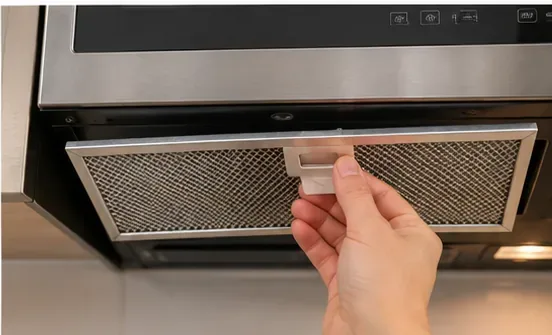
Most grease filters slide, tilt, or drop out using a small tab or finger grip. Do not force the frame. Some models also use a retaining screw. Whirlpool manuals show several different mounting arrangements, which is why the exact model instructions matter.
A typical metal grease filter is located on the underside of an over-the-range microwave. Disconnect power and follow the model's release-tab or screw instructions rather than forcing the frame.
Example: if your filter has a spring tab, you may push the tab back and pull the filter down. Another model may require sliding the filter away from a tab area before lowering it. Both are normal designs.
2. Soak the metal grease filter in hot, soapy water
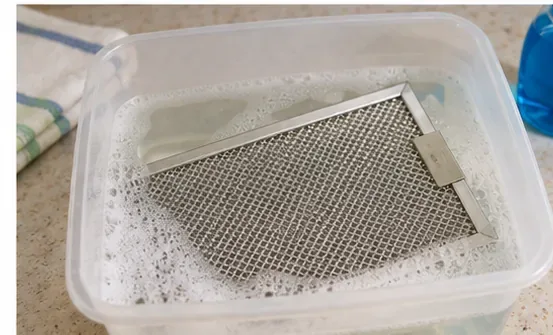
Place the grease filter in a sink, basin, or container filled with hot water and a small amount of dish soap or another mild cleanser. Whirlpool's consumer guide recommends hot, soapy water and says an exceptionally dirty filter can be soaked with about 1/4 cup of baking soda added to the bath. Let the filter soak long enough for the greasy film to soften; Whirlpool suggests at least 10 minutes when using this approach.
Do not apply this soaking step to a charcoal filter. Charcoal works by trapping odors in porous media; washing it does not restore that capacity and can damage the filter.
Soak only a washable metal grease filter. Hot soapy water softens cooking grease so it can be removed with less pressure.
3. Scrub gently, then rinse thoroughly
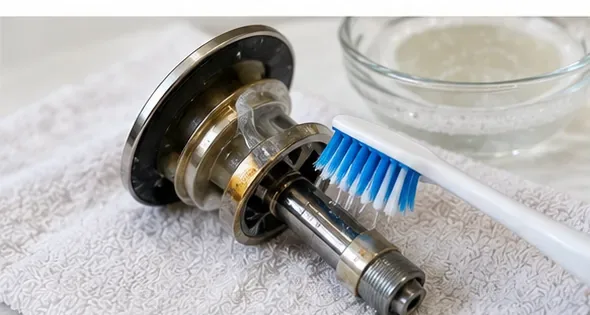
Use a soft dish brush, toothbrush, or non-damaging sponge to work loosened grease out of the mesh. Keep pressure light. Maytag explicitly cautions against scrubbing hard enough to bend the filter or its frame.
Work from both sides, paying attention to corners and the perimeter where grease often collects. Then rinse with clean water until soap and loosened residue are gone.
Use a soft brush and light pressure. The goal is to lift grease from the mesh without bending the filter frame or crushing the layers.
Can you use a dishwasher? Sometimes. Whirlpool says most of its grease filters can be cleaned in a dishwasher, but it specifically tells owners to verify this in the owner's manual. Do not assume dishwasher-safe status across brands or models. If the manual is unclear, hand washing is the more conservative choice.
4. Dry completely and reinstall the filter
Shake off excess water and let the filter air-dry completely, or pat it dry with a clean towel if the manufacturer permits. Do not reinstall a filter while water is still trapped in the mesh.
Once dry, return it in the same orientation and locking sequence used during removal. Make sure it sits flat and secure. If the filter has a damaged frame, torn mesh, or a tab that no longer holds it in place, replace it rather than improvising a fit.
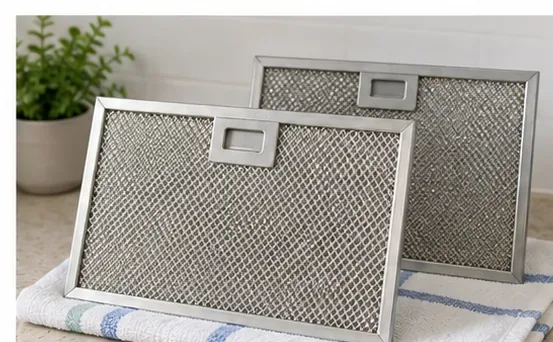
Let washed grease filters dry fully before reinstalling them. A clean, dry filter should sit flat and secure in its original position.
What should you do with the charcoal filter?
If your microwave is configured for recirculating ventilation—meaning it filters the air and sends it back into the room instead of exhausting through a wall or roof—it may use a charcoal filter. GE and Samsung both note that charcoal filters are used for recirculating installations, while outside-vented configurations may not need them.
Do not soak or scrub the charcoal filter. Replace it with the correct part number for your model. Access varies: it may sit behind a top vent grille, behind a filter door, or behind the grease filter. GE's model-specific articles show several different grille and access-panel arrangements, so copying a screw-removal sequence from a different microwave can waste time or damage trim.
A charcoal filter may need replacement sooner if cooking odors linger, grease coats the surface, the material becomes shiny instead of dull and porous, or the filter-status reminder appears. Note that GE explains some filter-reminder lights are simply timers; they do not actually sense how dirty the filter is.
How do you know whether your microwave vents outside or recirculates?
Check the installation instructions, model documentation, or ductwork above the microwave. If there is ducting that carries air outdoors through a wall or roof, the unit is externally vented. If there is no external duct and air exits back into the kitchen through a front or upper grille, it is probably set up for recirculation.
This matters because buying and maintaining a charcoal filter for an outside-vented setup may be unnecessary. Samsung specifically says you do not need to clean or replace a charcoal filter on microwaves that vent up or out the back, while GE states that charcoal media is required when the microwave is not vented outside.
What if the filter is still greasy after one wash?
Repeat the soak and gentle scrub rather than escalating immediately to caustic degreasers or a stiff wire brush. Very old grease can require more than one round. If the mesh remains clogged, smells rancid, has become brittle, or is physically damaged, replacement is often a better solution than increasingly aggressive cleaning.
A clean filter should allow air to pass through the mesh readily and should not feel coated in a thick oily layer. It does not need to look brand-new to function, especially after years of cooking use.
Common mistakes to avoid
Washing the charcoal filter
This is the biggest category error. Manufacturer guidance from Whirlpool, Maytag, Samsung, and GE treats the charcoal filter as a replaceable item rather than a washable one.
Reinstalling the grease filter while wet
Let the mesh dry completely first. Trapped moisture around metal parts and grease residue is not useful for airflow or cleanliness.
Bending the mesh while scrubbing
A grease filter is a thin metal assembly. Heavy scrubbing can warp the frame or crush the mesh, reducing fit and airflow.
Assuming the dishwasher is always safe
Some grease filters are dishwasher-safe; others may not be. Check the owner's manual before choosing the dishwasher over hand washing.
Buying a generic charcoal filter without checking the model
GE emphasizes that charcoal filters are model-specific. A filter that looks roughly the same size may not fit, seal, or sit in the airflow path correctly.
Ignoring the vent fan because the microwave still heats food
The microwave cooking function and the ventilation system solve different problems. A clogged grease filter can reduce the effectiveness of the hood fan even when the microwave heats normally.
Quick maintenance checklist
Check the underside grease filter about monthly.
Wash the metal grease filter with mild soap and hot water unless the manual gives different instructions.
Use only soft brushes or non-damaging sponges.
Verify dishwasher compatibility before machine-washing the filter.
Air-dry completely before reinstalling.
Replace a damaged grease filter.
Do not wash a standard charcoal filter; replace it on the model's schedule or when odor/grease buildup indicates.
Use the exact charcoal-filter part specified for the microwave model.
Reset the filter reminder after replacement only if your model requires it.
Bottom line
If your microwave filter is a metal grease filter, the standard maintenance method is to disconnect power, remove it, soak it in hot soapy water, scrub gently, rinse, dry completely, and reinstall it. If it is a charcoal filter, do not wash it; replace it with the correct model-specific part.