Home
» INTERNET
»
How to Clean a Puffer Jacket and Restore Its Loft Safely
How to Clean a Puffer Jacket and Restore Its Loft Safely
A good puffer-jacket wash should accomplish more than removing visible dirt. The jacket should finish clean, fully dry, evenly lofted, free of detergent residue, and structurally unchanged. If the shell comes out clean but the insulation is still clumped, damp, flattened, or lopsided, the job is not finished.
The safest method starts with the care label on your specific jacket. In the United States, the Federal Trade Commission requires covered garments to include regular-care instructions that are supported by a reasonable basis. That matters because two jackets that look nearly identical can have different shell fabrics, coatings, trims, insulation, and drying limits. See the FTC Care Labeling Rule guidance.
What should the finished jacket look and feel like?
Quality check
Good result
Warning sign
What to do next
Cleanliness
Surface dirt, body oils, and normal odor are substantially reduced.
Greasy cuffs, collar marks, or odor remain.
Repeat a gentle spot treatment or another label-approved wash instead of increasing heat.
Rinse quality
Fabric feels clean rather than slick or soapy.
Foam, fragrance, or a slippery feel remains.
Run another rinse if the care instructions allow it.
Loft
Baffles look evenly puffy once fully dry.
Dense lumps or flat sections remain.
Continue low-heat drying if permitted and gently break up clumps by hand.
Dryness
No damp, cool, heavy, or compact patches remain in the insulation.
Some baffles feel denser or cooler than others.
Keep drying before storage; do not judge down loft while it is still damp.
Shell condition
No new snags, seam damage, warping, or melted-looking areas.
Fabric is distorted, shiny from heat, or stitching is opening.
Stop the process and switch to repair or professional care.
Water repellency, if applicable
Water still beads on a jacket designed with a DWR finish.
The face fabric wets out quickly after it is clean.
Consider a compatible DWR treatment only if the manufacturer recommends one.
First identify the insulation: down or synthetic
“Puffer jacket” describes the construction, not the fill. Natural down and synthetic insulation can both be quilted into puffy baffles, but their care priorities differ. Down is especially dependent on complete drying and restored loft. Synthetic insulation is generally less prone to feather-style clumping, but high heat can still damage lightweight face fabrics or insulation fibers.
Patagonia’s current product-care guidance says down garments should be cleaned with a down-specific detergent when possible, avoiding fabric softener and bleach, and that low-heat machine drying helps restore loft. Arc’teryx gives a similar down-care sequence and separately advises low-heat drying for synthetic-insulated garments while warning against overheating. The North Face also emphasizes checking the garment tag and notes that professional cleaning by a service experienced with down is an option for down products. These are useful general references, but your own label remains the final instruction.
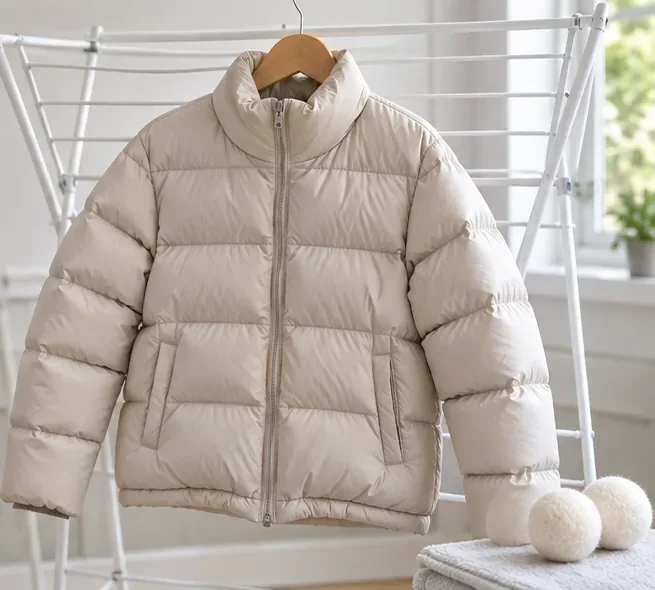
Read the care label before choosing water temperature, cycle, detergent, or drying method; visually similar puffer jackets can require different care.
How to clean a puffer jacket: an eight-step method
1. Read the label and confirm what the jacket is filled with
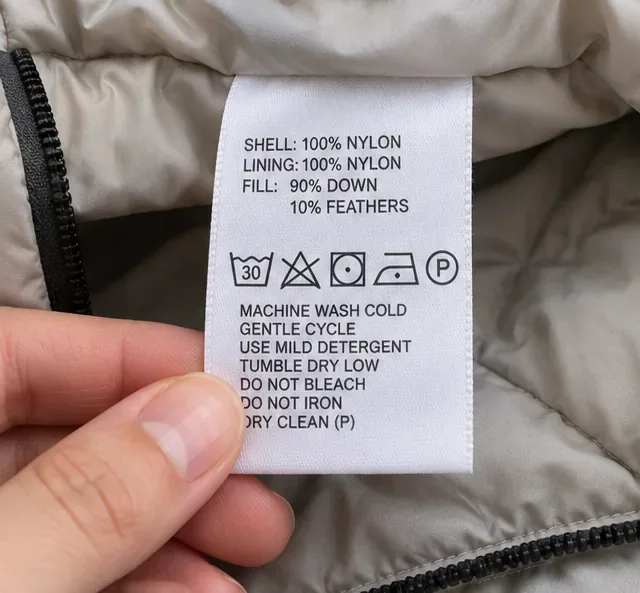
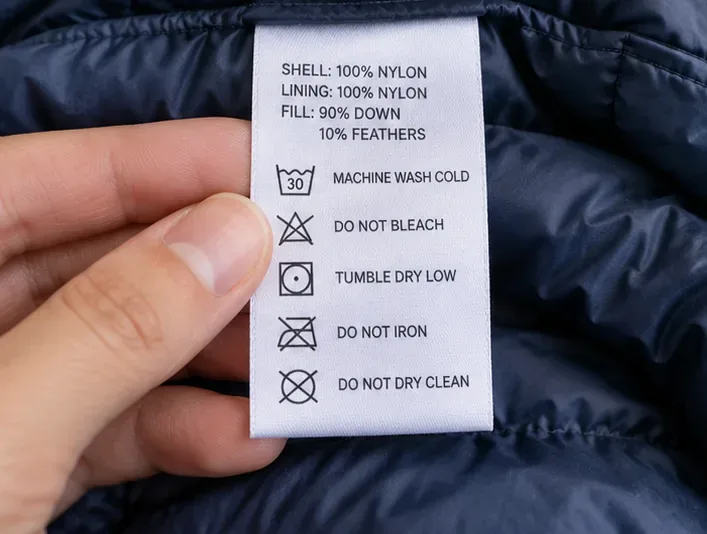
Find the sewn-in care tag and look for both the fiber content and care instructions. If it identifies down or feathers, use the down branch of this guide. If it lists polyester or another synthetic insulation, use the synthetic branch. If the label says hand wash, do not substitute a machine cycle simply because another puffer jacket can tolerate one. If it says not to tumble dry, skip the dryer advice below.
Result check: Before washing, you should know the permitted wash method, maximum temperature, drying method, and any warnings such as no bleach, no ironing, or no dry cleaning.
A fill-content label helps distinguish a down jacket from a synthetic puffer before you choose detergent and drying technique.
2. Inspect the jacket and treat localized dirt first
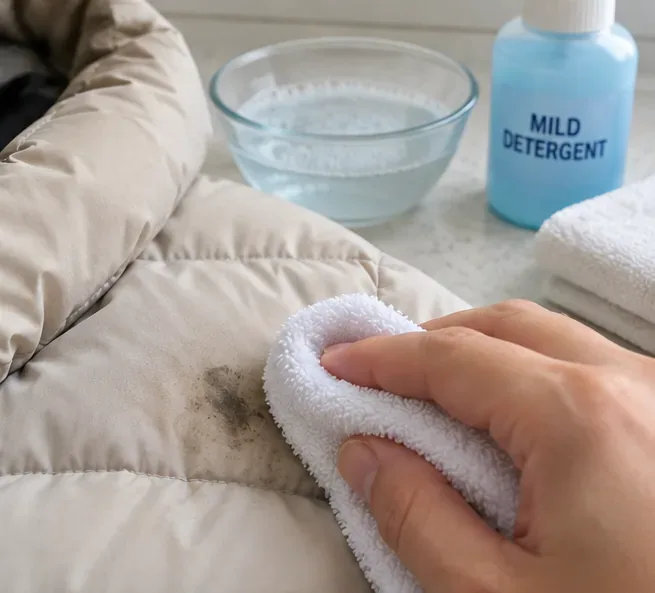
Check the collar, cuffs, pocket edges, zipper placket, and hem. These areas often collect skin oils and surface grime before the rest of the jacket needs a heavy wash. If the care label permits wet cleaning, use a soft white cloth and a small amount of compatible cleaner to work on the dirty area without saturating the insulation unnecessarily.
Avoid aggressive scrubbing on thin nylon or polyester shells. Do not use chlorine bleach unless the care label specifically permits it. If a stain requires a strong solvent, or if the jacket has glued details, delicate prints, leather trim, or a damaged coating, professional care may be the safer choice.
Result check: The stain should begin to lift without color transfer, fuzzing, coating damage, or spreading into a larger ring.
Spot-treat high-soil areas gently before the full wash so you do not have to compensate later with harsher heat or excess detergent.
3. Prepare the washer and protect the shell
For technical outerwear, detergent and softener residue left in the washer can be undesirable. Arc’teryx recommends running an empty rinse cycle before washing its synthetic insulation. A clean front-loading machine is also a common choice for down because it avoids the central agitator found in some top-loaders.
Close the main zipper so its teeth do not catch fabric. Follow the manufacturer’s directions for pocket zippers, hook-and-loop cuffs, and drawcords. Arc’teryx, for example, advises closing main zippers, opening pocket zippers, releasing drawcord tension, and lightly re-securing hook-and-loop cuffs on its technical garments.
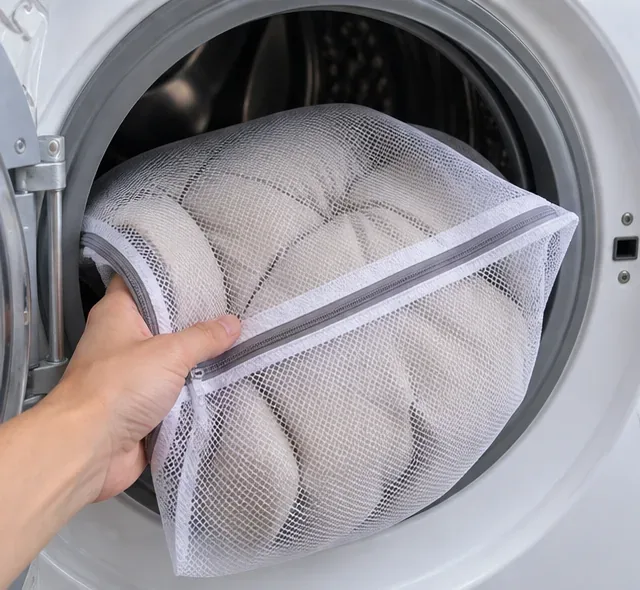
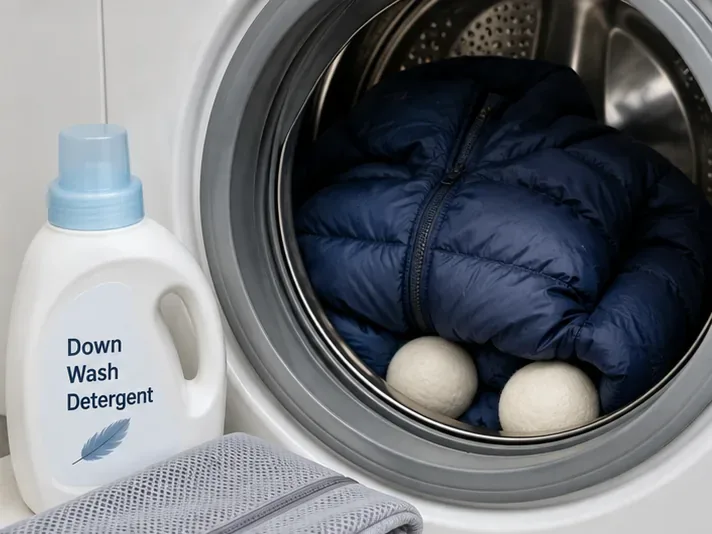
If your brand specifically recommends a protective mesh bag for an agitator-style top loader, use one large enough that the jacket is not tightly compressed. Do not assume a mesh bag is required for every machine or every puffer.
A roomy mesh bag can add protection when a garment maker recommends it, but the jacket should remain loose enough to rinse and move freely.
4. Use the right cleaner and the label-approved cycle
For down, a down-specific cleaner is the safest general recommendation from technical outerwear manufacturers because it is designed to rinse clean without leaving the same residues as some conventional detergents. Patagonia says traditional detergent can strip natural oils from down and may reduce loft if residue remains. Its current product-care guidance recommends a down-specific detergent and no fabric softener or bleach for down pieces.
For synthetic insulation, follow the jacket maker’s detergent recommendation. Arc’teryx recommends a technical detergent for its synthetic-insulated outerwear and says standard products containing softeners or brighteners can leave deposits that may affect performance. See the Arc’teryx synthetic insulation wash guide.
Use the temperature and cycle on the care label. “Cold and gentle” is common, but it is not universal. Arc’teryx’s current down home-wash guidance, for example, specifies 40°C/104°F for certain garments, which is exactly why the label and brand guidance should outrank a generic internet rule.
Keep the wash cleaner and drying aids distinct: use the recommended cleaner during washing, then reserve clean dryer balls for the low-heat drying stage if allowed.
5. Wash without overcrowding, then rinse thoroughly
A puffer needs room for water to move through the shell and insulation. Do not pack the drum with towels or a large load of everyday laundry. Use only the amount of cleaner directed by the product maker; extra detergent is not a shortcut to a cleaner jacket and can make complete rinsing harder.
Both Patagonia and Arc’teryx emphasize thorough rinsing for down. Arc’teryx explicitly recommends a second rinse in its down-care instructions. If you still see suds or the jacket feels soapy after the first rinse, use another label-approved rinse rather than immediately adding another wash dose.
Result check: At the end of rinsing, the jacket may look alarmingly flat, especially if it is down-filled. That alone is not a failure. Wet down collapses; the real loft assessment comes after complete drying.
6. Support the wet jacket when moving it
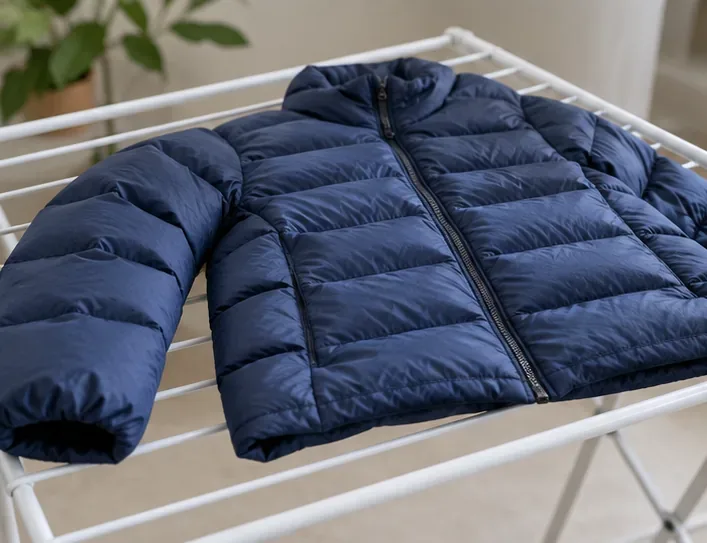
A soaked puffer is heavier than a dry one. Lift it with both hands and support the body instead of pulling one sleeve or the hood. If the care label requires air drying, spread the garment so the insulation is distributed rather than leaving it in a wet heap.
For down jackets whose labels permit tumble drying, do not leave the jacket hanging wet for hours just because the outer fabric feels dry. Patagonia notes that down can look and feel dry before it is fully dry inside, and storing damp down compressed can promote mildew.
After washing, handle the wet jacket gently and move promptly to the drying method allowed by its care label.
7. Dry completely and restore loft
This is the stage that most strongly determines the final quality of a down-jacket wash. If the label permits tumble drying, use the specified low or gentle heat. Patagonia recommends low heat for down and notes that clean tennis balls can help separate clumps. Arc’teryx likewise recommends low heat with two clean tennis balls or dryer balls for its down garments and advises periodically turning the garment to promote even drying.
Stop the dryer periodically and feel several baffles. Gently massage dense clumps apart with your fingers, then return the jacket to the dryer if it is still damp. Do not switch to high heat simply to finish faster. Lightweight shell fabrics and synthetic components can be damaged by overheating.
For synthetic insulation, Arc’teryx says low-heat tumble drying can help restore loft, while warning not to overheat the garment. If your label calls for air drying instead, follow it even if another brand recommends machine drying.
Result check: The insulation should be evenly distributed, the jacket should regain its normal volume, and no section should feel cold, heavy, damp, or marble-like inside.
Do not call the job finished until the baffles are evenly lofted and no dense damp sections remain.
8. Check the shell, water repellency, and storage condition
Once the jacket is fully dry, inspect the zipper, seams, cuffs, hem, and baffles. Compare its loft with neighboring sections and with how the jacket normally feels. A little unevenness can often be corrected by gently redistributing insulation by hand, but persistent flat chambers, broken stitching, or large empty zones may indicate a repair issue rather than a cleaning issue.
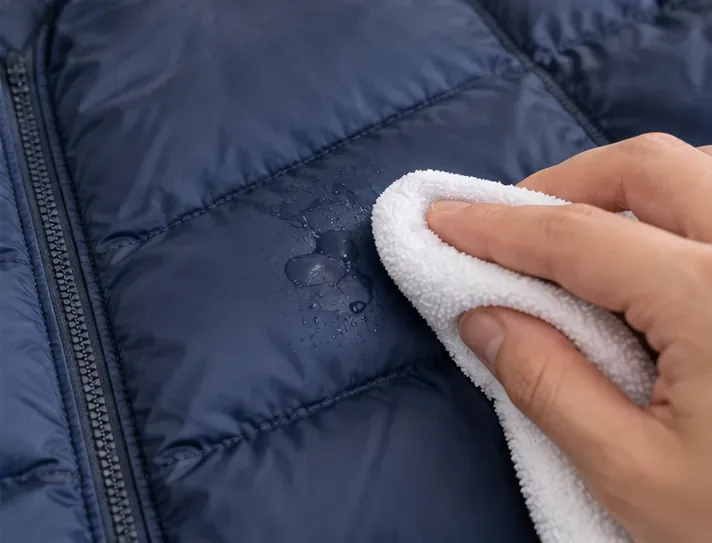
If the jacket was designed with a durable water-repellent finish, test a small clean area with a light spray of water. Arc’teryx advises reapplying DWR when a clean garment no longer beads water. A DWR treatment is not a substitute for waterproof construction, and it should only be used when it is compatible with the jacket.
Store the jacket only when it is completely dry. Avoid leaving a down jacket tightly compressed for long-term storage because loft is the feature that creates its insulating air space.
On a jacket designed with a water-repellent face finish, a light bead test after cleaning can show whether the outer treatment still sheds water.
When should you change course instead of continuing?
The label conflicts with this guide: follow the label.
The jacket has a torn baffle or open seam: repair it before washing so insulation is not lost.
Color transfers during spot cleaning: stop and avoid expanding the wet area.
The washer has a strong central agitator and the jacket is delicate: use a safer machine or the protection method recommended by the brand.
The dryer runs unusually hot: do not risk heat damage; use another approved drying option.
Loft does not return after the jacket is truly dry: the problem may be damaged or migrated insulation rather than remaining moisture.
The item is expensive, vintage, heavily embellished, or technically complex: a cleaner experienced with down or performance outerwear may be the lower-risk choice. The The North Face product-care page specifically recommends professional cleaning by a service that specializes in down for its down jackets and sleeping bags.
Common mistakes that reduce the quality of the result
Using too much detergent: More cleaner can mean more residue and more rinsing. Follow the product dose.
Using fabric softener: Patagonia warns that softener can leave waxy residues that interfere with technical fabric performance, including DWR behavior. Many technical-jacket makers advise against it.
Using high heat to save time: A faster dryer setting can damage shell fabrics, coatings, elastic components, or insulation. Low heat may take longer, especially for down.
Stopping when the outside feels dry: Down can retain moisture inside the baffles after the face fabric seems dry. Continue until the insulation itself is dry and lofted.
Dry cleaning by default: Do not assume dry cleaning is automatically safer. The care label decides. Patagonia states that its products do not require dry cleaning, while The North Face recommends a specialist down-cleaning service for its down products. Different manufacturers deliberately give different advice.
Quick reference: down vs. synthetic puffer care
Decision
Down-filled puffer
Synthetic-filled puffer
Cleaner
Prefer a down-specific cleaner when the manufacturer recommends it.
Use the label-approved mild or technical detergent recommended by the maker.
Wash cycle
Gentle or permanent-press settings are common; use the specific label temperature.
Gentle washing is common; use the care-label temperature.
Rinsing
Especially important; an extra rinse is often recommended.
Rinse well to remove detergent residue.
Drying
If allowed, low-heat tumble drying with clean dryer or tennis balls can restore loft.
Low-heat tumble drying is common when allowed; avoid overheating.
Main success test
Completely dry, evenly lofted, no dense clumps.
Dry, evenly shaped, resilient loft, no heat distortion.