Home
» INTERNET
»
How to Clean a Shower Head Without Vinegar: What Works, What Depends on the Finish, and What to Avoid
How to Clean a Shower Head Without Vinegar: What Works, What Depends on the Finish, and What to Avoid
You do not need vinegar to clean every shower head. In fact, the safest vinegar-free method often starts with no chemical cleaner at all: inspect the fixture, remove loose scale mechanically, and then use only a cleaner that the manufacturer says is compatible with that specific finish and nozzle design.
That distinction matters because “shower head” describes many different products. Some have flexible silicone nozzles designed to be rubbed clean. Some can be removed and immersed. Others have plated, coated, or specialty finishes that can be damaged by acids, bleach, abrasives, or prolonged soaking. The U.S. EPA WaterSense home-maintenance guidance, last updated June 16, 2026, recommends periodically inspecting shower heads for scale buildup and using an appropriate cleaning product or white vinegar. If you want to avoid vinegar, “an appropriate cleaning product” is the important part—not a random household substitute.
First, clear up the biggest misconceptions
Myth: Vinegar is required to remove shower-head buildup
Verified: vinegar is not the only route. Delta states that shower heads with its Touch-Clean rubber spray holes can have mineral deposits loosened by wiping the spray holes; several Delta product pages explicitly say this can be done without soaking or chemical cleaners. Hansgrohe likewise describes flexible silicone nozzles on QuickClean models that can be rubbed with a finger. These are product-specific examples, but they establish an important point: mechanical cleaning can be enough when the fixture is designed for it.
What to do now: find the brand and model if possible. If the nozzles are flexible rubber or silicone, check the manual for a wipe-or-rub cleaning method before reaching for any cleaner. See Delta's mineral-deposit guidance and Hansgrohe's shower-care guidance.
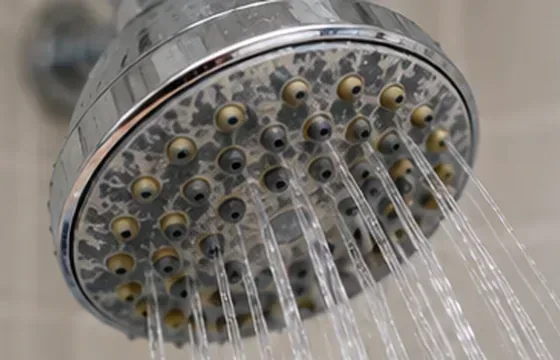
Visible mineral deposits and uneven spray are signs that cleaning the shower head is a reasonable first troubleshooting step.
Myth: If vinegar is off the table, baking soda is the universal replacement
Not verified as a universal descaler: the official sources reviewed for this article do not support baking soda as a one-size-fits-all treatment for mineral scale on every shower head. Mineral deposits and finishes differ, and a mildly abrasive paste can be a poor choice on a finish that the manufacturer says to clean only with a soft cloth. A household remedy being common online does not make it compatible with your particular fixture.
What to do now: do not choose a substitute merely because it is in the pantry. If the manual specifies mild detergent, a proprietary fixture cleaner, citric-acid cleaner, or mechanical cleaning, follow that instruction instead.
Myth: Any acid is safe if you dilute it enough
False as a general rule: cleaner compatibility depends on the product. Hansgrohe recommends gentle cleaners such as certain citric-acid products for its showers, while warning against products containing hydrochloric acid, formic acid, chlorine bleach, or acetic acid. It also advises against spraying cleaner directly onto the shower, because mist can enter the fixture. Other manufacturers may give different instructions.
What to do now: if your manufacturer approves a citric-acid cleaner, use the concentration and contact time on the cleaner label and fixture instructions. If you cannot confirm compatibility, stay with water, a soft cloth, and mechanical cleaning until you can identify the product.
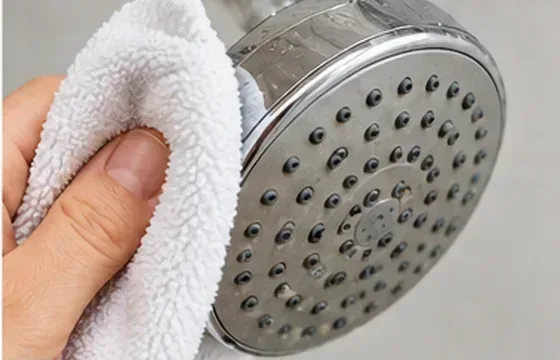
Start with the least aggressive method: a soft cloth and gentle mechanical cleaning, especially on finishes that may be sensitive to chemicals.
Myth: A clogged spray hole should be opened with a pin or needle
Potentially damaging: manually enlarging or boring spray holes can change the spray pattern and water use. EPA WaterSense guidance for commercial facilities specifically cautions against boring holes or manually removing scale in ways that can cause performance problems. Flexible nozzles are generally intended to be rubbed or cleaned as directed by the manufacturer, not reshaped.
What to do now: use fingers, a soft cloth, a soft brush, or the manufacturer-prescribed method. Avoid needles, drill bits, metal picks, and other sharp tools unless the product manual explicitly calls for one.
Myth: Cleaning mineral scale also disinfects the shower head
Different jobs: removing visible scale, soap residue, or debris is not the same thing as disinfecting a water fixture. The CDC advises cleaning shower heads when buildup is visible and following manufacturer instructions. EPA guidance on Legionella at home similarly says to keep fixtures clean and to follow the manufacturer's recommended cleaning product and method. Specialized disinfection protocols—especially in healthcare or known Legionella situations—are a separate matter.
What to do now: if your goal is routine home maintenance, focus on removing buildup safely. If there is a specific health concern, known Legionella contamination, or a high-risk person in the home, follow public-health and manufacturer guidance rather than improvising with stronger chemicals. See the CDC's home waterborne-germ guidance and the EPA's Legionella guidance.
A manufacturer-first way to clean a shower head without vinegar
The following sequence is intentionally conservative. It starts with the least aggressive intervention and adds a descaling cleaner only when your product documentation supports one.
1. Inspect the spray pattern and the type of buildup
Look for white or chalky deposits around the nozzles, a crust on the faceplate, stray jets, or a noticeably uneven spray. Those signs are consistent with scale or debris restricting water passages. If every faucet and shower in the home has weak pressure, however, the problem may be upstream rather than limited to this shower head.
Action: take a quick photo of the spray pattern and the faceplate before cleaning. It gives you a useful before-and-after comparison without requiring a flow meter.
2. Try the gentlest cleaning method first
Wipe the exterior with a soft, clean cloth. If the shower head has flexible rubber or silicone nozzles and the manufacturer says they are designed for touch cleaning, gently rub each nozzle with your fingertips to break loose scale. Do not use an abrasive scrub pad. Hansgrohe explicitly advises a soft clean cloth and warns against abrasive materials; Delta's Touch-Clean models are designed so deposits can be rubbed from the spray holes.
Action: run the shower briefly after rubbing the nozzles. If the spray pattern returns to normal, stop there—you have avoided unnecessary chemical exposure.
3. Remove the shower head only if the product is designed to be removed
A removable head is easier to flush and, where approved, immerse. But some assemblies, rain panels, or integrated systems have model-specific disassembly instructions. Forcing a decorative fitting can scratch the finish or damage the connection.
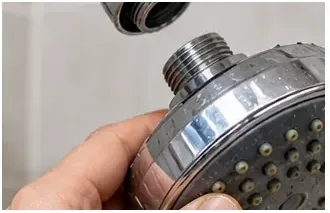
Action: check the installation or maintenance manual first. If hand removal is permitted, unscrew it carefully. If a wrench is required, protect the finish with a soft cloth and follow the manufacturer's instructions.
Remove the shower head only when its manual allows it; protecting the finish matters if a tool is needed.
4. Flush loose debris with clean water
Before soaking anything, rinse accessible passages and the spray face with clean water. If the manual permits removal of a filter screen or screen washer, rinse that component separately and reinstall it in the original orientation. This step may solve a debris restriction without exposing the finish to a descaler.
Action: hold removable parts over a sink and rinse until visible loose particles are gone. Keep small screens, washers, and seals together so none are lost.
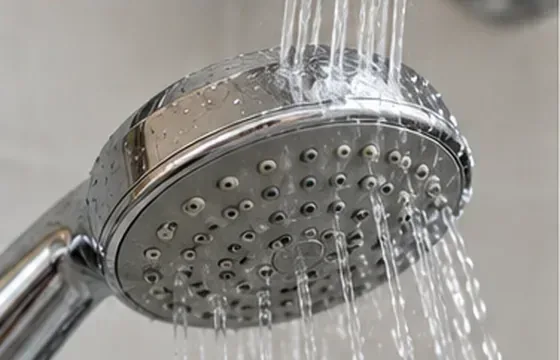
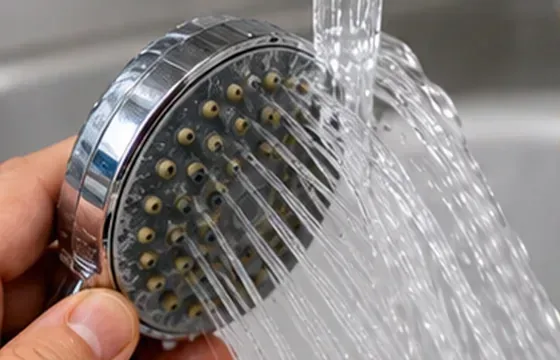
Flushing with clean water can dislodge loose debris before you introduce any cleaner.
5. If scale remains, use only a manufacturer-approved non-vinegar cleaner
This is the point where the answer becomes product-dependent. Hansgrohe's current care page recommends a mild citric-acid cleaning product for its shower heads and describes immersing a removable hand shower for a few minutes, followed by thorough rinsing. That does not mean every shower head can safely be soaked in citric acid. Coatings, plastics, adhesives, internal seals, and plated finishes vary.
KOHLER's shower-care page illustrates the opposite reason to stay product-specific: it directs users to its fixture cleaner, says to hold the sprayer 6–8 inches from the surface, wipe with a dry cloth, and test unfamiliar surfaces in a small inconspicuous area first. A cleaner or soaking method suitable for one brand is not automatically suitable for another.
Action: use the cleaner named in your manual. If a mild citric-acid product is explicitly allowed, follow the listed dilution and contact time. Do not extend a “few minutes” into an overnight soak unless the manufacturer specifically says you can.
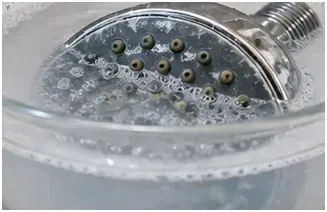
If the manufacturer permits immersion, use only an approved cleaner and the stated contact time rather than assuming every acidic solution is safe.
6. Loosen softened residue with a soft tool
After the approved cleaner has had its stated contact time, use a soft cloth, natural sponge, or soft toothbrush only where the manufacturer permits it. The goal is to lift softened deposits, not grind them off. Aggressive scouring may remove or dull a decorative finish before it removes the scale.
Action: work lightly around the nozzles and faceplate. If deposits do not move with gentle pressure, repeat the approved treatment rather than switching to a metal scraper or abrasive pad.
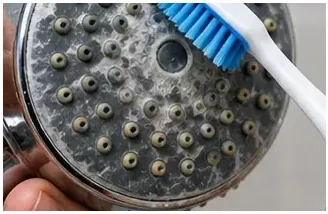
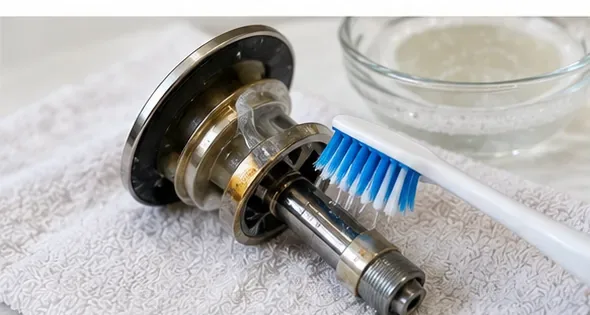
A soft brush can help lift loosened deposits, but avoid abrasive pads and never enlarge spray holes with sharp tools unless the manufacturer explicitly instructs you to.
7. Rinse thoroughly inside and out
Rinsing is not an optional finishing touch. Hansgrohe specifically instructs users to rinse the shower head thoroughly with clear water after cleaning. Residual cleaner left inside passages or on a finish can continue reacting after you think the job is done.
Action: rinse until no foam, cleaner odor, or loosened residue remains. If the head was immersed, make sure fresh water reaches the internal water path as well as the exterior.
Rinse the shower head inside and out so no cleaning product remains on the finish or in the water passages.
8. Reassemble, flush, and test every spray mode
Reinstall any screen, washer, or seal in the correct position, reconnect the shower head, and run the water. Hansgrohe recommends switching through the spray modes after reassembly; EPA WaterSense also notes that stray sprays or drips can indicate a connection problem that may need tightening and pipe tape where appropriate.
Action: check three things: the connection does not leak, the spray is more even, and all settings operate normally. If the spray remains weak while other fixtures have normal pressure, consult the product's troubleshooting guide or consider replacement.
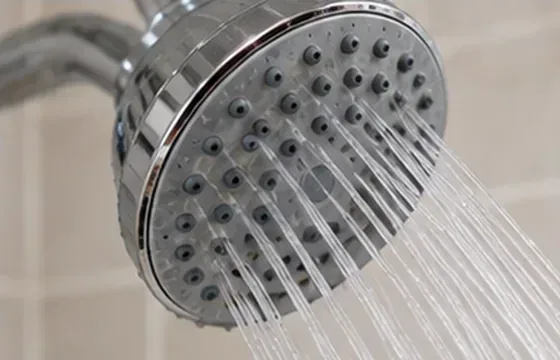
After reassembly, run the water and test every spray mode; an even pattern and leak-free connection are the practical checks that matter.
What is known, what depends on your shower head, and what may remain unknown
Question
Best-supported answer
Your next move
Do I need vinegar?
No. Some shower heads can be mechanically cleaned; others have manufacturer-approved non-vinegar cleaners.
Start with the manual and the least aggressive method.
Is citric acid always safe?
No. It is recommended for some products, including certain Hansgrohe care instructions, but compatibility is model- and finish-specific.
Use it only when your manufacturer approves it.
Can I use baking soda?
There is no universal manufacturer or agency recommendation supporting it for every shower-head finish or for dissolving scale.
Do not assume it is safer than a product named in your manual.
Should I soak the whole fixture?
Only if the product instructions allow immersion.
For an unknown model, wipe and rinse externally while you identify the fixture.
How long should I soak it?
There is no universal time.
Follow the approved cleaner and fixture instructions; avoid improvised overnight soaking.
How often should I clean it?
The needed frequency depends on water hardness, visible buildup, use, and fixture design.
Clean when buildup or spray distortion appears, and follow any model-specific schedule.
When cleaning is not the whole answer
If the shower head becomes dirty again very quickly, the underlying issue may be hard water rather than poor housekeeping. Hansgrohe notes that cleaning frequency depends on local water hardness, and EPA WaterSense recommends periodic inspection for scale buildup. A shower head that is physically damaged, badly corroded, cracked, or persistently restricted after correct cleaning may be more practical to replace.
What to do now: if scale returns rapidly, check your water utility's hardness information or have the water tested. If pressure is low throughout the house, investigate the plumbing or pressure regulator rather than repeatedly descaling one fixture.
The safest vinegar-free approach is therefore not a single substitute ingredient. It is a sequence: identify the fixture, start mechanically, escalate only to a compatible cleaner, rinse completely, and verify the spray afterward. That method is less dramatic than a viral cleaning hack, but it is far more likely to preserve both the finish and the performance of the shower head.