Home
» INTERNET
»
How to Get Chewing Gum Out of Clothes Without Damaging the Fabric
How to Get Chewing Gum Out of Clothes Without Damaging the Fabric
Chewing gum on clothing is frustrating because the obvious reaction—pulling at it while it is still soft—can stretch the gum deeper into the fibers or even damage the fabric. The most consistently supported first move is the opposite: make the gum hard, remove as much as possible mechanically, then treat the residue before washing.
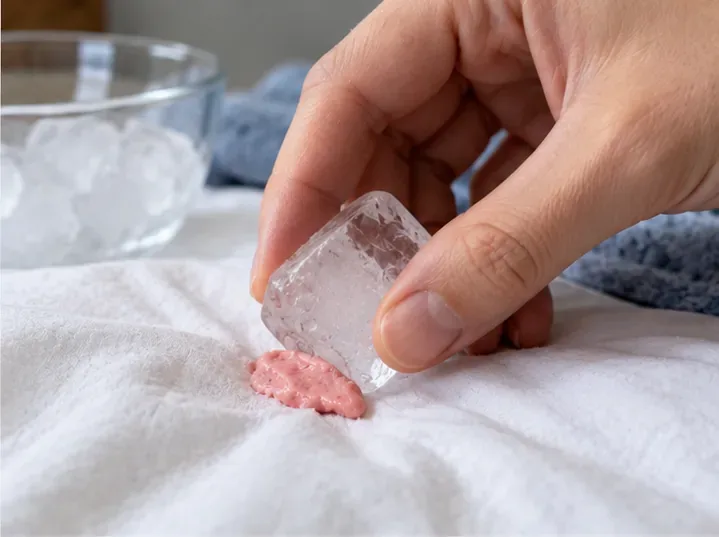
Tide, Clorox, and Maytag all recommend a cold or freezing step for gum removal. Tide advises using a bag of ice for about 15 minutes or placing a small garment in the freezer, then scraping carefully. Clorox also explains that freezing breaks the gum's bond with the fabric, while Maytag recommends ice followed by gentle scraping with a butter knife or spoon. See Tide's chewing gum stain guide, Clorox's gum-removal guidance, and Maytag's gum-removal guide.
What Is Verified, What Depends on the Fabric, and What Should You Avoid Guessing?
Question
Best-supported answer
Your action
Should you pull soft gum off immediately?
No. Tide warns that pulling can tear the garment.
Harden the gum first.
Does ice/freezing help?
Yes. Tide, Clorox, and Maytag all recommend hardening the gum before removal.
Use ice or a freezer if the garment fits safely.
Can you use liquid detergent or stain remover afterward?
Yes, for washable fabrics when the product is compatible with the garment.
Spot-test if needed, then pretreat residue.
Should you put the item in the dryer if a mark remains?
No. Tide and Whirlpool warn that heat can set remaining stains.
Repeat treatment before drying.
Is hot vinegar always safe?
No. Tide lists it as an alternative but requires a colorfastness test first.
Use only when the care label and spot test support it.
Is adhesive remover always safe?
No. Maytag says it must be clothing-safe and spot-tested.
Reserve it for stubborn residue and follow the product label.
Step 1: Harden the Gum With Ice or a Freezer
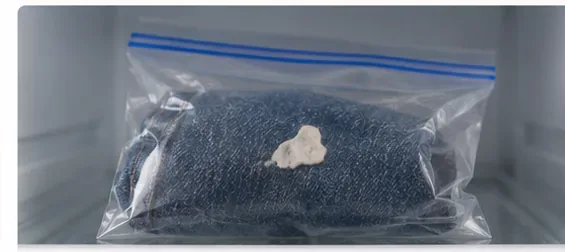
If the gum is soft, sticky, or stretching when touched, stop pulling at it. Place ice in a small plastic bag and hold it against the gum until the gum becomes firm. Tide's U.S. guide gives about 15 minutes as a practical ice-contact time. If the garment is small enough, putting it in the freezer is another manufacturer-supported option.
The goal is not to freeze the entire garment solid. You only need the gum firm enough that it no longer smears when you touch an edge. Clorox explains that gum adheres to the surface of fabric and that freezing can make it easier to separate from the fibers.
What depends on the garment: a structured coat, leather-trimmed item, or garment with unusual embellishments may not belong in a freezer. In that case, local ice treatment is the more controlled option.
Action: move to scraping only when the gum is hard and brittle enough to lift rather than stretch.
Cold makes soft gum firmer and easier to separate from fabric without smearing it deeper into the fibers.
Step 2: Scrape Off the Hardened Gum Gently
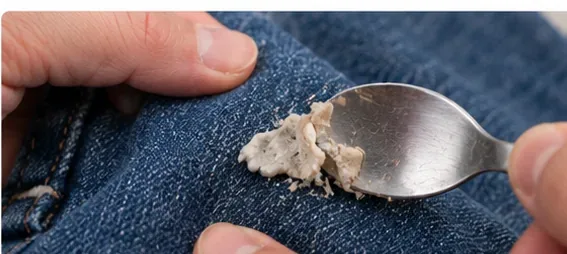
Use the edge of a spoon, a dull butter knife, or another smooth, non-sharp tool to lift the hardened gum from the fabric. Work from the outside edge toward the center. Maytag specifically recommends a butter knife or spoon, and Tide similarly advises scraping carefully so you do not damage the fibers.
Do not use a razor blade or aggressively saw at the fabric. On denim or a sturdy cotton twill, you may have more room to work than on a fine knit, satin, lace, or lightweight performance fabric. The correct amount of force depends on the textile.
If the gum begins to soften and smear again, stop and reapply ice. Trying to finish quickly while the gum is warm often makes the cleanup harder.
Action: remove as much solid gum as you reasonably can before adding detergent or another cleaning product.
Use a dull, smooth edge to lift hardened gum gradually; stop if the fabric starts to stretch or the gum turns soft again.
Step 3: Treat the Sticky Residue That Remains
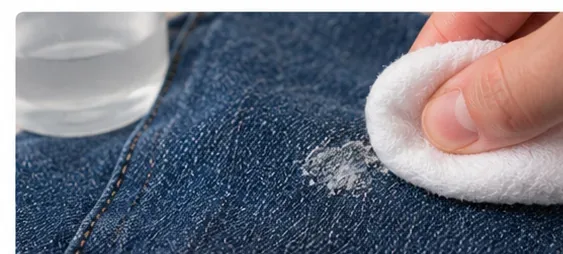
After the bulk gum is gone, you may still see a tacky film, pale mark, or small particles bonded to the fibers. That is a different stage of the job. Whirlpool recommends applying a stain remover or a small amount of liquid laundry detergent to the affected area, gently working it in with fingers or a soft toothbrush, letting it sit for about 10 to 15 minutes, and then laundering in the warmest water that is safe for the fabric. See Whirlpool's official gum-residue guidance.
Tide recommends checking the care label and, when using a cleaning solution that may affect color, spot-testing in an inconspicuous area first. A spot test means applying a small amount of the cleaner somewhere hidden—such as an inside seam—to check for dye loss, texture change, or damage before treating the visible area.
What is verified: liquid detergent or a clothing-safe stain remover is a reasonable next step for ordinary washable garments.
What depends on the garment: dry-clean-only fabrics, silk, acetate, leather, suede, and specialty finishes can require professional care or a different product. The laundry methods here are not permission to ignore the care label.
Action: pretreat only the residue area, use a soft touch, and give the cleaner the contact time directed by the product or manufacturer.
Once the solid gum is gone, treat the remaining film with a fabric-compatible laundry product rather than scraping harder.
Step 4: Wash, Inspect, and Only Then Dry
Wash the garment using the cycle and water temperature allowed by its care label. Tide and Whirlpool both advise using the warmest water that is safe for the fabric when laundering a treated gum stain. That does not mean choosing hot water automatically; if the care label says cold, cold is the safe limit.
When the wash cycle ends, inspect the area while the garment is still wet. If you can still see gum residue or discoloration, repeat the pretreatment and washing process. Tide and Whirlpool both caution against machine-drying a remaining stain because dryer heat can set it and make later removal more difficult.
This is one of the most useful points to remember: washing is not the finish line; inspection is.
Action: air-dry the item or keep it out of the dryer until you are satisfied that the gum and residue are gone. Once the area is clean, dry the garment according to its care label.
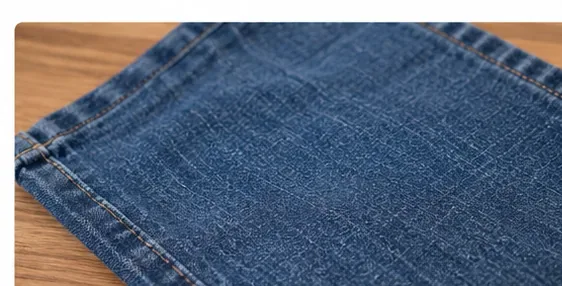
Inspect the cleaned fabric before using dryer heat; repeat the treatment if any gum residue or stain is still visible.
Common Misunderstandings About Gum Removal
“The Faster I Pull, the Cleaner It Will Come Off”
This is not supported by the manufacturer guidance reviewed here. Tide specifically warns against pulling because you can tear the garment. Soft gum also stretches and spreads.
Action: harden first, then lift gradually.
“Hot Water Should Melt the Gum Away”
Heat is not the best first step for soft gum. The primary method supported across Tide, Clorox, and Maytag is to harden the gum with cold. Heat can be used in some alternative techniques, but it also makes gum soft and can complicate handling.
Action: use cold for the initial removal. Save any heat-based technique for a method specifically recommended for your fabric and cleaning product.
“Vinegar Is Always Better Than Detergent”
Tide does list hot distilled white vinegar as an alternative gum-removal method, but it also says to test the garment for colorfastness first. That makes vinegar a conditional method, not the universal first choice.
Action: if ice plus detergent works, there is no need to escalate. If you choose vinegar, test a hidden area first and follow the garment's care restrictions.
“Adhesive Remover Is Fine Because Gum Is Sticky”
Maytag says adhesive or sticker remover can be used only after confirming that the product is safe for clothing and after a discreet spot test. Maytag also warns that if the remover contains alcohol, the garment must be rinsed thoroughly before it goes into a washer or dryer because alcohol is flammable.
Action: use adhesive remover only as a stubborn-residue option, not as a casual first step.
What About Delicate or Dry-Clean-Only Clothes?
If the care label says Dry Clean Only, or if the garment is made from a delicate material that can be distorted by scraping or spot treatments, home gum removal becomes less predictable. The manufacturer sources above focus mainly on washable garments and do not establish one universal DIY method for every delicate textile.
That is an important limit rather than a gap to fill with guesswork. A professional cleaner can evaluate the fiber, dye, finish, and construction before choosing a solvent or mechanical treatment.
Action: for a valuable, delicate, structured, or dry-clean-only garment, remove only loose gum that lifts without force and then take the item to a professional cleaner.
How to Self-Check the Result
Once the garment has been washed but before it is dried, inspect the treated area under bright light. Look for three things:
No visible lump or smear of gum remains.
The fabric no longer feels tacky when lightly touched.
The area has no remaining discoloration that would justify another pretreatment cycle.
If all three checks pass, dry the garment according to the care label. If any one fails, repeat the residue-treatment step before applying dryer heat.
The simplest reliable sequence is: freeze, scrape, pretreat, wash, inspect. It is less dramatic than many internet hacks, but it matches the strongest overlap in current manufacturer guidance and gives you clear stopping points that help protect the fabric.