Home
» INTERNET
»
How to Wash a Baseball Cap in the Dishwasher: A Practical Risk-First Guide
How to Wash a Baseball Cap in the Dishwasher: A Practical Risk-First Guide
Washing a baseball cap in the dishwasher can sound appealing because the hat is not tumbled the way it would be in a washing machine. The catch is that a dishwasher is built for dishes, not textiles. Hot water, heated drying, strong automatic-dishwasher detergent, and long spray cycles can affect color, shape, stitching, adhesives, and the bill.
The safest starting point is the cap's own care label. New Era's current care guidance, for example, recommends spot cleaning many of its caps with a damp cloth and mild, color-safe detergent and specifically says not to machine wash or fully submerge them. It also recommends air-drying in a natural position. See New Era's official cap-care guidance. If your label gives similar instructions, skip the dishwasher.
If you have a sturdy, non-collectible cap whose manufacturer allows full wet washing, you can consider the dishwasher only as a cautious, low-heat rinse method. Hand washing remains the easier method to control.
Quick decision table: should this cap go in the dishwasher?
Cap condition or care instruction
Dishwasher?
Better choice
Label says spot clean only, do not submerge, or do not machine wash
No
Spot clean by hand
Wool, leather, suede, silk, vintage, collectible, or unknown construction
No
Use the maker's care method or professional cleaning
Fragile patch, loose embroidery, cracked print, or lifting adhesive
No
Gentle local cleaning
Sturdy cotton/polyester cap with a label that permits full wet washing
Maybe
Hand wash first; dishwasher only if you accept the added risk
Material or bill construction is unknown
No
Choose the least aggressive method
Before you start: a short checklist
Read the sewn-in care label and any brand-specific care page.
Make sure the cap is not valuable, vintage, signed, or collectible.
Check the bill, seams, patches, and embroidery for looseness or cracking.
Test an inconspicuous area for color transfer with a damp white cloth.
Confirm your dishwasher lets you disable heated dry, sanitize, and other high-temperature options.
Plan to run the cap without dirty dishes.
A five-step dishwasher method for a washable baseball cap
1. Inspect the cap and stop if the care instructions conflict
Look at the sweatband, crown, bill, seams, closure, and decorations. If the care label says spot clean only or warns against soaking, that instruction overrides any generic dishwasher method. The same goes for caps with materials that should not be exposed to water.
Also check for dye transfer. Dab a hidden area with a white cloth dampened with cool water. If color comes off easily, do not put the cap through a spray cycle.
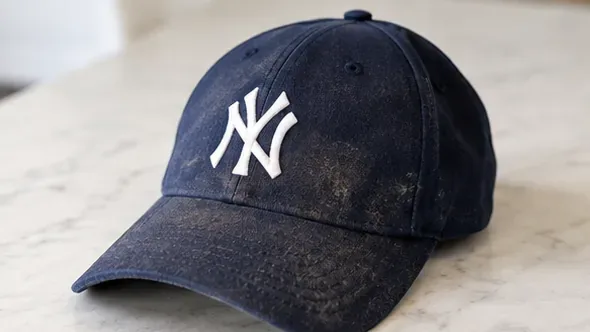
Inspect the fabric, bill, seams, decoration, and care label before deciding whether full wet cleaning is appropriate.
2. Remove loose dirt and pre-treat only where needed
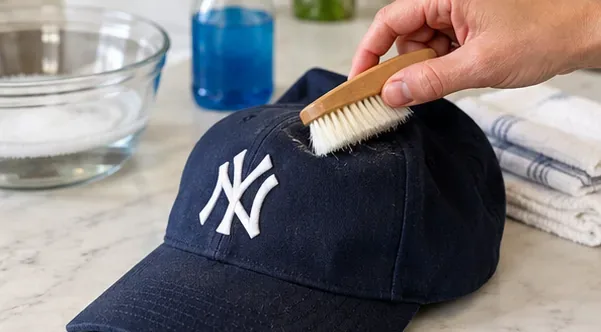
Brush away dust and dried soil with a soft brush. For sweat marks or a small stain, use a minimal amount of mild, color-safe detergent on a damp cloth or soft brush. Work gently instead of saturating the entire cap.
Then rinse the treated area thoroughly at the sink. This matters because you should not pour laundry detergent, hand dish soap, or other high-sudsing cleaners into a dishwasher. Whirlpool's dishwasher guidance says to use only detergent made for automatic dishwashers because other detergents can create excessive suds and poor wash performance. See Whirlpool's detergent guidance.
Use a soft brush and mild spot treatment first, then rinse away the cleaner before the cap goes near the dishwasher.
3. Secure the cap on the upper rack
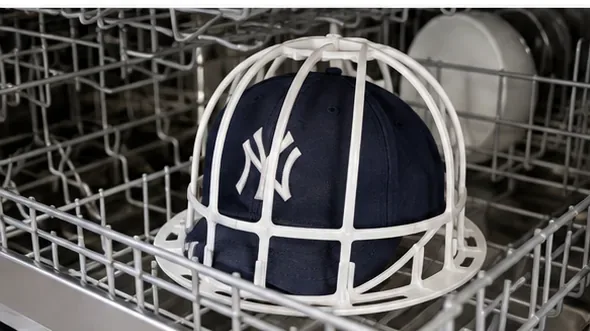
Place the cap on the upper rack where it cannot fall, collapse, or block a spray arm. A rigid cap form or cap cage can help support the crown, but it does not make an otherwise non-washable hat safe. Check that the dishwasher's spray arms can rotate freely before closing the door.
Do not wash the hat with plates, cookware, or food-soiled items. The goal is to reduce contamination and avoid having the cap rub against hard objects.
The upper rack is the less aggressive location when heat is a concern. Whirlpool advises placing heat-sensitive plastics in upper racks because lower-rack placement can expose them to more heat. That advice is about dishwasher-safe plastics, not hats, so treat it as a placement principle rather than proof that a cap is dishwasher-safe.
A cap form can support the crown on the upper rack, but the hat's care label still determines whether full wet washing is appropriate.
4. Choose the coolest, shortest cycle your machine allows
If your dishwasher has a rinse-only, light, or short low-temperature cycle that can run without detergent, that is the least aggressive dishwasher option after pre-treatment. Do not improvise by adding laundry detergent or hand dish soap to the machine.
Turn off heated dry. Avoid sanitize, high-temperature wash, steam, or similar heat-boosting options. Whirlpool explains that heated drying uses a heating element and recommends avoiding it for items with finishes, adhesives, or materials that may be affected by heat. See Whirlpool's heated-dry guidance.
Dishwasher temperatures vary by model. As one concrete example, a Whirlpool cycle guide documents a High Temp option that can raise the main wash temperature to 135°F (57°C). That number is not universal, but it illustrates why you should read your own appliance manual rather than assuming every "normal" cycle is gentle.
If you cannot confidently disable high heat or identify a low-temperature cycle, stop here and hand wash the cap instead.
5. Remove the cap promptly, reshape it, and air-dry
Take the cap out as soon as the water portion of the cycle finishes. Blot excess moisture with a clean towel rather than twisting or wringing. Smooth the panels, restore the bill to its intended curve, and let the cap air-dry in a natural shape with good airflow.
Do not put it through the dishwasher's heated drying stage, a clothes dryer, or direct high heat. New Era likewise recommends air-drying to help maintain size and shape.
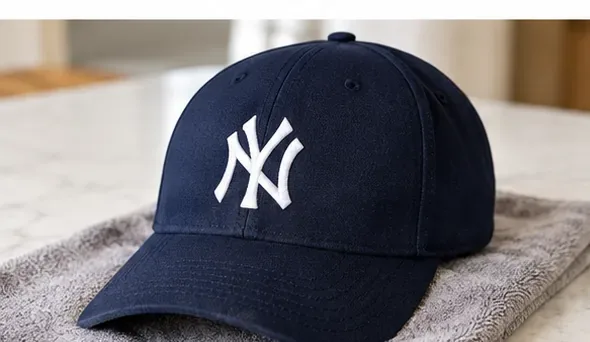
Reshape the crown and bill while damp, then let the cap air-dry naturally instead of using heated drying.
How to judge the result
A successful clean is not just "the stain is gone." Check the cap after it is fully dry:
Good result: the crown sits evenly, the bill holds its original shape, the color is consistent, and the sweatband is clean without stiffness or residue.
Switch methods: stains remain but the cap is structurally fine. Do not automatically run a second dishwasher cycle; targeted hand cleaning gives you more control.
Stop using the dishwasher: you see color bleeding, puckered fabric, a warped bill, loose stitching, lifting patches, bubbling adhesive, or a changed fit.
Common questions
Can I use dishwasher detergent on a baseball cap?
It is not the best choice. Automatic dishwasher detergent is formulated for dishes and the dishwasher's wash system, while cap makers such as New Era recommend mild, color-safe detergent for textile spot cleaning. A safer compromise is to pre-treat the cap by hand, rinse the mild cleaner out at the sink, and use a detergent-free rinse or low-impact dishwasher cycle only if the hat's care instructions permit full wet washing.
Can I put a baseball cap in the dishwasher with dishes?
It is better not to. A cap can carry sweat, skin oils, soil, sunscreen, and hair products, while plates and cookware can carry food residue and grease. Running the cap by itself also makes it easier to secure the hat and keep spray arms unobstructed.
Does a cap cage make the dishwasher method safe?
No. A cage can support the shape, but it cannot change the cap's fiber content, dye stability, adhesives, bill construction, or care instructions. Think of it as a shape-support tool, not a compatibility guarantee.
Is a polyester cap automatically dishwasher-safe?
No. Fiber content is only one part of the construction. The bill, interfacing, thread, patches, adhesives, printed decoration, and dye can all respond differently to water, detergent, and heat. Follow the complete care label rather than judging by "polyester" alone.
The safest default
If you are unsure, hand cleaning is the safer default because you can control water temperature, detergent strength, soaking time, and pressure. The dishwasher method should be reserved for a sturdy cap whose care instructions permit full wet washing and for a dishwasher that can run a genuinely low-heat cycle without heated drying.
The most useful rule is simple: do not use the dishwasher to override the hat manufacturer's care instructions. Use it, if at all, only as a controlled rinse tool after you have already confirmed the cap can tolerate full wet cleaning.