Home
» INTERNET
»
How to Wash a Sunbeam Electric Blanket Safely: What to Do Before, During, and After Washing
How to Wash a Sunbeam Electric Blanket Safely: What to Do Before, During, and After Washing
If your Sunbeam electric blanket has picked up body oils, a spill, pet hair, or a musty storage smell, the first question is not simply “Can I put it in the washer?” The important question is whether your specific heated bedding model is designed to be washed with its controller detached. For most Sunbeam heated blankets covered by the company’s current heated-bedding care guidance, the answer is yes: disconnect the power and controller, use cold water and mild soap on a gentle cycle, and make sure the blanket is completely dry before reconnecting anything.
As of September 2026, Sunbeam’s official heated-bedding care page still gives detailed washing and drying instructions for blankets, throws, and mattress pads. Those instructions are the basis for the process below. Your model’s sewn-in care label and instruction booklet take priority if they differ, because Sunbeam publishes separate manuals for different bedding families. You can check the official Sunbeam heated bedding care and cleaning instructions and the Sunbeam instruction manual library before washing.
Can you machine-wash a Sunbeam electric blanket?
Usually, yes—if it is a Sunbeam heated bedding product with a detachable controller and its care label permits machine washing. Sunbeam’s general heated-bedding instructions call for a cold-water wash with mild soap on a delicate or gentle cycle. The company also says the power cord and control cords must not be washed or submerged.
This distinction matters because a Sunbeam electric blanket is not the same product as every Sunbeam heating pad or wrap. Some heating pads have removable covers that can be washed while the heating pad itself should only be wiped. If you are cleaning a blanket, throw, or mattress pad, use the heated-bedding instructions for your model rather than borrowing directions from a heating-pad page.
Question
Practical answer
Can the blanket go in a washer?
Yes, when the model label/manual allows it; Sunbeam’s general bedding guidance uses cold water and a gentle cycle.
Can the controller go in the washer?
No. Disconnect it and keep all control and power cords out of water.
Can you use bleach?
No. Sunbeam says not to use bleach or cleaning fluids on heated bedding.
Can you dry-clean it?
No. Sunbeam warns that dry-cleaning solvents can damage the wires.
Can you use a dryer?
Sunbeam’s general care page allows short low-temperature tumble drying, followed by air drying. Do not use a commercial or laundromat dryer.
Can you reconnect it while slightly damp?
No. The blanket and connector must be completely dry first.
What should you check before washing?
Unplug the blanket from the wall before you do anything else. Sunbeam specifically says to disconnect the power cord from the wall first and then detach the control cord from the heated product. Inspect the fabric while it is unplugged. If a wire appears to have worn through the fabric, the blanket should not go through a wash-and-reuse cycle as though nothing happened; stop using it and consult Sunbeam support or the model manual.
Also check the sewn-in care label. Older blankets, connected models, specialty blankets, and products sold in different regions may not use identical care directions. If the label gives a different water temperature, drying method, or cycle instruction, follow the model-specific label.
How to wash a Sunbeam electric blanket in four steps
1. Unplug it, detach the controller, and inspect the blanket
Turn the blanket off, unplug the power cord from the wall, and detach the controller cord from the blanket’s connector. Do not tug on the cord itself; support the connector while disconnecting it. Set the controller and cords aside somewhere dry. Before washing, look across the blanket for damaged fabric, exposed wiring, split connectors, or areas where the internal wiring seems unusually bunched.
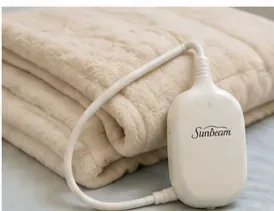
Disconnect the wall power and remove the controller before the blanket goes near water; the controller and cords must stay dry.
If your only problem is a small surface mark, you may not need a full wash. A limited spot clean can reduce wear from unnecessary laundering, but only use methods allowed by the care label and avoid saturating the connector area.
2. Treat minor soil and presoak when the model instructions call for it
For a full wash under Sunbeam’s general heated-bedding care directions, presoak the blanket for 15 minutes in cold water with mild soap. The goal is to loosen ordinary soil without harsh chemicals or aggressive scrubbing. Do not use bleach, dry-cleaning fluid, fabric treatments not permitted by the label, or a wringer.
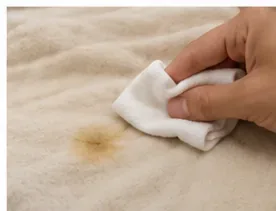
For localized soil, use gentle blotting rather than hard scrubbing; for a full wash, Sunbeam’s general care guidance starts with a cold-water mild-soap presoak.
For example, if a coffee splash affected only one corner and the wiring and connector are intact, gently blotting the area before the wash may be enough preparation. If the entire blanket smells stale from storage, a full wash is more appropriate.
3. Wash briefly in cold water on the gentle cycle
Sunbeam’s general care page says to wash heated bedding in mild soap and cold water on the delicate or gentle cycle for two minutes, rinse in fresh cold water, and spin dry in the washing machine. That short wash is very different from a long, heavy-duty cycle designed for towels or work clothes.
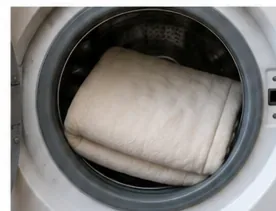
Use the cold, delicate or gentle settings specified by Sunbeam rather than a hot or heavy-duty cycle.
Do not cram an oversized blanket into a drum where it cannot move freely. If your home washer is too small, do not automatically switch to a commercial laundromat machine just because it has more capacity: Sunbeam specifically warns against commercial dryers because their heat can damage heated-product wiring. For an oversized blanket, the safer choice is to consult the model manual and Sunbeam support rather than improvise.
4. Dry on low only as directed, reshape, and finish air drying
Drying is the part where patience matters most. Sunbeam’s general care page says to preheat a household dryer on low for two minutes, tumble the blanket on low for 10 minutes, remove it while still damp, gently shape it back to its original size, and then drape it over a clothesline or shower rod to finish drying. The same page also allows air drying without the dryer step.
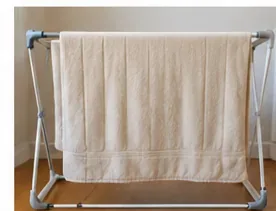
Finish drying with the blanket broadly supported and unpowered; do not reconnect the controller until every part is completely dry.
Do not use clothespins, a wringer, an iron, or a commercial dryer. Do not reconnect the controller because the surface feels dry while the connector area or inner layers still feel cool or damp. When in doubt, give it more drying time.
Should you use a dryer or air-dry the blanket?
Either can be appropriate under Sunbeam’s general instructions, but air drying is the lower-heat option. If you use a household dryer, stay with the manufacturer’s low-temperature, short-duration method. Do not substitute medium or high heat, and do not leave the blanket tumbling until it is bone-dry. Sunbeam’s process intentionally removes the blanket while damp so it can be reshaped and finished on a line or shower rod.
If your dryer does not have a reliably low setting, air drying is the safer practical choice. Drape the blanket so its weight is supported across a wide area rather than creating a sharp fold at one point.
What cleaning methods should you avoid?
The biggest mistakes are the ones that can damage insulation, wiring, fabric, or connectors. Sunbeam’s heated-bedding care instructions specifically say not to dry-clean, bleach, use cleaning fluids, use a wringer, iron, use mothballs or sprays, wash the cords, or reconnect the product before it is completely dry.
Do not immerse or wash the controller.
Do not wash the power cord or control cords.
Do not use bleach or dry-cleaning solvents.
Do not wring, twist, or aggressively stretch the blanket.
Do not iron the blanket.
Do not use a commercial or laundromat dryer.
Do not use clothespins while line drying.
Do not plug the blanket in while any part remains damp.
What if your model’s label says something different?
Follow the model-specific label and manual. Sunbeam maintains separate bedding guides, including guides for standard and connected bedding, and not every item currently appears in the active product catalog. The general care page is useful when it matches your product, but it is not a reason to override a different instruction printed on your blanket.
If you cannot identify the model number, check the blanket’s sewn-in label, connector area, original packaging, or controller markings. Use that information with Sunbeam’s official instruction manual page.
How do you know the blanket is safe to use again?
Before reconnecting anything, do a simple self-check. The blanket should be completely dry to the touch on both sides, including around the connector. The fabric should lie normally without hard twists or unusual bunching. The connector should be dry, clean, and undamaged. No internal wire should be visible through the fabric.
Once those checks pass, reconnect the controller according to the manual and use the blanket normally. If it does not heat properly, heats unevenly, shows an error, smells unusual, or has visible wiring damage, stop using it. Sunbeam’s care page includes a fold-test procedure for troubleshooting heated bedding, but it also says to stop using the product and contact the company if the test does not produce normal heat.
The safest way to wash a Sunbeam electric blanket is therefore not complicated: disconnect everything electrical, use cold water and mild soap with a gentle wash, avoid harsh chemicals and high heat, and wait until the blanket is fully dry before power is restored. The small amount of extra care protects the part you cannot see—the heating system sewn inside the fabric.