Home
» INTERNET
»
How to Wash a Weighted Blanket With Glass Beads: Choosing the Safest Method
How to Wash a Weighted Blanket With Glass Beads: Choosing the Safest Method
A glass-bead weighted blanket can sometimes go in a washing machine, but the fill material alone does not decide the safest cleaning method. Two blankets can both contain glass microbeads and still have completely different care rules. The most useful decision is therefore not “Are glass beads washable?” but “What does this specific blanket allow, and can my equipment handle its weight?”
Hypothetical example: Maya owns a 15-pound quilted weighted blanket filled with glass beads. She has a removable cover, a residential front-load washer, and a stain that has reached the inner blanket. Her goal is to clean it without stressing the stitched bead pockets or overloading the washer. This example is only an illustration; it is not a product test or a claim about a particular brand.
Quick answer: choose the method from the label, construction, and load
If the sewn-in label says the weighted insert is machine washable, a cold gentle cycle in an adequately sized washer may be appropriate. If the insert is hand-wash-only, the bathtub or another manufacturer-approved hand-wash method is the better choice. If the blanket is too large or heavy for your home machine, a commercial-capacity washer may reduce equipment risk—but only if the blanket itself is approved for machine washing.
Label permits machine washing and washer has enough capacity
Fast and convenient
Dense wet load can strain seams or an undersized machine
Commercial washer
Large/heavy machine-washable blanket
More drum space and load capacity
Extra trip and cost; still not appropriate for hand-wash-only inserts
Hand washing
Label requires it or machine use is questionable
More control over agitation
Heavy, awkward, and slower to rinse and dry
Step 1: read the care label before deciding anything
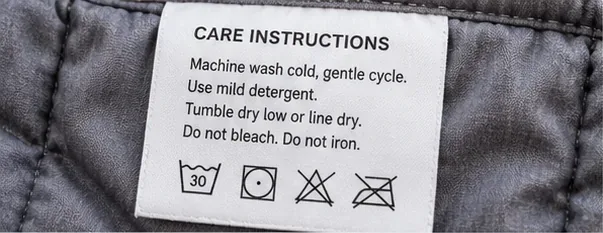
Start with the sewn-in care label. Glass beads do not make every weighted blanket machine washable; the shell, stitching, batting, and manufacturer instructions still control the method.
Check the sewn-in label on the weighted insert, not just the removable cover. Look for the permitted water temperature, machine-versus-hand-wash instruction, bleach restrictions, and drying method. If you cannot read the label, look up the exact model on the manufacturer’s support or product page rather than assuming all glass-bead blankets behave the same way.
Whirlpool’s weighted-blanket washing guidance similarly says a blanket filled with glass, steel, or plastic beads can be washed in a large-capacity commercial washer only when the care tag says it is machine washable. That is a useful boundary: washable fill does not override a hand-wash-only construction.
Step 2: remove the cover and inspect the blanket
Prepare the blanket before adding water: remove a washable cover if present and check the insert for open seams, loose beads, or damaged fasteners.
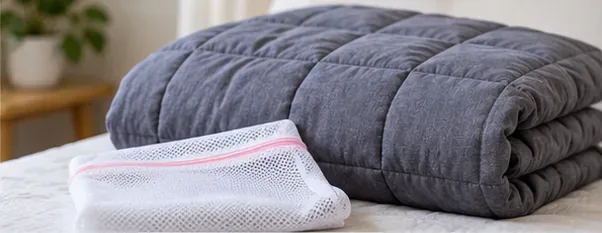
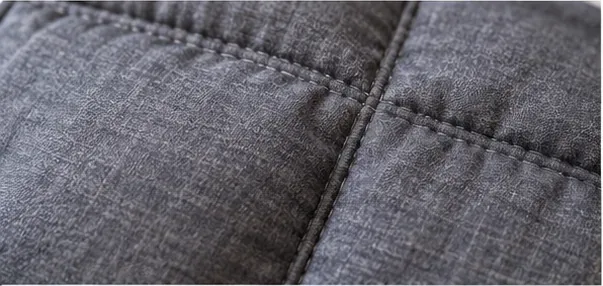
If the blanket has a duvet-style cover, remove it and wash the cover according to its own label. Then inspect the weighted insert in good light. Run your hands along the outer edge and across the quilted grid. Do not put an insert with a split seam, visible bead leakage, or failing corner attachment into a washing machine.
For Maya’s hypothetical blanket, this is the decision point. If the cover took most of the sweat and soil and the insert only has one small mark, spot cleaning may be enough. A full wash adds more mechanical stress than a targeted clean, so “deep clean every time” is not automatically the better choice.
Step 3: decide whether your washer is actually suitable
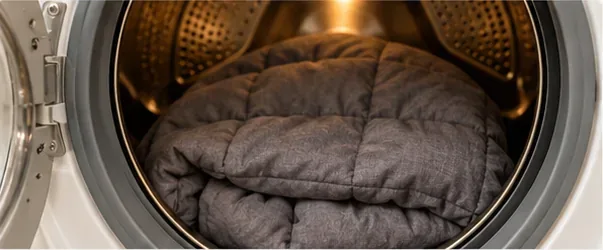
Machine washing is only an option when the label allows it and the washer can handle the load without crowding the drum.
A machine-washable label does not mean every residential washer is suitable. The blanket needs enough room to move, and the appliance must be able to handle the load. Weighted bedding is already heavy while dry, and the fabric and any batting retain water during a cycle.
If the blanket crowds the drum, the washer struggles to balance, or the appliance manual does not support a load that heavy, use a commercial machine if the blanket’s label permits machine washing. Whirlpool specifically frames its machine-wash method around a commercial washer. Baloo likewise directs king-size blankets to a commercial machine. The tradeoff is inconvenience versus reducing the risk of overloading a smaller home unit.
Step 4: pre-treat stains and use mild detergent
Use a small amount of mild detergent and follow the blanket maker’s limits on bleach, softener, and water temperature.
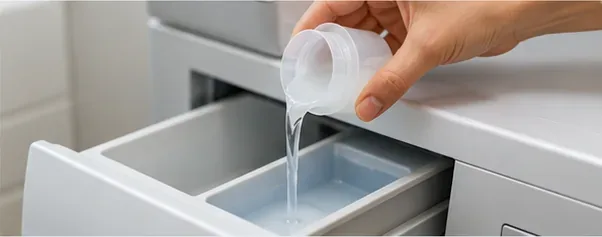
Pre-treat only the stained area with a product that is compatible with the blanket’s fabric and care label. For the main wash, use a modest amount of mild detergent. Whirlpool advises cold water, a gentle cycle, mild detergent, and avoiding bleach-based cleaners and fabric softeners for its general machine-wash method.
More detergent is not necessarily cleaner. Dense quilted construction can be harder to rinse than ordinary sheets, so excess detergent can leave residue in the shell and batting. When in doubt, follow the detergent dose recommended for the load and washer rather than adding extra because the blanket is heavy.
Step 5: if machine washing is allowed, keep the cycle gentle
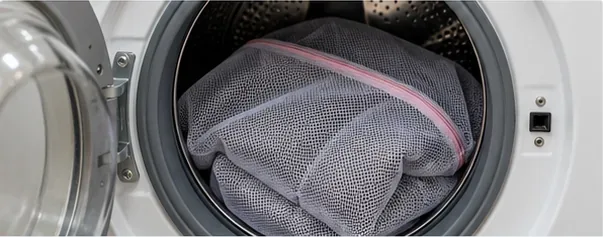
Wash the weighted insert by itself unless the manufacturer says otherwise. Select the temperature and cycle on the care label; cold water and a gentle cycle are common manufacturer directions for washable glass-bead blankets. Place the blanket evenly in the drum instead of packing it tightly to one side.
For Maya, suppose her label explicitly says “machine wash cold, gentle,” but her home washer is small enough that the blanket barely fits. The better choice is not to force the load. She could use a larger commercial washer, provided the blanket remains machine-washable according to its own label.
What if the label says hand wash?
Use a bathtub or large basin that can support the blanket. Add the amount of mild detergent allowed by the manufacturer, gently work water through the fabric, then rinse thoroughly. Avoid aggressive twisting if the label does not specifically call for it; a wet weighted blanket places substantial force on its stitched compartments. Support the blanket across both hands or along the tub as you move it.
This is where Gravity’s current instructions provide a useful real-world contrast: its glass-bead inner is hand-wash-only even though the cover is machine washable. Choosing hand washing for that insert is not “being extra careful”; it is following the product’s actual care specification.
Step 6: choose drying based on the label, not on the beads
A dryer is not universal. Use low or no heat only when the care label permits it; otherwise choose the manufacturer-approved air-drying method.
Drying instructions vary just as much as washing instructions. Some machine-washable glass-bead blankets permit low-heat tumble drying. Others require air drying. High heat is not a useful shortcut when the manufacturer specifies low or no heat, because the shell, batting, thread, and bindings—not just the glass beads—must survive the process.
Whirlpool recommends air drying when possible and says some blankets may use a dryer at no heat or low heat if their care instructions permit it. Gravity directs its weighted inner to air dry, while Baloo permits low heat on its washable weighted throw. Again, the tradeoff is speed versus the material and construction limits of the specific blanket.
Step 7: verify that the entire blanket is dry
Do not use or store the blanket until the fabric, batting, seams, and every weighted pocket are fully dry.
A surface that feels dry does not prove the interior of every quilted pocket is dry. Press several sections, especially corners and thicker areas. If any section feels cool, damp, or noticeably heavier, continue drying using the approved method. Do not put a damp weighted insert back inside a duvet cover or into storage.
For air drying, distribute the blanket’s weight across a broad, sturdy surface or heavy-duty rack rather than letting all of the wet weight pull from one narrow point. If the manufacturer permits flat drying, that is often an easy way to support the grid evenly. If it specifies another method, follow that instruction instead.
Step 8: inspect the seams and bead distribution after cleaning
After washing, inspect the grid seams and corners for new openings, puckering, or bead migration before putting the blanket back on the bed.
Once the blanket is completely dry, inspect the stitched grid again. Look for opened seams, distorted pockets, loose threads, or sections where the fill appears to have shifted. A small amount of settling can often be redistributed by laying the blanket flat and gently smoothing the pockets with your hands. If beads are escaping, stop using the blanket until it is repaired according to the manufacturer’s guidance.
This check matters because a wash can reveal a pre-existing weak seam that was not obvious when the blanket was dry. Finding that problem before the next wash also keeps loose beads away from a washer or dryer.
Store it dry and reduce how often the insert needs a full wash
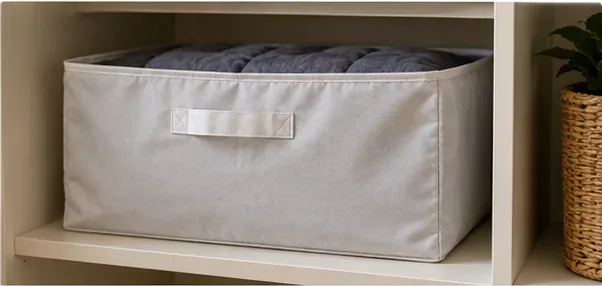
Store the blanket only when fully dry, with enough support that its weight is not hanging from one narrow edge.
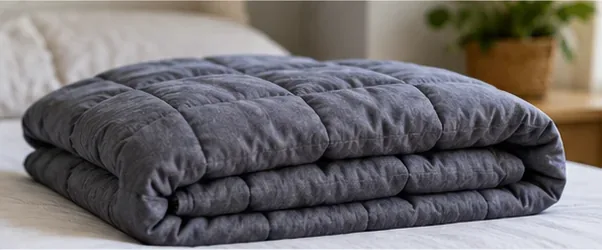
Store a weighted blanket only when it is fully dry. Keep it folded or broadly supported so its full weight is not pulling from one corner or loop. A removable cover can make future care easier because the cover takes most day-to-day contact and is usually simpler to wash than the weighted insert.
In Maya’s hypothetical case, the practical long-term choice is to wash the removable cover more often and reserve full insert washing for spills, odor, or broader soiling. That reduces wear while still keeping the bedding clean. The exact frequency should reflect use, exposure to pets or sweat, and the manufacturer’s instructions rather than a fixed schedule copied from another blanket.
Common mistakes to avoid
Assuming glass beads automatically mean machine washable. Gravity and Baloo are both glass-bead examples with different insert-care instructions.
Ignoring washer capacity. A blanket that technically fits may still be too dense for the machine to balance safely.
Using hot water or high heat without permission. The surrounding textiles and stitching may have stricter limits than the glass fill.
Washing a leaking or damaged insert. Repair the problem before putting loose fill near appliance pumps or drains.
Using extra detergent because the blanket is heavy. More product can mean more residue and more rinsing difficulty.
Storing before every pocket is dry. Thick quilted sections can retain moisture after the surface feels dry.
Which method should you choose?
Choose spot cleaning when the problem is small and localized. Choose a home machine only when the label allows it and the appliance can handle the load comfortably. Choose a commercial washer for a large machine-washable blanket that exceeds your home setup. Choose hand washing when the label requires it or machine agitation is not approved.
The safest rule is also the simplest: let the specific blanket’s care label and manufacturer instructions outrank generic advice about glass beads. Glass beads can tolerate water in many designs, but the blanket is a complete textile system—shell, batting, seams, fasteners, and fill—and the weakest part of that system determines how it should be cleaned.