Home
» INTERNET
»
How to Wash Stuffed Animals in the Washing Machine Without Ruining Their Shape
How to Wash Stuffed Animals in the Washing Machine Without Ruining Their Shape
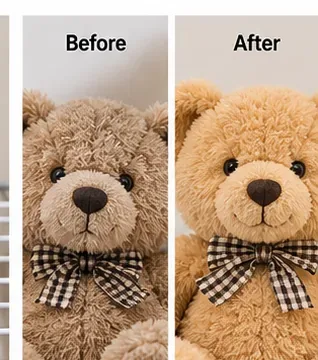
Machine washing can be a practical way to clean a stuffed animal, but the best result is not simply “the toy survived the washer.” A good result means the plush is visibly cleaner, smells fresh without a strong detergent odor, keeps its shape, has intact seams and attachments, and is completely dry inside before it goes back into use.
The first rule is to treat the care label as the deciding authority. Whirlpool advises checking the care tag before choosing machine washing, hand washing, or spot cleaning, and notes that toys with battery packs, mechanical parts, or metal components should not be immersed. Maytag likewise recommends avoiding machine washing for plush toys with electronics, delicate decorations, or certain specialized fillings. Manufacturer instructions can differ even within one brand, so a method that works for one teddy bear may be wrong for another. See the official Whirlpool stuffed-animal washing guidance and Maytag stuffed-animal care guidance.
Quick decision guide: washer, hand wash, or surface clean?
Condition
Best starting method
Why
Care tag says machine washable; seams are sound; no electronics or fragile parts
Machine wash
A gentle cycle can clean the entire toy while a mesh bag limits abrasion.
Care tag is missing, the toy is old, or construction is delicate
Hand wash
You can control soaking, squeezing, and agitation more carefully.
Electronic, musical, mechanical, structural, or explicitly “surface wash only”
Surface clean
Immersion can damage internal components or adhesives.
Water and agitation can turn a small defect into permanent damage.
This distinction is not theoretical. Jellycat states that many of its designs can be machine washed at up to 30°C, while items with structural elements or musical chips should not be immersed. That is a useful example of why construction matters as much as fabric. See Jellycat’s official washing and care statement.
How to wash stuffed animals in the washing machine
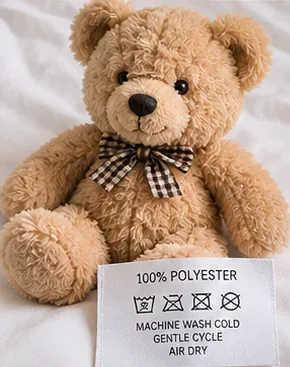
1. Read the care label and inspect the toy
Start with the care label and the toy’s construction. Machine washing is appropriate only when the manufacturer allows it and the toy has no water-sensitive parts.
Look for explicit washing and drying instructions before doing anything else. If the tag allows machine washing, inspect the toy as if you were checking it for wear before a trip: tug gently at seams, look around plastic eyes and noses, inspect embroidered areas, and check whether any glued trim is lifting.
If the care label is missing, Maytag recommends hand washing as the safer default. That is especially sensible for older toys whose fibers, thread, or stuffing may have weakened over time. A plush that is already splitting at a seam is not a good candidate for a washer until the seam is repaired.
2. Remove accessories and deal with loose dirt first
Remove detachable clothing and accessories, brush off loose debris, and check seams, eyes, noses, and decorations before the toy enters the washer.
Take off removable clothing, ribbons, collars, battery compartments, or other accessories that the manufacturer says can be detached. Wash removable fabric accessories separately if their own care instructions permit it.
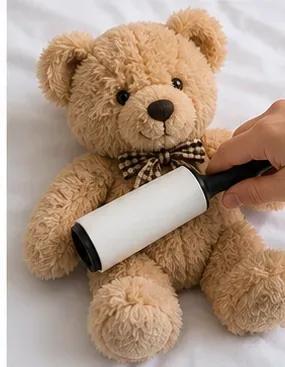
Brush or lint-roll away hair, crumbs, dust, and surface debris before washing. If there is a localized stain, test a small amount of diluted mild detergent on an inconspicuous area first. Whirlpool specifically recommends a color test because some dyes can transfer during cleaning. If color comes off during the test, stop and use a gentler method.
3. Protect the stuffed animal in a mesh bag or pillowcase
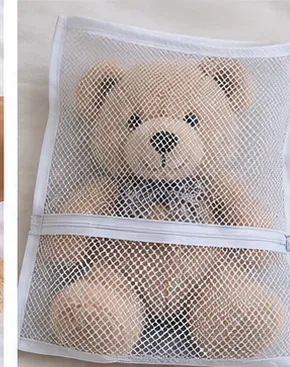
A mesh laundry bag or securely closed pillowcase reduces rubbing and snagging during a gentle wash cycle.
Put the toy in a zippered mesh laundry bag. A pillowcase can also work if it is securely closed. This barrier does not make an unsuitable toy safe to wash, but it reduces direct rubbing against the drum and helps prevent small parts from snagging.
For multiple plush toys, separate bags are preferable when practical. Do not cram a large stuffed animal into a bag or machine so tightly that water and detergent cannot circulate around it.
4. Load the washer without forcing an oversized toy
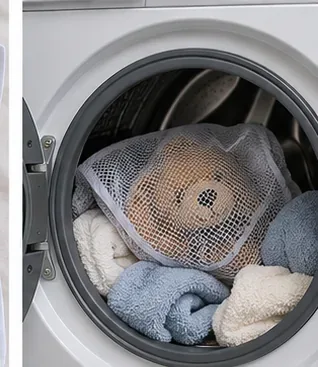
Place the protected toy in the washer only after confirming that its materials and internal components are washable.
The toy should fit comfortably in the drum. If it is compressed hard against the door or agitator, switch to hand washing or spot cleaning. Oversized plush can become extremely heavy when saturated, making it harder to rinse and dry evenly.
Before starting the machine, confirm one more time that there is no hidden battery pack, sound box, motor, wire frame, or other water-sensitive insert. Whirlpool specifically calls out battery packs, mechanical parts, and metal components as reasons to spot clean rather than immerse.
5. Use a gentle cycle, cold water, and mild detergent
For many machine-washable plush toys, cold water and a gentle or delicate cycle reduce mechanical stress. Follow the care tag if it specifies something different.
For a toy whose tag allows machine washing, a gentle, delicate, or hand-wash-type cycle with cold water is a conservative starting point. Whirlpool recommends gentle settings and cold water to help limit color fading, while Maytag also recommends a gentle cycle and avoiding bleach or harsh chemicals. Use a small, normal amount of mild laundry detergent rather than trying to “deep clean” with extra detergent.
If the care label specifies a different temperature or cycle, the label takes priority. Some manufacturers explicitly allow a warmer wash, while others restrict the item to cooler conditions. There is no universal temperature that is correct for every plush toy.
6. Remove excess water without twisting or wringing
After washing, press the toy gently in a clean towel rather than wringing it. Removing surface moisture helps shorten air-drying time.
When the wash finishes, take the toy out of the protective bag and inspect it before drying. Check the seams, attached features, and overall shape. If the toy is holding a lot of water, place it on a clean dry towel, roll or wrap it gently, and press to transfer moisture into the towel.
Avoid twisting the body or limbs. Wringing can distort stuffing and place concentrated stress on seams. If the toy looks misshapen, redistribute the filling gently with your fingers while it is still damp.
7. Reshape and air-dry thoroughly
Reshape the toy while it is damp, then air-dry it in a well-ventilated location until the stuffing and seams are completely dry.
Air drying is the safest general recommendation unless the care label clearly permits machine drying. Whirlpool notes that high dryer heat can damage glue or plastic parts and recommends air drying for most stuffed animals. Maytag also advises checking the care tag before using a dryer and suggests low heat only when drying is specifically allowed.
Set the toy on a clean drying rack or towel in a well-ventilated area. Rotate it periodically so the underside does not stay damp. Gently fluff the fur and reshape the body as it dries. Large, dense toys can remain wet at the core after the outside feels dry, so give them enough time rather than judging dryness by the surface alone.
8. Check the result before putting the toy back into use
Judge the result by more than appearance: the toy should be clean-smelling, evenly shaped, free of detergent residue, and dry all the way through.
A successful wash should improve cleanliness without creating new damage. Smell the toy, squeeze thicker areas, inspect the seams, and look at the pile from several angles. If the outside is dry but the center feels cool, heavy, or damp, keep drying it.
Do not return a still-damp plush to a bed, toy bin, or closed storage container. Trapped moisture can produce musty odor and makes it harder to tell whether the cleaning process truly succeeded.
How to judge whether the wash actually worked
Check
Good result
Change your approach if...
Odor
Neutral or fresh, without a heavy detergent smell
Musty odor returns after drying, suggesting retained moisture or deeper contamination
Shape
Body and limbs return close to their original form
Stuffing remains clumped, compressed, or shifted after gentle reshaping
Surface
Fur is clean and can be fluffed gently
Color has bled, pile is damaged, or glued details are loosening
Seams
No new gaps, pulled threads, or exposed stuffing
A seam has opened or stitching is visibly stressed
Dryness
Thick areas and seams feel dry through the center
Core remains cool, heavy, damp, or develops a stale smell
When to switch from machine washing to another method
Stop using the washer as your default if the toy repeatedly comes out misshapen, loses color, develops loose trim, or takes so long to dry that the stuffing remains damp. The next wash should be by hand or limited to spot cleaning, depending on the care label and construction.
Surface cleaning is also the better route when the toy contains electronics, music modules, mechanical parts, structural inserts, or decorations that cannot tolerate immersion. For a valuable, vintage, handmade, or sentimental plush, professional textile or toy restoration may be more appropriate than experimenting with repeated wash cycles.
Common mistakes that reduce the quality of the result
Ignoring the care label: Brand and product lines can differ. A machine-washable plush from one collection does not prove that another toy is washable.
Using high heat by default: Heat can affect adhesives, plastic features, fibers, and stuffing. Air drying is the safer general choice unless the label says otherwise.
Using more detergent than necessary: Excess detergent can be harder to rinse from dense stuffing and may leave residue or odor.
Washing an already damaged toy: Repair weak seams first. A gentle cycle still applies repeated movement and water weight.
Putting the toy away while the center is damp: Surface dryness is not enough for thick plush.
Cleaning is not always the same as disinfecting
For routine dirt, sweat, dust, or everyday odors, following the toy’s care instructions and using detergent is usually the relevant goal. A special contamination event is different. For example, CDC guidance for soft pet items says to follow manufacturer cleaning instructions, and CDC has separate procedures for items contaminated by rodents or floodwater. Do not simply increase water temperature, add bleach, or use a stronger chemical if the toy’s materials cannot tolerate it. In those situations, use the applicable health guidance and the manufacturer’s limits together. See the CDC guidance on cleaning soft pet items.
Bottom line
The best machine-washing routine for a stuffed animal is conservative: verify that the toy is machine washable, inspect and prepare it, protect it in a mesh bag, use the gentlest appropriate settings, and give drying as much attention as washing. The finished toy should be cleaner without being structurally worse than when it went in.
If the care tag is missing, the toy contains electronics or fragile components, or the first wash causes color, seam, shape, or drying problems, switch methods. A hand wash or surface clean may take more time, but preserving the toy is a better outcome than forcing a machine-wash routine that its construction cannot handle.