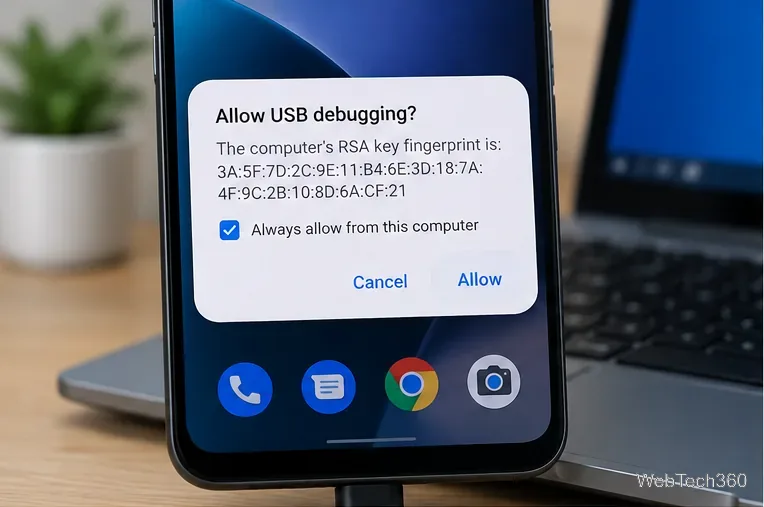
How to Enable the Android Power Button Bug Report Shortcut
Enable Android’s power-menu bug report shortcut, capture a diagnostic report on your phone, and share it safely without relying on a desktop computer.
The short answer: the most believable Galaxy S27 Ultra rumors are evolutionary ones: a denser battery, continued 200MP-class main camera, deeper agentic AI, another refined design, and possibly a regional processor split. The least convincing claims are the ones that ignore what Samsung already ships — such as “60W charging is coming for the first time” — or predict a dramatic feature with no visible path in Samsung’s current products, such as a sudden jump to a 144Hz display or removal of the S Pen.
As of September 14, 2026, Samsung has not announced the Galaxy S27 Ultra. There is no official S27 Ultra specification sheet, launch price, camera layout, battery capacity, processor list, or release date. The useful question is therefore not “Which leak is true?” It is “Which claims fit technology Samsung has already demonstrated, and which require too many unproven assumptions?”
This article uses Samsung’s current Galaxy S26 Ultra, 2026 foldables, One UI 9 direction, and official Qualcomm collaboration as the reality check. Rumors can still be wrong even when they look plausible, but this approach helps separate reasonable expectations from concept-phone wish lists.
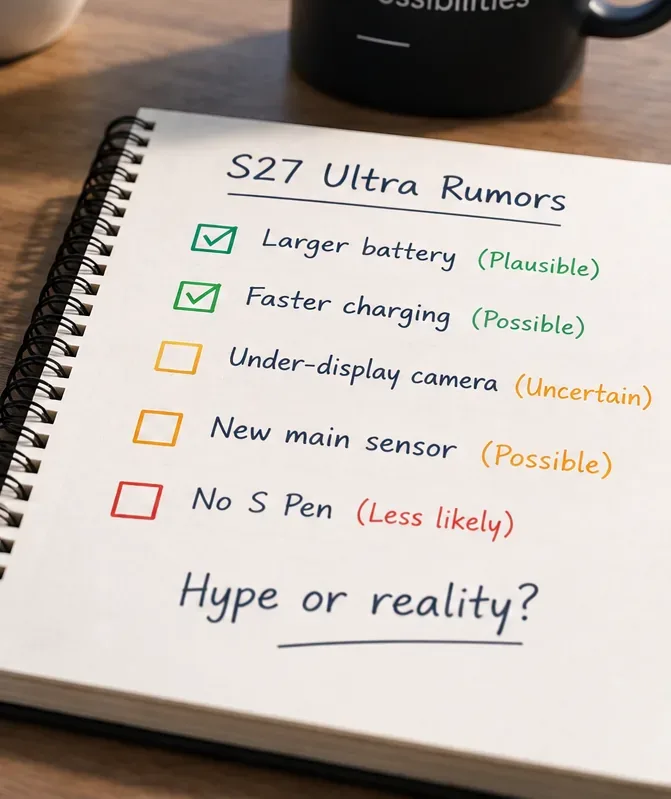
A credible rumor does not need to be boring, but it should clear at least two of three tests.
Samsung’s official Galaxy S26 Ultra product page is the most useful starting point. The phone already has a 6.9-inch 120Hz display with Privacy Display, a 5,000mAh battery, a 200MP main camera, dual telephoto cameras, a built-in S Pen, 60W-class fast charging, and Snapdragon 8 Elite Gen 5 for Galaxy.
Verdict: believable direction; exact capacity is not.
The S26 Ultra still uses a 5,000mAh typical battery. A modest capacity increase on the next Ultra would make sense because Samsung has kept the Ultra near that level for years while rivals have increasingly emphasized larger batteries. More importantly, Samsung has now publicly demonstrated the technology that could make higher energy density easier.
In July 2026, Samsung explained that the Galaxy Z Fold8 Ultra uses a silicon-carbon anode to improve energy density. Samsung said it had to optimize the whole battery system to manage the material’s higher reactivity while preserving long-term stability. That is not proof that the S27 Ultra will use silicon-carbon, but it changes the rumor from “Samsung might adopt a technology it has never used” to “Samsung might bring a technology it already ships to another flagship family.” See Samsung’s engineering interview on the 2026 Galaxy Z series.
Claims around roughly 5,200mAh to 5,500mAh are therefore technically plausible, but no exact S27 Ultra capacity is confirmed. Much larger figures should be treated more cautiously because they would require Samsung to balance thickness, weight, heat, charging speed, and internal space.
What would change the verdict? A Samsung certification, regulatory filing, or Samsung-published launch specification with rated battery capacity would move this from plausible to confirmed. Until then, the chemistry story is stronger than any precise capacity number.
Verdict: not believable as a new S27 upgrade, because it already happened.
This is a good example of why rumor timelines matter. The Galaxy S26 Ultra already supports Samsung’s newer fast-charging system, with Samsung advertising up to 75% charge in around 30 minutes. Samsung also sells a 60W USB Power Delivery 3.1 adapter for current Galaxy devices. You can verify the current charging accessories on Samsung’s Galaxy S26 accessory support page.
So a headline saying the S27 Ultra will “finally get 60W” is behind the product Samsung already sells. A more credible S27 rumor would be faster than 60W, a more efficient charging curve, better thermal control, or the same charge time with a larger battery.
Decision rule: ignore a future wattage leak unless it is paired with battery capacity and a time-to-charge result. Peak watts alone do not tell you how quickly the phone reaches 50%, 80%, or 100%.
Verdict: plausible, but far from settled.
The S26 Ultra is globally powered by Snapdragon 8 Elite Gen 5 for Galaxy. Qualcomm explicitly stated that its customized platform powers the S26 Ultra globally, while the standard S26 and S26+ use Snapdragon or Exynos 2600 depending on market. That makes two facts clear: Samsung still has a deep premium partnership with Qualcomm, and Samsung is also willing to run a regional dual-chip strategy in the same Galaxy S generation.
Qualcomm’s official S26 platform announcement confirms the global Snapdragon arrangement for the S26 Ultra. Samsung’s official S26 specifications show that Exynos 2600 is already used in other S26 models depending on device and market.
That makes a regional Exynos-powered S27 Ultra structurally believable. What is not believable yet is treating “Exynos 2700 in the Ultra” as settled, or assuming one chip will automatically outperform the other. Samsung has not announced an S27 chipset, and Qualcomm and Samsung were still publicly expanding their collaboration in July 2026.
What to watch: official device certification, Samsung firmware identifiers tied to processor variants, or a Samsung/Qualcomm launch announcement. Benchmark screenshots alone are not enough to establish the commercial chipset mix.
Verdict: possible, but one of the more uncertain hardware rumors.
The S26 Ultra has four rear cameras: a 200MP wide camera, 50MP ultra-wide, 50MP 5x telephoto, and 10MP 3x telephoto. Samsung lists those specifications on its official Galaxy S26 comparison page.
Current S27 rumor coverage is not consistent. Some reports describe Samsung testing a single larger 4x telephoto in place of the current two-telephoto arrangement; others describe retaining a 5x camera while removing only the 3x module. Those are materially different architectures, which is a warning sign that the design may still be in flux or the reports may not be equally reliable.
The concept itself is believable. A larger telephoto sensor can gather more light and may allow high-quality cropping to cover intermediate focal lengths, so fewer physical cameras do not automatically mean worse photography. Samsung already uses “optical quality” crop zoom on current Galaxy cameras.
But it would be premature to say the S27 Ultra will definitely have three rear cameras. Camera count, focal length, sensor size, lens aperture, stabilization, and image processing need to be evaluated together.
Before deciding this is an upgrade: wait for Samsung to specify native optical focal lengths and sensor resolution. Losing a 3x camera could improve or worsen real-world portraits depending on how the replacement system performs.
Verdict: highly believable at the resolution level; a completely new sensor is less certain.
Samsung has used a 200MP-class main camera across multiple Ultra generations, and the S26 Ultra still uses a 200MP wide camera, now with a wider F1.4 aperture. Continuing with 200MP is therefore one of the safest assumptions in the current rumor set.
What should not be assumed is that “200MP” means the camera is unchanged. Samsung can alter sensor generation, pixel structure, readout, aperture, image stabilization, processing, and lens design while keeping the same headline resolution. Conversely, a rumor claiming a new 200MP sensor needs more evidence than the resolution number itself.
Buyer takeaway: do not judge a future S27 camera leak by megapixels alone. Look for sensor dimensions, aperture, readout speed, autofocus, stabilization, and Samsung’s actual sample images once the device is official.
Verdict: low confidence.
The current Galaxy S26 Ultra uses a 6.9-inch QHD+ Dynamic AMOLED 2X panel with an adaptive 1–120Hz refresh rate. Samsung’s official launch specification confirms the 120Hz ceiling. The major display innovation on the S26 Ultra was not a higher refresh rate; it was the built-in Privacy Display.
A move to 144Hz is technically possible, but Samsung has not shown a clear Galaxy S Ultra trajectory toward higher-than-120Hz refresh rates. The practical benefit outside certain games would also be smaller than improvements in efficiency, brightness behavior, privacy, touch response, or power consumption.
When to believe it: when Samsung display documentation, certification data, or the product specification itself names a 144Hz mode. Until then, it belongs closer to a wish list than a baseline expectation.
Verdict: very likely.
Samsung calls Privacy Display a world-first built-in mobile privacy display and made it a flagship S26 Ultra differentiator. The technology can hide the entire screen, selected apps, notifications, or sensitive input from side-angle viewing. Removing a newly introduced flagship feature one generation later would be surprising unless Samsung found a major technical or user-experience problem.
The S26 Ultra product page describes Privacy Display in detail, including quick-panel controls and selective privacy modes. That makes continuation far more believable than a rumor about an entirely new display feature with no Samsung precedent.
More realistic S27 questions: Will Privacy Display become more power efficient? Will brightness or viewing quality improve when it is active? Will Samsung expand the feature across more S27 models? Those are more grounded than assuming the Ultra will abandon it.
Verdict: possible, but current evidence is weak.
Samsung removed Bluetooth Low Energy functionality from the built-in S Pen on the S25 Ultra and has continued that approach on the S26 Ultra. Samsung’s support documentation explicitly says the Galaxy S26 Ultra S Pen does not rely on Bluetooth, does not need pairing or charging, and does not support Air Actions. See Samsung’s official S26 Ultra S Pen guide.
There is clear user interest in remote S Pen features, and Samsung still supports Bluetooth on the separate S Pen Pro. But user requests are not a product roadmap. A Bluetooth return would require Samsung to decide that remote gestures justify the added electronics, battery, space, and charging components.
More believable than “Bluetooth definitely returns”: Samsung keeps the current passive built-in S Pen while improving handwriting, AI selection, or software workflows around it.
Verdict: low confidence.
The S Pen remains central enough to the Ultra identity that Samsung still ships it inside the S26 Ultra and maintains dedicated support pages for note-taking, drawing, translation, AI Select, and Air Command. Removing it would free internal space for battery or other components, so the engineering argument is easy to imagine. The product-positioning argument is harder.
A rumor that Samsung changes the S Pen implementation is believable. A rumor that it removes stylus support entirely needs much stronger evidence.
What would make removal credible: Samsung would need another clear differentiator for the Ultra and a convincing replacement workflow for users who depend on handwriting or precise pen input.
Verdict: moderately believable, but expect small gains.
Samsung already calls the S26 Ultra its slimmest Ultra yet. It measures 7.9mm and weighs 214g according to Samsung’s product page. The company has also spent several foldable generations reducing thickness and weight through structural redesign, so continued refinement fits its engineering direction.
The limit is physics: a larger battery, larger camera sensors, cooling hardware, S Pen silo, strong frame, and large display all compete for volume. A dramatic reduction in thickness at the same time as every rumored internal upgrade would be harder to believe than a modest refinement.
Watch the trade-offs: if a leak promises a much thinner body, much larger battery, bigger camera sensors, faster charging, and unchanged S Pen storage all at once, skepticism is warranted until component-level evidence appears.
Verdict: highly believable.
Samsung’s software direction is already public. One UI 9 emphasizes richer, more personal AI, proactive Now Nudge suggestions, more personalized Now Brief information, conversational Photo Assist, and visibility into actions AI assistants perform. Samsung describes One UI 9 as its latest interface and says AI features can vary by device, language, and region. See Samsung’s official One UI 9 overview.
Samsung also described the S26 generation as the beginning of more agentic Galaxy AI — software that can understand context and help complete tasks rather than simply return an answer. A future Ultra continuing that direction is more believable than almost any specific unannounced camera or battery number.
The uncertainty is not whether Samsung will emphasize AI. It is which capabilities will be exclusive to new hardware and which will arrive on existing S26 devices through software updates.
| Rumor theme | Confidence | Why |
|---|---|---|
| Larger battery | Medium-high | Samsung has demonstrated silicon-carbon battery technology in 2026 foldables, while S26 Ultra remains at 5,000mAh. |
| Silicon-carbon battery chemistry | Medium-high | Already shipping in Samsung’s latest foldable engineering; S27 adoption is still unconfirmed. |
| “First” upgrade to 60W charging | Very low | S26 Ultra already moved to 60W-class charging. |
| Charging faster than S26 Ultra | Medium | Logical next step, but no official S27 wattage or charge-time claim exists. |
| Regional Exynos Ultra variant | Medium | Samsung already mixes Snapdragon and Exynos by market on S26/S26+, but S26 Ultra is globally Snapdragon. |
| 200MP main camera remains | High | Strong multi-generation precedent and current S26 Ultra baseline. |
| Three rear cameras with one larger telephoto | Medium-low | Technically sensible, but current reports conflict on the exact camera layout. |
| 144Hz display | Low | Current official Ultra remains 1–120Hz, with no clear Samsung trajectory toward 144Hz. |
| Privacy Display continues | High | Major newly introduced S26 Ultra differentiator. |
| Bluetooth Air Actions return to built-in S Pen | Low-medium | Possible, but Samsung has omitted BLE on both S25 Ultra and S26 Ultra built-in pens. |
| S Pen removed entirely | Low | Still integrated into S26 Ultra hardware and software identity. |
| More agentic Galaxy AI | High | Already Samsung’s stated One UI 9 and Galaxy AI direction. |
Almost none of the precise hardware rumors should. If you are choosing between buying the S26 Ultra now and waiting, only broad possibilities should influence the decision: the next phone may have a larger battery, revised cameras, a newer processor, and newer AI capabilities. Those are normal expectations for an annual flagship.
Do not postpone a needed purchase because a rumor promises a specific battery capacity, 144Hz display, 4x telephoto sensor, or a particular processor. Those details can change before launch, can vary by market, or may never ship.
If your current phone works well, waiting is still rational because you lose little and gain certainty. If your phone is failing and the S26 Ultra meets your needs at a good price, unconfirmed S27 rumors are a weak reason to live with a bad device for months.
The believable Galaxy S27 Ultra story is not a radical reinvention. It is a refinement of technologies Samsung is already moving toward: denser batteries, stronger on-device and agentic AI, more efficient hardware, camera rebalancing, and incremental industrial-design gains.
The strongest rumor themes are the ones backed by visible Samsung groundwork. Silicon-carbon battery technology exists in Samsung’s 2026 foldables. Regional Exynos/Snapdragon strategies exist in the S26 family. Agentic AI is already central to One UI 9. Privacy Display is already a flagship Ultra feature. A 200MP main camera has years of precedent.
The weakest claims are those that ignore the current product or require multiple simultaneous leaps. “60W is coming” is already outdated. 144Hz has no clear current Galaxy Ultra trajectory. Bluetooth S Pen revival is possible but unsupported. Removing the S Pen entirely would be a major identity change and needs stronger evidence.
Until Samsung officially unveils the Galaxy S27 Ultra, treat every exact specification as provisional. The best rumor filter is simple: ask what Samsung has already built, what problem the alleged change solves, and how many assumptions are required to make the claim work. The fewer assumptions, the closer a concept is likely to be to reality.
Enable Android’s power-menu bug report shortcut, capture a diagnostic report on your phone, and share it safely without relying on a desktop computer.
Fix the ADB device unauthorized error by reauthorizing USB debugging, restarting the ADB server, and checking Platform-Tools, cables, and drivers.
If your Android power button is broken, try charging, a volume-key USB boot, or Fastboot. Learn what works when the phone is fully off and why ADB often won’t.
Is BlueStacks safe and legal? Learn what the official installer, privacy policy, antivirus behavior, game rules, and system requirements mean for you.
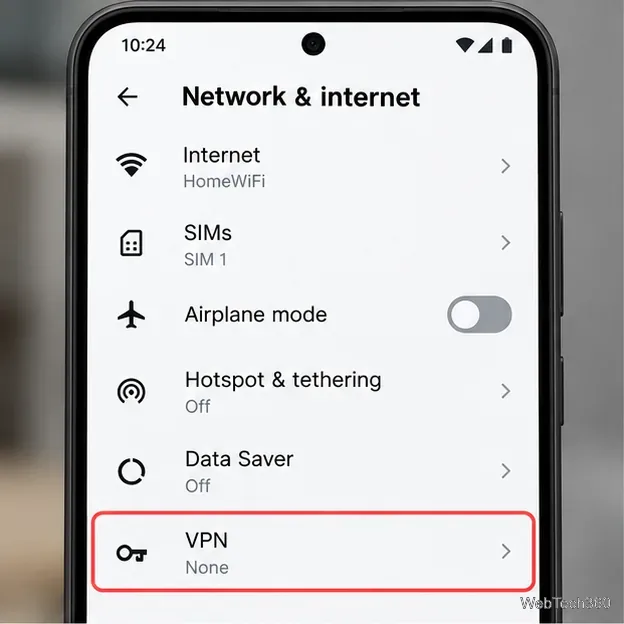
Learn three practical ways to hide your IP address on Android: a VPN, Tor Browser, or a trusted Wi-Fi proxy, with current setup steps and limits.
Join a FaceTime call on Android through Chrome or Edge. Get the link, set browser permissions, wait for the host, and fix common connection issues.
Galaxy S27 Ultra is unannounced, but Samsung and Microsoft already show the path: Phone Link, File Explorer, Quick Share, app streaming, and smarter handoff.
Samsung has not announced Galaxy S27 Ultra pricing. Here’s what the S22–S26 Ultra price history suggests, what is still unknown, and how to budget.
Samsung has not announced Galaxy S27 Ultra gaming specs. Here is what it would need to beat 2027 rivals, based on the confirmed S26 Ultra baseline.
Which Galaxy S27 Ultra rumors deserve attention? We rank battery, camera, chipset, display, charging, S Pen, and AI claims against Samsung’s confirmed 2026 hardware.