How to Enable the Android Power Button Bug Report Shortcut
Enable Android’s power-menu bug report shortcut, capture a diagnostic report on your phone, and share it safely without relying on a desktop computer.
Hypothetical example: imagine Alex owns a Galaxy S26 Ultra and likes almost everything about it except the small selfie-camera hole at the top of the display. Alex watches a lot of full-screen video, reads comics, and uses the S Pen near the top edge, so the idea of a Galaxy S27 Ultra with no visible camera cutout sounds like an obvious reason to wait.
But Alex also makes daily video calls and regularly uses the front camera for group photos. That changes the decision. A hidden camera is only an upgrade if Samsung can remove the hole without making selfies, autofocus, video, display uniformity, or low-light performance noticeably worse.
As of September 14, 2026, Samsung has not announced the Galaxy S27 Ultra or confirmed an under-display front camera for it. So the useful question is not “Is the rumor true?” but “What would Samsung have to solve before an under-display camera would make sense on an Ultra phone?”
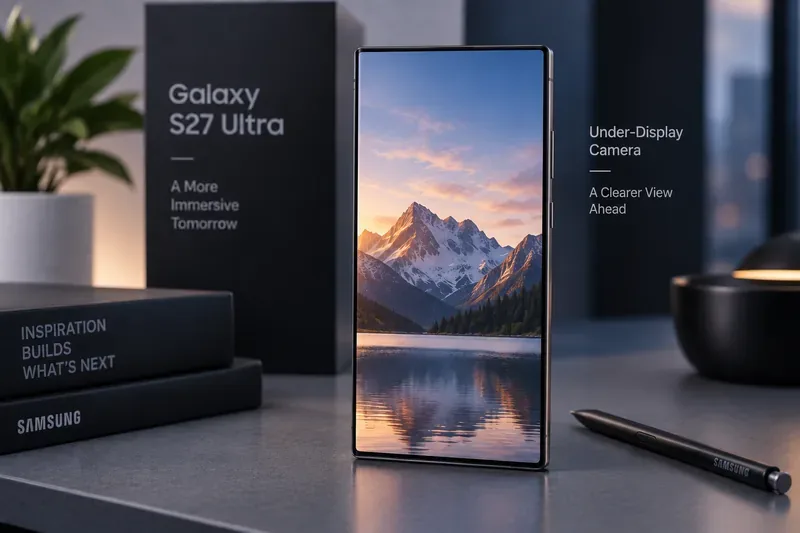
An under-display camera, also called an under-panel camera or UDC/UPC, places the selfie camera beneath the active display instead of cutting a visible hole through the screen. When the camera is not being used, pixels above the lens continue showing normal content so the front of the phone can appear uninterrupted.
Samsung Display explains that this requires the display area above the lens to let enough light pass through while still functioning as a screen. That is difficult because display layers and pixels can block, scatter, or distort the incoming light. Samsung Display’s official UPC technology guide specifically identifies light transmittance and optical interference as core engineering challenges.
For Alex, that means the missing camera hole is only the visible benefit. The harder work happens underneath the screen.
Yes. Samsung has commercial experience with under-display cameras. Its current Galaxy Z Fold camera support page states that the Galaxy Z Fold3, Z Fold4, Z Fold5, and Z Fold6 use an under-display camera on the large inner screen.
Samsung’s Fold6 product specifications list that under-display camera at 4MP with an F1.8 aperture and no autofocus. On the Fold4 and Fold5, Samsung also explained that the pixel density above the camera is reduced so more light can reach the sensor. The company warned that a faint cross-hatch pattern may sometimes be visible around the camera area, especially on bright screens. See Samsung’s official Fold UDC explanation.
So Alex should not treat “Samsung already has UDC” as proof that the S27 Ultra is ready for it. Samsung has proven the concept, but the Fold implementation was designed for a different role.
The Fold line gave Samsung a practical compromise. On Fold3 through Fold6, the hidden inner-screen camera helped create a more immersive large display for video, reading, and multitasking. If users wanted better selfie quality, they still had other cameras available on the device.
That distinction matters. A Galaxy S Ultra relies much more heavily on its single front-facing camera. It has to handle selfies, video calls, social video, face framing, and front-camera recording without an alternative front display camera to fall back on.
In Alex’s case, a 4MP fixed-focus UDC similar to older Fold models would make the display cleaner but could be a poor trade for daily calls and group photos.
Samsung’s current Galaxy S26 Ultra uses a conventional visible selfie camera. Samsung’s official S26 series specification table lists a 12MP wide front camera with autofocus, an 85-degree field of view, and 4K video recording at 60 fps.
That is the real benchmark a future S27 Ultra UDC would need to meet. A hidden camera would not be convincing if it removed the punch hole but also lost autofocus, reduced front-video quality, or produced softer images in indoor light.
| Front-camera area | Galaxy S26 Ultra baseline | What an S27 Ultra UDC would need to prove |
|---|---|---|
| Resolution | 12MP | Enough real detail after shooting through display layers |
| Focus | Autofocus | Preserve reliable focus for selfies and video calls |
| Video | 4K at 60 fps | Maintain sharp video without haze or excessive processing artifacts |
| Display | Visible camera hole | Hide the camera area without obvious pixel-pattern differences |
| Low light | Direct optical path to the lens | Compensate for light loss caused by the display above the camera |
This is one of the most useful clues for Alex’s decision. Samsung’s current support documentation identifies Fold3 through Fold6 as the models with under-display cameras. The Galaxy Z Fold7 instead uses a 10MP camera on the main display.
Samsung’s own Fold7 camera overview says the 100-degree main-display front camera produces images that are 2.5 times clearer than those from the Fold6. Samsung’s Fold7 camera support page lists a 10MP main-screen camera rather than the older 4MP under-display setup.
This does not prove that Samsung abandoned UDC permanently. It does show that the company was willing to give up the hidden-camera approach in one generation to improve front-camera quality.
For Alex, that is a warning against assuming the cleanest-looking screen is automatically Samsung’s highest priority.
Possibly. Samsung Display has continued developing the panel technologies that make under-display cameras more practical. Its Eco² OLED technology removes the traditional polarizer and improves light transmission. Samsung Display says this design can expose more light to the camera module and support better UPC performance. The company explains the approach in its official Eco² OLED announcement.
Samsung Display also describes newer UPC concepts designed to improve the full-screen appearance while increasing light transmission. That is encouraging, but a display supplier demonstrating better panel technology is not the same thing as Samsung Electronics confirming that technology for a particular Galaxy S phone.
Alex therefore has two separate questions to track: can Samsung Display build a better UDC panel, and will Samsung Electronics decide the image-quality tradeoff is finally good enough for the S27 Ultra?
It can help, but it cannot remove the physical tradeoff. Computational photography uses software to combine frames, reduce noise, recover contrast, sharpen detail, correct color, and compensate for optical artifacts. Samsung already uses extensive image processing across its camera systems.
An under-display camera could use more advanced processing to reduce haze, flare, softness, or color changes caused by shooting through display layers. But the camera still needs usable light in the first place. If too much light is blocked or scattered, software has less clean information to work with.
That means Alex should be skeptical of any rumor that says “AI fixes the UDC” without showing real production-camera samples. Software can improve a compromised optical signal; it does not make the display physically transparent.
For the hypothetical scenario, imagine Alex receives a production S27 Ultra with a hidden front camera. The upgrade would only feel successful if several things happen at once:
If only the first item improves, Alex gets a prettier display but potentially a worse camera. That would be a design win, not necessarily a user-experience win.
Yes, visually. This is the clearest advantage. Full-screen video, cloud gaming, reading, drawing, and photo editing would no longer have a camera hole interrupting the active image area.
The benefit is most noticeable when content extends to the very top of the display. For Alex, who watches full-screen video and uses the S Pen, that cleaner canvas could be genuinely satisfying.
However, the S26 Ultra’s camera hole is already relatively small. The practical benefit therefore depends on how strongly the cutout bothers you. Some users notice it constantly; others stop seeing it after a few minutes.
Not necessarily. Samsung’s own Fold support documentation acknowledges that the UDC area can have different light permeability and may reveal a cross-hatch pattern under certain conditions. Samsung Display has worked to reduce visible color differences, but complete visual uniformity remains a demanding goal.
That means “no camera hole” and “camera completely invisible” are not the same claim.
If Alex is waiting specifically for a perfect uninterrupted screen, it would be wise to examine the production S27 Ultra under white, light gray, and low-brightness backgrounds before buying. Marketing wallpapers can hide display differences that become obvious in ordinary apps.
The most useful details are not renders. They are technical claims that can eventually be checked against Samsung’s official specification page.
A concept render with no visible punch hole cannot answer any of those questions.
Only if the visible camera hole is a real daily annoyance and Alex is willing to wait for proof that image quality has not regressed.
If Alex mostly uses the rear cameras and cares deeply about an uninterrupted display, a high-quality UDC could be a meaningful upgrade. But if Alex depends on the selfie camera for work calls, social video, family photos, or autofocus, the smarter move is to wait for Samsung’s official specification sheet and real production samples.
| Alex’s priority | What would make waiting worthwhile? |
|---|---|
| Maximum screen immersion | A camera area that is truly difficult to see in normal apps |
| Video calls | 12MP-class detail, reliable autofocus, strong indoor quality |
| Selfies | No obvious haze, flare, or excessive AI sharpening |
| Front video | 4K/60-class recording with stable exposure and focus |
| S Pen and reading | A uniform display surface without a distracting pixel patch |
| Buying soon | Do not delay solely because of an unconfirmed UDC rumor |
The strongest evidence would be straightforward: Samsung officially announces the S27 Ultra, publishes the front-camera specification, and describes the camera as being beneath the display. The next layer would be Samsung Display documentation explaining the panel technology used in that product.
After that, real-device testing should confirm four things: display uniformity, selfie detail, autofocus behavior, and low-light/video quality.
Anything before those steps is provisional. Supply-chain rumors, renders, patents, and concept images can indicate technical possibilities, but they do not prove the final commercial product.
It is technically plausible, but it is not confirmed. Samsung has years of commercial UDC experience from the Galaxy Z Fold3 through Fold6, and Samsung Display continues to develop panel technology designed to improve light transmission over hidden cameras. At the same time, Samsung moved the Fold7 to a conventional 10MP main-screen front camera and highlighted a large improvement in clarity over Fold6. That is an important reminder that camera quality still competes directly with the desire for a perfectly clean screen.
Return to the hypothetical Alex: if Samsung can hide the camera while preserving the S26 Ultra’s 12MP autofocus experience, 4K/60 front video, strong indoor quality, and a uniform display, then UDC could finally be an Ultra-class upgrade rather than a cosmetic compromise.
Until Samsung publishes those details, the safest conclusion is simple: the technology exists, the engineering path is credible, but the Galaxy S27 Ultra UDC remains a possibility rather than a verified feature.
Enable Android’s power-menu bug report shortcut, capture a diagnostic report on your phone, and share it safely without relying on a desktop computer.
Fix the ADB device unauthorized error by reauthorizing USB debugging, restarting the ADB server, and checking Platform-Tools, cables, and drivers.
If your Android power button is broken, try charging, a volume-key USB boot, or Fastboot. Learn what works when the phone is fully off and why ADB often won’t.
Is BlueStacks safe and legal? Learn what the official installer, privacy policy, antivirus behavior, game rules, and system requirements mean for you.
Learn three practical ways to hide your IP address on Android: a VPN, Tor Browser, or a trusted Wi-Fi proxy, with current setup steps and limits.
Join a FaceTime call on Android through Chrome or Edge. Get the link, set browser permissions, wait for the host, and fix common connection issues.
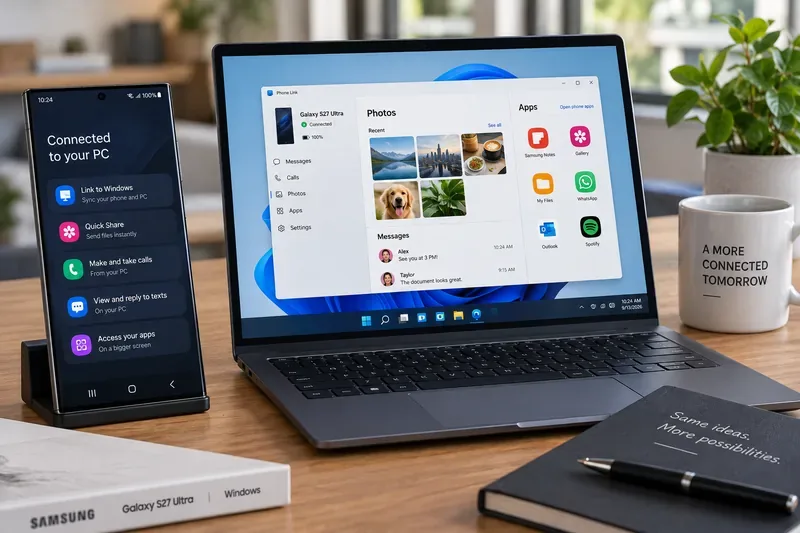
Galaxy S27 Ultra is unannounced, but Samsung and Microsoft already show the path: Phone Link, File Explorer, Quick Share, app streaming, and smarter handoff.
Samsung has not announced Galaxy S27 Ultra pricing. Here’s what the S22–S26 Ultra price history suggests, what is still unknown, and how to budget.
Samsung has not announced Galaxy S27 Ultra gaming specs. Here is what it would need to beat 2027 rivals, based on the confirmed S26 Ultra baseline.
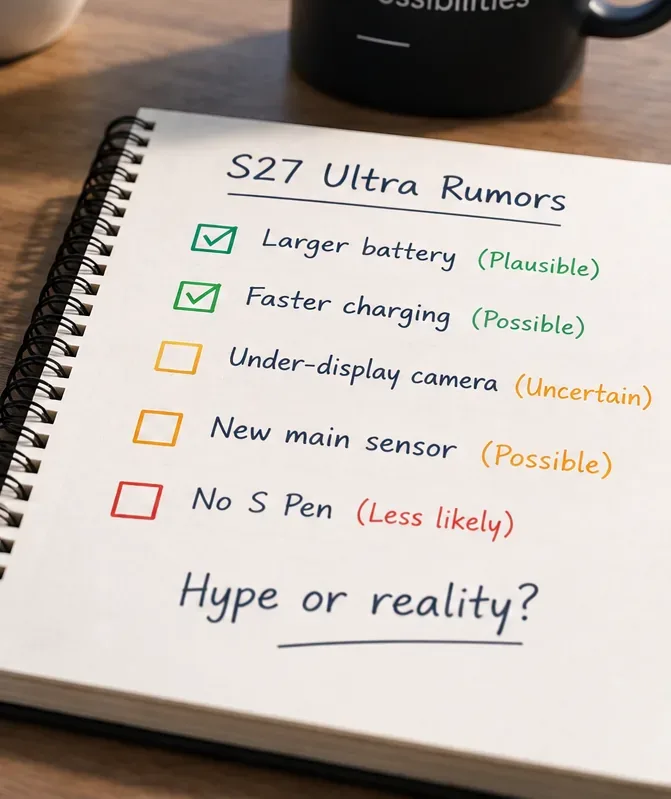
Which Galaxy S27 Ultra rumors deserve attention? We rank battery, camera, chipset, display, charging, S Pen, and AI claims against Samsung’s confirmed 2026 hardware.