How to Enable the Android Power Button Bug Report Shortcut
Enable Android’s power-menu bug report shortcut, capture a diagnostic report on your phone, and share it safely without relying on a desktop computer.
If you are deciding whether to buy the Galaxy S26 Ultra now or wait for the Galaxy S27 Ultra, the processor question can make the decision feel harder than it should. A switch from Snapdragon to Samsung’s own Exynos silicon could affect performance, battery efficiency, modem behavior, gaming, camera processing, and how buyers compare regional models. The problem is that many online claims treat a possible chipset change as if Samsung has already confirmed it.
Short answer: as of September 14, 2026, Samsung has not announced the Galaxy S27 Ultra processor. There is no official evidence that the S27 Ultra will “ditch” Snapdragon. In fact, the strongest confirmed evidence still points toward Snapdragon continuity at the Ultra tier: the Galaxy S26 Ultra uses Snapdragon 8 Elite Gen 5 for Galaxy globally, while Samsung uses Exynos 2600 on Galaxy S26 and S26+ in some markets. That makes an Exynos-powered S27 Ultra technically plausible, but not established.
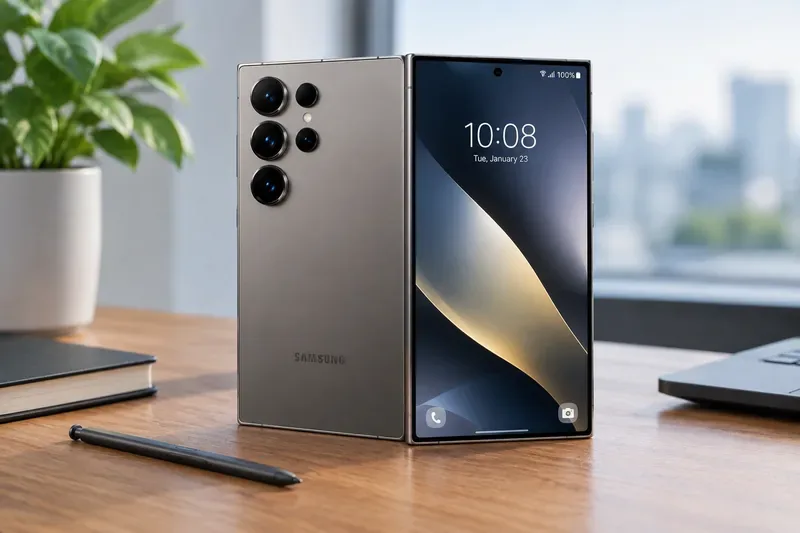
The latest official Ultra model gives us the clearest baseline. Samsung’s February 2026 Galaxy S26 announcement lists the Galaxy S26 Ultra with the Snapdragon 8 Elite Gen 5 for Galaxy. Qualcomm separately states that the same platform powers the Galaxy S26 Ultra globally. You can check Samsung’s official Galaxy S26 series announcement and Qualcomm’s official S26 platform announcement.
This matters because the Ultra is not simply following whatever processor Samsung puts in the smaller Galaxy S models. For the S26 generation, Samsung’s own specification table lists Snapdragon 8 Elite Gen 5 for Galaxy for the Ultra, while the S26 and S26+ can use either Snapdragon or Exynos depending on device and market.
What to do: treat the S26 Ultra’s processor choice as the current baseline. Do not treat an S27 chipset name as confirmed unless it appears on Samsung’s own launch page, specification table, or regional product page.
The reason this rumor is easy to believe is that Samsung has brought Exynos back into its flagship S-series family in a meaningful way. The Galaxy S26 and S26+ use the Exynos 2600 in markets including the United States, according to Samsung’s official Galaxy S26 product page, while Samsung’s global launch material says processor availability can vary by device and market.
More importantly, Exynos 2600 is not positioned as a low-end part. Samsung Semiconductor describes it as a 2nm GAA mobile processor with a deca-core CPU, integrated NPU, GPU, ray-tracing features, and an emphasis on power efficiency. Those specifications show that Samsung is still investing heavily in its own premium mobile silicon. See the official Exynos 2600 product page.
That creates a reasonable question: if Samsung is confident enough to use Exynos in the S26 and S26+, could a future Ultra follow? Yes, it could. But “could” is not the same as “will.” Samsung still made a distinct choice to keep the S26 Ultra on Snapdragon globally.
What to do: use Exynos 2600 as evidence that Samsung has a viable in-house flagship processor program, not as proof that the S27 Ultra will adopt it.
The recent pattern is unusually consistent. Samsung equipped the Galaxy S23 Ultra with Snapdragon 8 Gen 2 for Galaxy, the Galaxy S24 Ultra with Snapdragon 8 Gen 3 for Galaxy, the Galaxy S25 Ultra with Snapdragon 8 Elite for Galaxy, and the Galaxy S26 Ultra with Snapdragon 8 Elite Gen 5 for Galaxy. Samsung’s own launch materials document each generation.
| Ultra generation | Officially listed processor | What it tells us |
|---|---|---|
| Galaxy S23 Ultra | Snapdragon 8 Gen 2 for Galaxy | Samsung and Qualcomm began a multi-generation run of customized Snapdragon platforms. |
| Galaxy S24 Ultra | Snapdragon 8 Gen 3 for Galaxy | Samsung explicitly said every S24 Ultra used Snapdragon. |
| Galaxy S25 Ultra | Snapdragon 8 Elite for Galaxy | Samsung again used a customized Qualcomm flagship platform. |
| Galaxy S26 Ultra | Snapdragon 8 Elite Gen 5 for Galaxy | Qualcomm says the S26 Ultra uses Snapdragon globally. |
You can verify the pattern in Samsung’s Galaxy S23 launch information, Galaxy S24 announcement, and Galaxy S25 announcement.
Patterns can break, but four consecutive Ultra generations using Snapdragon make a sudden move away from Qualcomm something that requires stronger evidence than a rumor headline.
What to do: if you are estimating probabilities before launch, give Snapdragon continuity more weight than an unverified Exynos-switch claim simply because it matches the confirmed Ultra trend.
That conclusion skips an important distinction between product tiers. Samsung can use its own processor in the base and Plus models while reserving a customized Snapdragon platform for the Ultra. The S26 generation demonstrates exactly that strategy.
The Ultra also has different engineering requirements. It carries Samsung’s highest-end camera system, more demanding sustained-performance expectations, and a premium positioning that makes thermal behavior, modem performance, imaging pipelines, GPU capability, and AI acceleration especially important. Samsung does not publicly disclose every internal decision criterion, so it would be speculation to claim that one benchmark or fabrication node alone determines which chip wins.
What to do: compare processors at the exact model level. “Galaxy S27 uses Exynos” would still not automatically mean “Galaxy S27 Ultra uses Exynos.”
The available official evidence points the other way. In July 2026, Qualcomm announced an expanded collaboration with Samsung across smartphones, watches, and intelligent eyewear. The announcement says the companies jointly optimize Snapdragon platforms for Galaxy devices and describes their relationship as a long-running engineering partnership.
That does not guarantee a Snapdragon S27 Ultra. Corporate partnerships can coexist with Samsung using Exynos in other products. Still, an expanding partnership makes the idea that Samsung is obviously preparing to abandon Snapdragon across its premium lineup difficult to support.
What to do: treat partnership news as context, not a product confirmation. The only decisive evidence will be an S27 Ultra-specific announcement or specification.
| Scenario | How plausible it looks today | Why |
|---|---|---|
| Snapdragon globally | Most consistent with current evidence | The S23, S24, S25, and S26 Ultra generations all use customized Snapdragon platforms, and the S26 Ultra uses Snapdragon globally. |
| Snapdragon and Exynos split by region | Plausible but unconfirmed | Samsung already uses multiple processor suppliers within the S26 family, so regional sourcing is technically credible. |
| Exynos globally on S27 Ultra | Possible, but unsupported by official S27 evidence | Samsung has a modern 2nm Exynos platform, but it has not announced an Exynos-powered S27 Ultra. |
The key point is that none of these is an official S27 Ultra specification yet. The first scenario has the strongest historical support, while the other two depend on decisions Samsung has not made public.
What to do: if processor choice is a major purchase criterion, do not preorder based on a rumor. Wait until Samsung publishes the S27 Ultra AP line for your market.
You do not need to chase every leak. A small number of official signals are enough to settle the question. The most useful evidence would be a Samsung Galaxy S27 Ultra specification table naming an Exynos processor, a Samsung regional product page showing a different AP for a specific country, or a Samsung Semiconductor announcement explicitly connecting an Exynos chip to the S27 Ultra.
Likewise, a Qualcomm announcement naming the S27 Ultra would settle the issue in the other direction. For the S26 Ultra, Qualcomm explicitly stated that Snapdragon 8 Elite Gen 5 for Galaxy powers the model globally, which is much stronger evidence than reseller listings or community posts.
What to do: save the official Samsung Newsroom and Samsung product pages you trust, then check the processor line when the S27 series is announced. That is faster and safer than trying to reconcile conflicting rumor accounts.
If you need a flagship phone now and specifically want Snapdragon, the Galaxy S26 Ultra is a known quantity: Samsung and Qualcomm both confirm its processor. Waiting for the S27 Ultra solely because you hope Samsung will move to Exynos is betting on an unannounced specification.
If your current phone still works well and you care deeply about processor architecture, gaming behavior, battery efficiency, modem performance, or regional chip differences, waiting is reasonable. The important part is to wait for the official specification rather than for more rumors. A chipset name alone also does not guarantee a better phone; thermal design, software tuning, memory, modem integration, and camera processing can matter just as much in actual use.
What to do: decide now which outcome would change your purchase. If you prefer Snapdragon, buy only after confirming your region’s processor. If you prefer Exynos or want Samsung’s newest in-house silicon, wait for an official S27 Ultra specification instead of assuming the Ultra will follow the smaller models.
If a report fails those checks, treat it as unconfirmed. As of September 14, 2026, the safest conclusion is straightforward: Samsung has not confirmed that the Galaxy S27 Ultra will abandon Snapdragon, and the recent Ultra track record still favors another customized Snapdragon platform. Exynos has become more relevant again, especially with the 2nm Exynos 2600, so a future change is possible. It simply has not happened on paper yet.
Enable Android’s power-menu bug report shortcut, capture a diagnostic report on your phone, and share it safely without relying on a desktop computer.
Fix the ADB device unauthorized error by reauthorizing USB debugging, restarting the ADB server, and checking Platform-Tools, cables, and drivers.
If your Android power button is broken, try charging, a volume-key USB boot, or Fastboot. Learn what works when the phone is fully off and why ADB often won’t.
Is BlueStacks safe and legal? Learn what the official installer, privacy policy, antivirus behavior, game rules, and system requirements mean for you.
Learn three practical ways to hide your IP address on Android: a VPN, Tor Browser, or a trusted Wi-Fi proxy, with current setup steps and limits.
Join a FaceTime call on Android through Chrome or Edge. Get the link, set browser permissions, wait for the host, and fix common connection issues.
Galaxy S27 Ultra is unannounced, but Samsung and Microsoft already show the path: Phone Link, File Explorer, Quick Share, app streaming, and smarter handoff.
Samsung has not announced Galaxy S27 Ultra pricing. Here’s what the S22–S26 Ultra price history suggests, what is still unknown, and how to budget.
Samsung has not announced Galaxy S27 Ultra gaming specs. Here is what it would need to beat 2027 rivals, based on the confirmed S26 Ultra baseline.
Which Galaxy S27 Ultra rumors deserve attention? We rank battery, camera, chipset, display, charging, S Pen, and AI claims against Samsung’s confirmed 2026 hardware.