How to Move a Picture in Microsoft Word
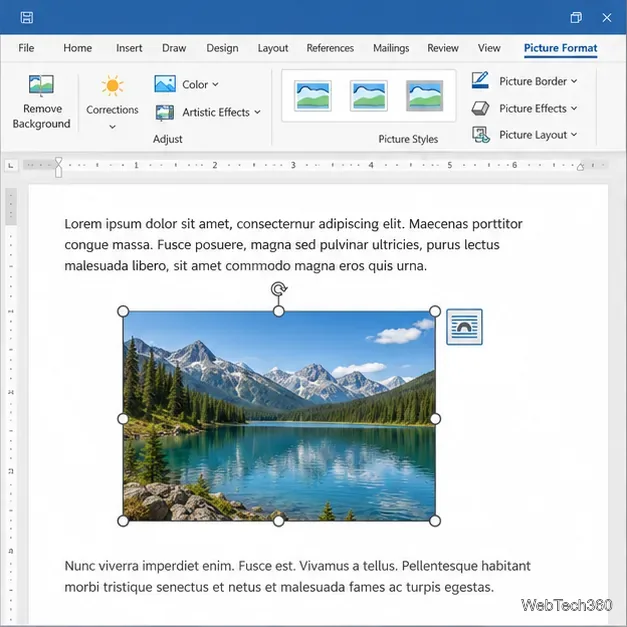
Learn how to drag a picture in Word, choose text wrapping, keep it with a paragraph or fix it on the page, and troubleshoot images that will not move.
Outlook 2010 can export mail, contacts, calendar appointments, tasks, and other folders with its built-in Import and Export Wizard. Use an Outlook Data File (.pst) for an Outlook-to-Outlook backup or transfer. Use CSV when you need a contact list for a spreadsheet or another service, and iCalendar (.ics) when you need calendar events. The old Outlook Data Export add-in described in earlier instructions is not required for these common exports.
| Format | Use it for | Limit |
|---|---|---|
| PST | Outlook mail, contacts, calendar, tasks, and folders | Best for Outlook transfers; it does not copy every profile setting. |
| CSV | Contacts | A contact list, not a mailbox or calendar archive. |
| ICS | Calendar appointments | A calendar snapshot; later changes are not synced. |
Microsoft lists messages, calendar items, tasks, and contacts among the Outlook 2010 wizard's uses. If you also need Notes, select that folder when it appears and confirm it is present in the finished PST; Microsoft's current PST overview does not specifically list Notes. See Microsoft's Outlook 2010 export overview.
Confirm that the correct account is selected and that Outlook has finished synchronizing. With an Exchange account in Cached Exchange Mode, a PST export can contain only the items currently available in the local cache. If older mail or appointments matter, check the account's offline sync range and wait for the required data to download before starting. Microsoft's PST export guidance also warns that current Outlook exports can be limited by the cache.
Outlook exports a copy, so the original items remain in Outlook. However, a PST does not preserve every Outlook setting: Microsoft lists folder properties such as views, permissions, and AutoArchive settings, as well as message rules and blocked-sender lists, as data that is not exported. Office 2010 support ended on October 13, 2020, so these instructions are version-specific and the software no longer receives security fixes.
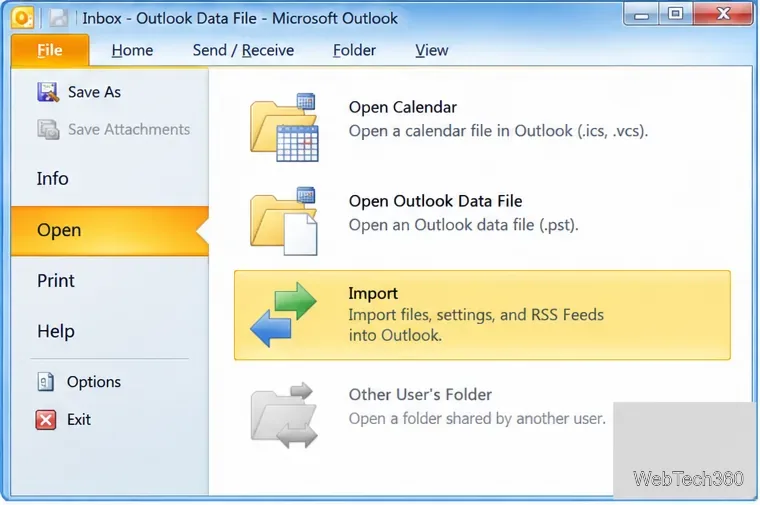
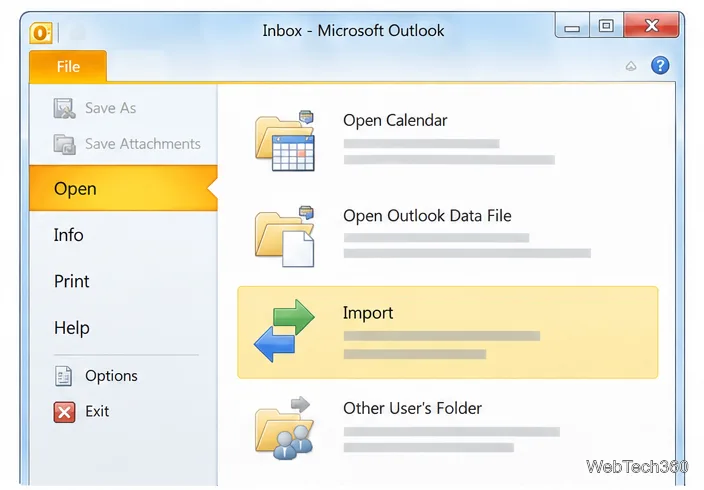
Open the wizard. In Outlook 2010, choose File > Open > Import. The Import and Export Wizard opens from this menu even though the command says “Import.”
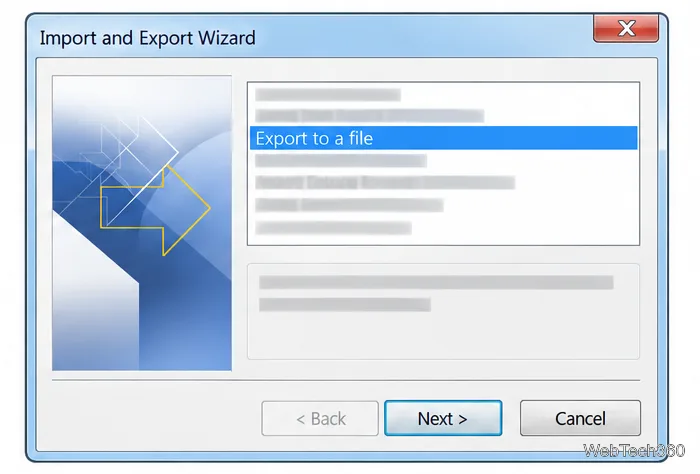
Choose the export action. Select Export to a file, then choose Next.
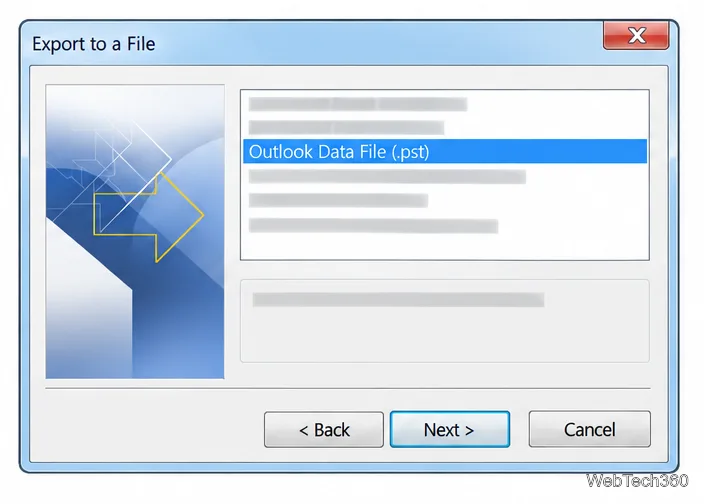
Select the PST format. Choose Outlook Data File (.pst), then select Next. This keeps Outlook items together in an Outlook data file rather than flattening them into a text list.
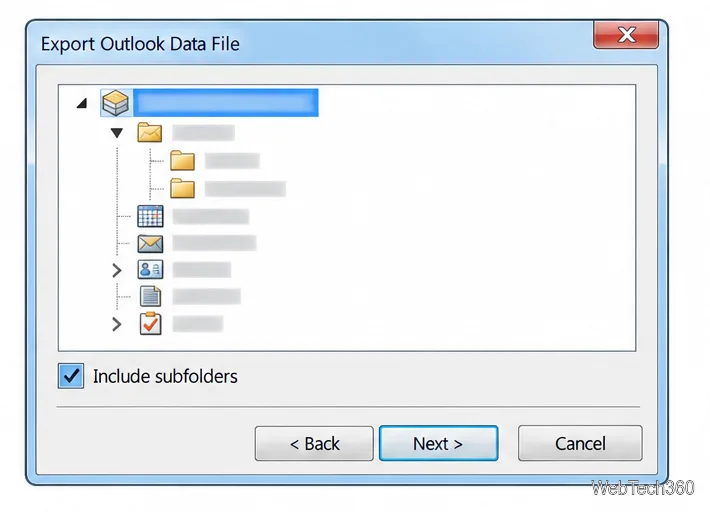
Pick the account or folder. Select the account root to export its folder tree, or select a specific folder for a smaller archive. Keep Include subfolders checked when you want nested folders such as Inbox subfolders. Export one account at a time. If Notes matter, select that folder explicitly when available and plan to verify it afterward.
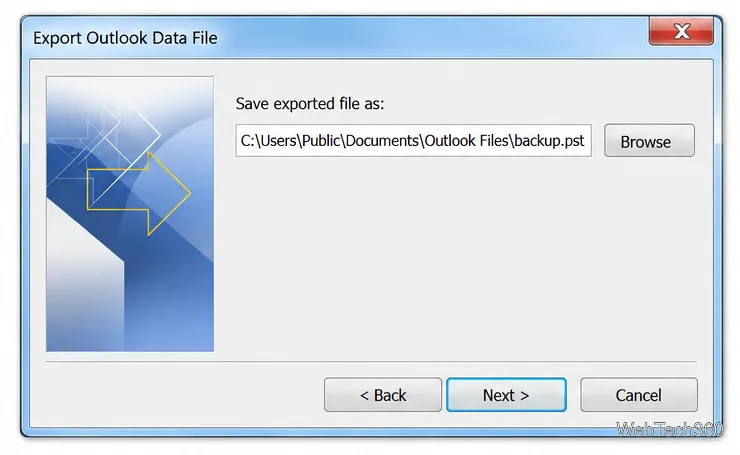
Set the destination. Choose Browse, pick a local folder, and enter a new file name such as Outlook-Archive-2026.pst. Save the PST outside a folder that syncs automatically with OneDrive; Microsoft's current guidance says OneDrive can block automatic PST syncing. If the wizard remembers a previous destination, replace the file name so you do not overwrite an earlier archive.
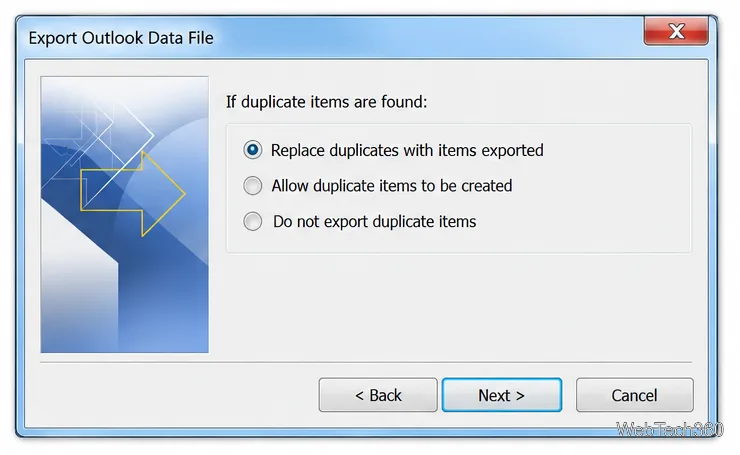
Finish and protect the file. If you are exporting into an existing PST, choose how Outlook should handle duplicate items; using a new PST avoids that decision. Select Finish and wait for the export to complete. Outlook may offer an optional password for a newly created PST. Use one only if needed, and store it safely because you will need it to open the file.
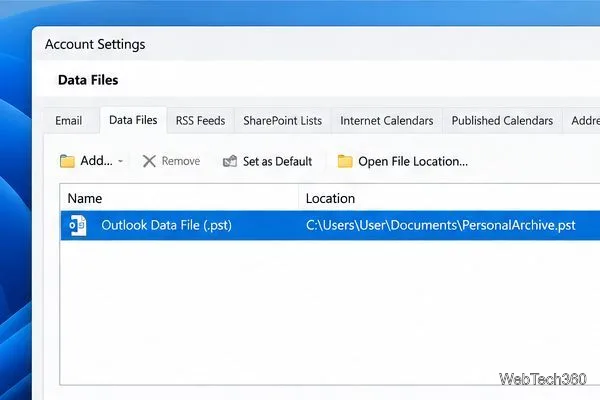
To check the result, use Outlook 2010's File > Open > Open Outlook Data File command, open the new PST, and inspect key folders, the oldest and newest dates, and several messages with attachments. Check Notes and Tasks separately if they are important. Do not delete the originals until the exported file contains what you need.
For contacts only, open File > Open > Import, choose Export to a file, and select Comma Separated Values. Select the Contacts folder under the correct account, choose a file name with Browse, and finish the wizard. Open the CSV to confirm that contact records are present. If you plan to import it again, avoid saving changes from Excel unless you have checked that the CSV structure and encoding remain usable. Microsoft's CSV contact instructions explain the same folder-selection principle.
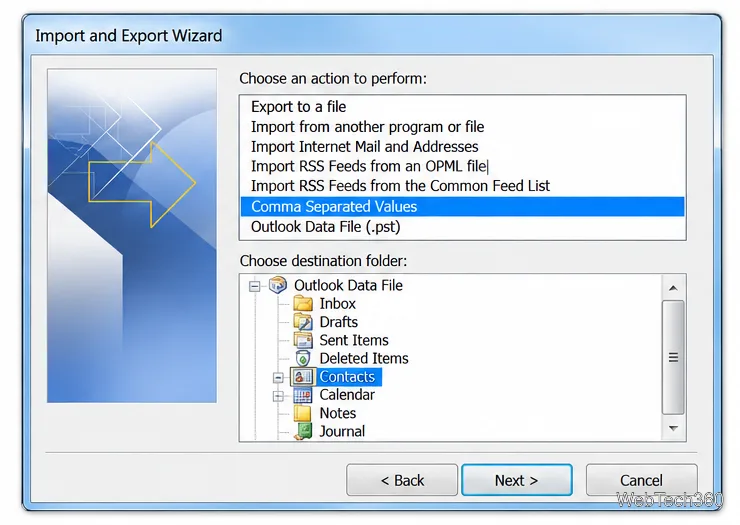
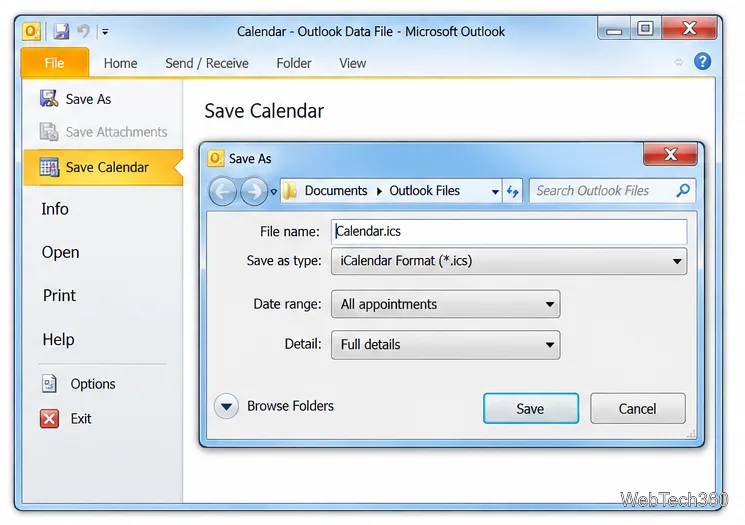
To share calendar events with another calendar app, open Outlook's Calendar, select the calendar, and choose File > Save Calendar. Save the file as .ics. Use More Options to choose the date range and detail level before saving. An ICS file is a snapshot of calendar appointments; it does not replace a PST for mail, contacts, Notes, or Tasks. Microsoft's calendar export instructions describe these date-range and detail options.
Learn how to drag a picture in Word, choose text wrapping, keep it with a paragraph or fix it on the page, and troubleshoot images that will not move.
Learn how to insert a checkbox in Excel with the in-cell tool, count checked items with formulas, or add a linked Form Control in older desktop versions.
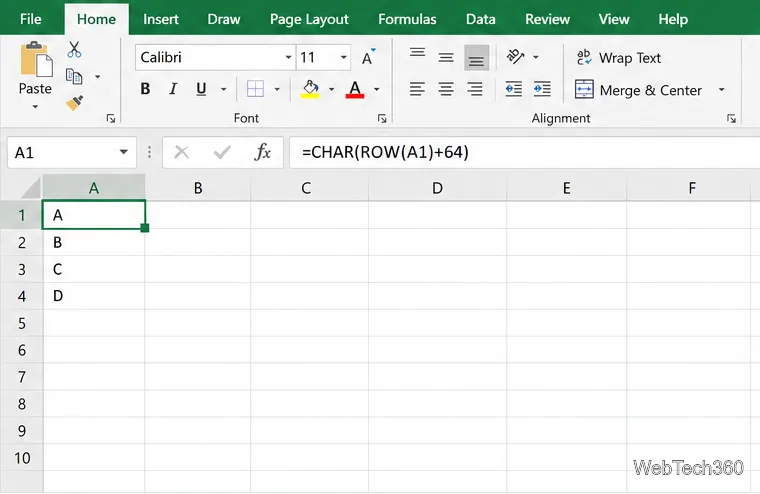
Generate A to Z, lowercase letters, or labels beyond Z in Excel with a fill-handle formula, SEQUENCE, or a reusable custom list.
Learn how to strikethrough in Excel on Windows, Mac, and the web, format part of a cell, and remove the line without deleting its value.
Microsoft Access is a Windows database app for storing related records, building queries, creating data-entry forms, and generating reports. Learn how it works and when it fits.
Learn how to import a PST into Outlook 2010 or export mail, contacts, calendar, and tasks. Follow the correct menus and avoid missing folders or duplicates.
Learn how to adjust gridline height and width in Word 2010, change visible line frequency, and set the underlying horizontal and vertical drawing-grid spacing.
Recover a forgotten Outlook PST password with Kernel’s current steps, including how to identify the right file, make a backup, and check the tool’s limits.
Use the LiveWeb add-in to place a website on a PowerPoint slide, set its size and refresh behavior, and check compatibility before presenting.
Set an Access 2010 database application to open directly to a data-entry form, hide object lists, limit menus, and check the setup before sharing.